
Chemo takes the hair of most men within two to three weeks of the first session. Most of it comes back. Soft, fine fuzz often shows up around six weeks after the last session, and fuller growth follows over the next few months. A hair replacement system helps in the gap, or when the hair comes back thin, patchy or late.
One thing before anything else. A system is stuck to the scalp with adhesive. After chemo, skin can be dry, sore and touchy, so ask your oncology team before anyone fits one. Plenty of men wait until treatment is over. Hats, scarves and an NHS wig cover the time in between.
Below, we go through what happens to hair during treatment, when a system might make sense, what the first visit at our London studio is like, and what to ask your care team first.
Why does chemo make hair fall out?
Chemo drugs go after cells that divide quickly. Cancer cells do that. So do the cells in your hair roots. The drugs can’t tell them apart, so your hair gets hit too.
For most men it starts two to three weeks after the first session. You might see it on the pillow one morning. Or in the shower drain. Or in your hand when you rub your head. Some men lose all of it. Others keep a thin layer. Your care team knows your drugs and doses, so they’re the best people to tell you what to expect.
It isn’t only the head. Beard, chest and body hair can go too.
Radiotherapy is different. It only takes hair from the spot the beam hits. If you’re having it on your head, that’s where you’ll lose hair. With high doses the loss can be permanent in that area.
When does it grow back?
After chemo, regrowth usually starts about three weeks after the final session. The first stuff is soft and fine, a bit like baby fuzz, and it can take around six weeks to show. Thicker, easier to see growth tends to come over the next three to six months.
That’s a general pattern, not a promise. Some men start regrowing before treatment even ends. Others wait longer. If you’re on long term treatment, or on hormone blocking medicine, growth can be slower and thinner. Ask your team what’s likely for you.
What can you wear during treatment?
Simple stuff does the job. A soft cotton or bamboo beanie. A cap. A scarf in winter and a wide brim hat in summer. They cost little, they feel fine on a sore scalp, and nobody has to fit them.
An NHS wig is another option. Synthetic wigs are available in many areas. Some places give them free. Others ask for a charge, which varies by area and by whether you’re exempt. Your hospital team can tell you how it works where you live. A wig consultant will look at your hair colour, texture and style. If your hair’s already gone, take a photo of how it used to look. It helps a lot.
Some men shave it before it falls out. That sounds odd, but a lot of them say they’d rather choose the moment than watch it leave in handfuls. Others do nothing and go bare. Any of those is fine.
Then there’s scalp cooling. It’s a tight cap worn before, during and after each session. It cools the scalp so less of the drug reaches the hair roots. It works better with some drugs than others, and some cancers aren’t suitable. If you’re interested, raise it with your oncology team early, before the first session.
Is it safe to wear a hair system during chemo?
This is the first thing most men ask us. So here’s a straight answer. Please remember we’re a hair studio, not doctors, and this call belongs to your oncology team.
A system is attached with adhesive that stays on the scalp for weeks. During chemo, skin is often dry and itchy. Some treatments also make it harder for the body to fight infection. Putting adhesive on skin in that state is something to talk through with your doctor or specialist nurse first. They may say wait.
Plenty of men do wait. They use a hat or an NHS wig during treatment, then look at a system once the last session is done and the scalp has calmed down. Some men check with their team and get the go ahead sooner. Both are fine.
If you’re unsure, say so when you come in. We’ll tell you plainly if we think you should hold off. And our booking form has a “Just Want Advice” choice for men who aren’t ready to order anything.
How should you look after your scalp?
Be soft with it.
During treatment, use a mild shampoo and a soft brush. Skip hot hairdryers and heated styling tools. Leave colouring and perms alone. Many people also wait around six months after treatment before dyeing, and do a patch test first when they do.
The sun is a bigger deal than most men think. A bare scalp burns fast. Wear a hat in summer, or put on sun cream of SPF 30 or higher. In winter, a hat or scarf keeps the cold off.
Dry, itchy skin is common once the hair’s gone. A simple moisturising cream may help, but check with your care team on what’s safe to use, especially if you’re having radiotherapy to that area.
Be careful with supplements and “regrowth” tonics too. Some, biotin included, may interact with cancer treatment. Ask before you buy anything.
Why does regrowth look different?
New hair doesn’t always match the old. Straight hair can come back wavy or tightly curly. People call it “chemo curls”. Some men find it’s finer or softer than before. Colour can change as well. Brown hair sometimes returns lighter or a bit reddish, and grey can show up sooner.
Doctors don’t fully know why. Genes, age and the drugs used all seem to matter. The good news is that these changes are usually temporary. As the roots recover, most men’s hair slowly drifts back toward its usual texture and colour.
Not everyone gets that. Hormone blocking medicine can slow growth or thin the hair. Long term treatment can make the changes last longer. And if you already had male pattern baldness before chemo, regrowth can be uneven. The roots that were struggling may not bounce back like the rest.
That uneven stage is when many men come to see us. A patchy crown. A front that looks further back than before. A thin top with fuller sides. If any of that sounds like your head, our post on significant hair loss is a good read, and so is the one on fine, weak hair.
When do men start thinking about a system?
Usually at one of a few moments.
The first is right after treatment ends. You’re through the worst, you’ve got some fuzz, and you want to look like yourself again. Maybe a wedding is coming. Or your first week back at work. Or a family event where there’ll be photos.
The second is when regrowth stalls. Months pass. The hair stays thin or patchy. Your team may have said it might not fully return. That’s hard to hear, and a lot of men want something practical to do about it.
The third is when the hair has come back but doesn’t feel like yours. Different colour. Different curl. Less of it. Some men are happy to wait that out. Others would like a look they control while their own hair settles.
And some men already wore a system before treatment and want to know when they can go back to it. That one goes to your care team first.
What is a hair system, exactly?
A hair system is a thin base with hair attached. It’s made to your measurements and colour, then bonded over the area where you’ve lost hair. There’s no surgery. And it doesn’t need donor hair, which matters if your own hair is too thin or too unreliable to take from. Our post comparing a system with a transplant goes into that.
A system isn’t a wig, even though people mix them up. A wig sits on top of your head and comes off at night. A system stays attached for weeks and is cut in with your own hair around the edges. If you’re choosing between the two, systems versus wigs for men lays out the differences, and the post on systems, units and toupees sorts out the names.
After chemo, what a system gives you is coverage. A full head of hair on the day, whatever your own hair is doing underneath. It can be worn while your natural hair keeps growing in, which helps through those awkward months with half an inch of patchy fuzz you’d rather not show.
Our systems are for men. We don’t fit women, and we’d rather say so up front.
Which base suits a recovering scalp?
There are three base types.
Lace is hand tied. It gives the softest, most natural hairline. It costs more and needs a bit more upkeep. Skin is a thin polyurethane base. It’s tough, and it suits active men who sweat a lot. Mono, short for monofilament, is breathable and lets you part the hair along the base.
Which one fits a scalp that’s just finished treatment is a conversation for the consultation. We look at your hair loss pattern, your day to day life, and how your skin is reacting. Our post on lace, skin and mono bases compares all three in plain words.
Why does the skin test come first?
Before any fitting, we test your skin. We use the same products that might go on at the fitting and see how your skin reacts. We then pick a bonding method that suits it. This happens at your first visit, so there’s no surprise on the day.
After chemo, that test counts for more. Skin can be dry, thin or touchier than it used to be. A reaction on a small test patch is easy to deal with. A reaction under a whole system is not. If you have a skin condition on top of everything else, read our posts on sensitive scalps and psoriasis and eczema. They cover what we check and what tends to help.
The adhesive is medical grade, and we choose its strength based on how active you are. Some itching after fitting is common. It even has its own post, why a hair system itches, and the causes are usually simple to sort out.
What happens at the first visit?
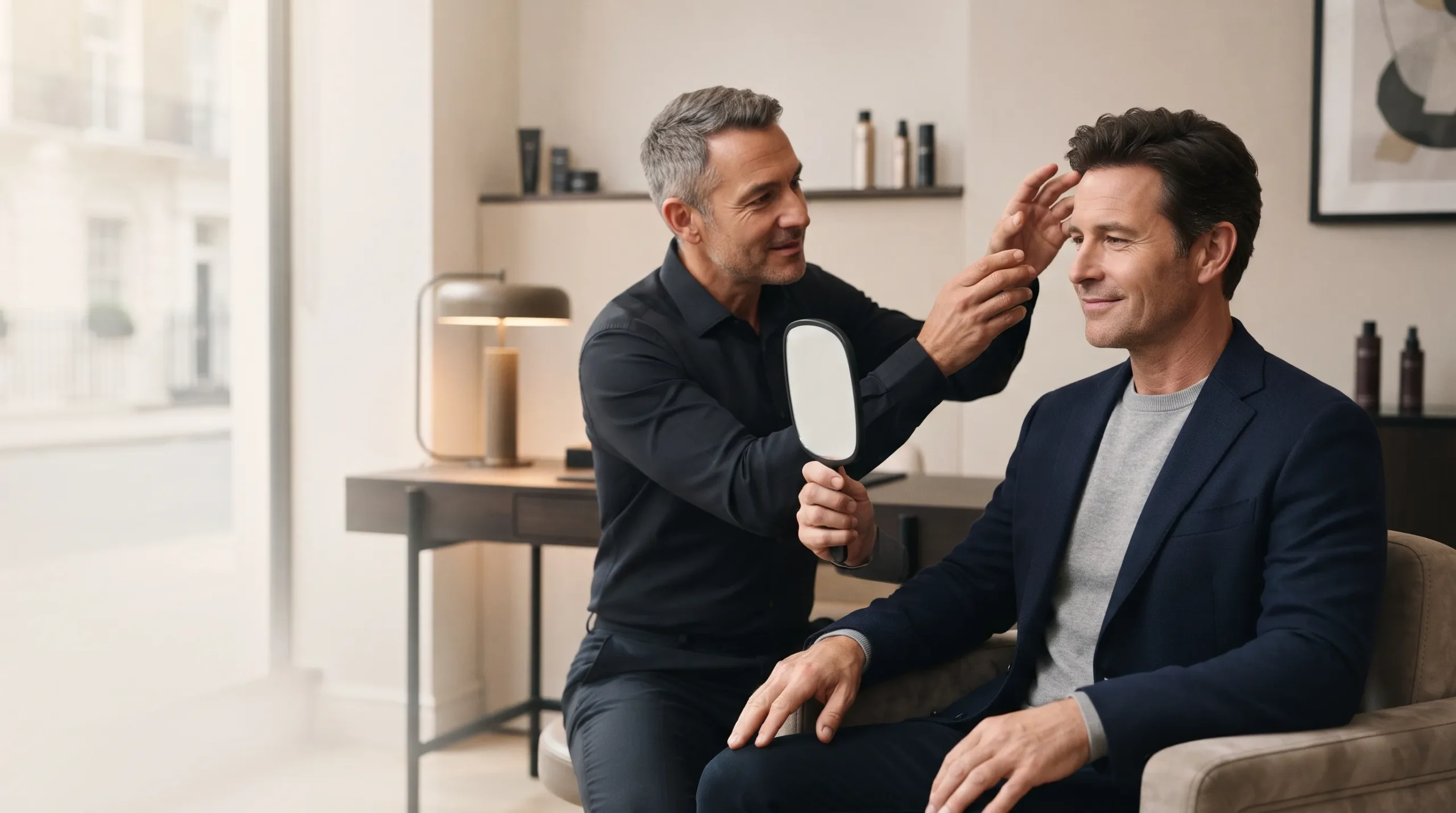
You get a private consultation of around an hour. It’s free. Nobody expects you to book on the spot.
The studio is at Unit C, Dorset House, 845 Harrow Rd, London NW10 5NH. It’s one to one. Just you and us.
We start by talking. What’s happened to your hair. What treatment you’ve had, if you want to say. Where you are now. What you’d like to look like. What worries you. You don’t have to go into your diagnosis. We only need enough to be sensible about timing and skin.
Next is the skin test. If you want to go ahead, we then design your system. Base type, density, hair direction, parting, hairline and colour. Colour is where an old photo helps most, especially if your hair has changed shade since treatment. We can match to what you have now or to how it used to look.
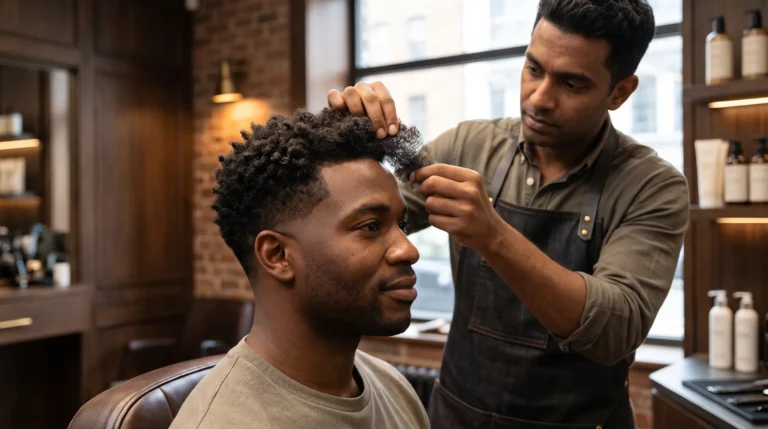
The fitting takes around 45 to 90 minutes. The system is bonded, cut in and styled so it blends with whatever hair you’ve got round the edges. For a walk through the whole thing, our post on getting your first hair system covers it.
Some men come in, ask their questions and leave without booking. That’s normal. You’re dealing with a lot already, and a hair decision can wait.
Should you get matched before your hair falls out?
If you know chemo is coming and you want a system later, there’s a case for coming in early. Not to be fitted. Just to talk.
Your hair is still there. We can see its real colour, how thick it is, where your hairline sits and how it grows. A photo or two taken before treatment gives us something to match against later. If you can’t make it in, take clear pictures from the front, the sides and the top, in daylight.
It’s not a must. Plenty of men match from old photos and it works fine. But if you’ve got the energy before treatment starts, it saves guessing afterwards.
Can you wear a system while your own hair grows back?
Yes, a lot of men do. Your care team has to be happy with your scalp first, though. After that, the system covers the thin area and your own hair carries on growing underneath and round the edges. Nobody has to wait for the fuzz to turn into a full head of hair.
The catch is that new hair is fragile. It’s fine and soft, and it can snap if it’s pulled. So how a system goes on and how it comes off both matter. We explain the choices in our posts on whether a system damages existing hair and on tape versus glue.
Your hair will keep changing, and the fit changes with it. Every four to six weeks you come back. We freshen the bond, clean the base, check the fit and restyle. If your own hair has grown or filled in since last time, that’s when we adjust the blend.
Curly regrowth is fine too. Hair that comes back with a wave or a tight curl can still be matched, and our post on systems for curly hair shows how we hide the join. Not sure you’re ready because you still have some hair on top? Read about getting a system before you’re completely bald.
Will it look natural?
It can, if three things are right: the hairline, the density and the colour. Get one wrong and people notice. Get all three right and most won’t think twice.
Start with the hairline, since that’s where eyes go first. A hard, straight line across the forehead gives it away. We soften it and blend it into your own hair, so you can’t see where one ends and the other begins.
Density comes next. A system that’s thicker than the hair you used to have looks odd, especially on a man in his fifties or sixties. We aim for what suits your age and how your hair grew before. A little thinner is usually more believable than too full.
Then colour. Chemo can leave you with hair that’s lighter, greyer or a different shade, so we match to what’s growing now, or to an old photo if you’d rather go back to how it was.
Our guide on why custom fitting matters covers the process, and the post on whether people can tell is blunt about what to expect up close.
One more thing. If your texture is still changing as the hair grows back, say so. We’ll keep it in mind when we blend the edge, and we can adjust at your next visit.
What about beard and eyebrows?
Chemo doesn’t stop at the head. Beard hair, eyebrows and lashes can all thin or fall out, and a lot of men tell us their brows bother them more than the scalp. A face with no eyebrows can look different even from across a room.
We can’t help with that, and we want to be clear. Our systems are made for the scalp only. We don’t make beard pieces or eyebrow pieces. Your care team or a cancer support centre is the best place to ask what’s out there for facial hair.
The good news is that it often grows back on a similar timeline to the hair on your head. Beards can come back patchy at first and fill in over the following months. If yours is slow, give it time and mention it to your team.
What does it cost?
A first system starts from £495. That price covers the system, the fitting, the cut and the styling. After that you come in every four to six weeks for maintenance. If you’d like to spread the cost across several fittings and visits, we have packages. Our prices page has the current figures.
The final number depends on three things: the base you choose, how dense you want the hair, and how long you want it. So the free consultation is the best place to get an exact quote. You’ll know the total before you commit to anything.
A system doesn’t last forever. Expect around three to six months before it needs replacing. Sweat, heavy wax or oil, and the way you sleep can all shorten that. The post on how long systems last goes through what makes the difference, and the one on aftercare covers the daily routine that keeps it going longer.
Money is tight for a lot of men after treatment. Some have had months off work. If cost is the sticking point, say so at the consultation. We’d rather you knew your options than guessed, and nobody will push you into a package you don’t need.
What changes in daily life?
Less than most men expect. You can shower, exercise and sleep in one, with a few simple rules. We cover each one: showering, sleeping and cleaning.
Styling works too, within limits. Keep the heat low and the products light. The post on styling a system like normal hair lists what works.
Now and then a system lifts at the front or feels tight in the first days. Both are fixable. Have a look at lifting at the hairline and why a system might feel tight before your first fitting so nothing catches you off guard.
What about the feelings side of it?
Losing hair to cancer treatment hits differently from ordinary balding. It’s sudden. It’s visible. And it can feel like a sign to everyone around you that you’re ill. Many men tell us they’re fine most days, then catch their reflection in a shop window and it stops them.
Some men feel they’ve lost a bit of who they are. Others feel angry. Others are just tired of explaining. There’s no right reaction.
Talking helps. Family, friends, a specialist nurse, or other men who’ve been through it. Many cancer support centres run workshops on hair loss, and your hospital team can point you to local ones. A system won’t change how you feel about the illness. For plenty of men, though, it takes one daily reminder off the table.
Going back to work with a system
Returning to work is a big moment for a lot of men. You’re still recovering. Colleagues know, or half know. Everyone looks at you a second longer than usual.
Some men like the system because it takes that look away. You walk in with the hair you had before and the conversation moves on to other things. Others prefer to go in bare or in a cap and let people get used to it. There’s no rule. You can also tell people about the system or keep it to yourself. That’s your business.
Plan your first fitting a few days before you go back, not the night before. Give yourself time to get used to how it feels and how to wash it. Our post on how a system holds up and the one on whether systems come off easily answer the worries men raise most about the first week.
Gym, swimming and hot weather
Once your doctor is happy with your skin and activity levels, most men get back to normal exercise. A system can handle sweat and showers. The adhesive we use is waterproof and sweat resistant, though heavy workouts and hot weather can wear the bond down faster, which is one reason maintenance visits matter.
Tell us how active you are at the consultation. We choose the adhesive strength with that in mind. A man who runs five days a week needs a different setup from one who walks the dog.
Heat on a recovering scalp needs care too. Skin that’s just come off treatment can burn and sweat differently. Cover up outdoors, keep the area clean, and let us know if anything stings or itches more than you’d expect.
What should you ask your care team before booking?
Take these to your next appointment:
- Is my scalp healthy enough for adhesive, or should I wait?
- Is any treatment or medicine I’m on likely to affect my skin or healing?
- Is radiotherapy to my head part of the plan, and when?
- Is it safe to use hair products or adhesives near the treated area?
- How long do you expect regrowth to take in my case?
If radiotherapy to the scalp is involved, it’s usually best to wait until the skin has fully recovered.
FAQs: Hair Systems After Chemotherapy
Can you wear a hair replacement system during chemotherapy?
Only after checking with your oncology team. The adhesive stays on your scalp for weeks, and skin during treatment can be dry, sore or more reactive than usual. Many men use a hat or an NHS wig through treatment and look at a system once it’s over. Your team knows your drugs and your skin, so they should make the call.
How long after chemo can you get a hair system?
There’s no fixed date. It depends on how your scalp is recovering and what your care team says. Many men start looking a few months after their last session, once the skin has settled and they can see how their regrowth is shaping up. Come in for a free consultation at any stage and we’ll give you an honest view on timing.
Will hair grow back after chemo?
Often, yes. Regrowth commonly starts a few weeks after the last session, and fuller growth follows over the next few months. It can come back with a different texture or colour, and those changes are usually temporary. Hormone blocking medicine or long term treatment can slow things down, so ask your team what to expect.
Is a hair system the same as a wig?
No. A wig sits on top of the head and comes off at night. A system is bonded to the scalp and cut in with your own hair, and it stays on for weeks between maintenance visits. Because of that, a system needs more care around the skin, which is why timing after chemo matters.
Do you fit systems for women?
No. Hair Standard works with men only. If you’re looking for support for a woman in your family, a hospital wig service or a specialist wig consultant is a better route, and we’d rather point you there than waste your time.
How much does a first system cost?
It starts from £495, and that includes the fitting, cut and styling. The final price depends on the base type, the density and the hair length. You can see more on our prices page, or get an exact figure at the free consultation.
Do clients have to share their diagnosis?
No. Tell us as much or as little as you like. We only need enough to be sensible about timing and skin, such as whether treatment has finished and whether your scalp has had radiotherapy. The rest stays with you.
Can you do beard or eyebrow pieces?
No. Our systems are for the scalp. Facial hair often grows back on a similar timeline to head hair, and your care team or a cancer support centre can talk through options if it doesn’t.
What if someone only wants advice?
That’s fine. Book the free consultation and say so, or pick “Just Want Advice” on the booking form. There’s no pressure to order anything, and you’ll leave with an honest answer about whether now is a good time.
How long does a system last?
Around three to six months, then it needs replacing. Maintenance visits every four to six weeks keep it fresh by refreshing the bond, cleaning the base and restyling the hair. Sweat, heavy products and sleep habits can shorten its life.
Should a man get a system before chemo starts?
Not usually. Most men use hats or an NHS wig during treatment and look at a system afterwards. What can help beforehand is a chat and a few clear photos, so colour and hairline can be matched later.
What if regrowth comes back curly or a different colour?
Tell us at the consultation. We match the system to the hair you have now, curl and colour included, or to how it used to look if you prefer. These changes are often temporary, so some men choose to wait a few months and see how their hair settles first.
Book a free, private consultation
If you’re not sure whether now is the right time, that’s okay. Come in, ask what you like and leave with an honest answer. You can read about our process, see what past clients say in our reviews, or learn more about us. Our non-surgical hair replacement page has the full service details.
To book, use our contact page, call 0203 393 1235, or message us on WhatsApp. We’re open Monday to Friday 9:00 to 18:30 and Saturday 9:00 to 16:00.
Sources
- Hair loss due to cytotoxic chemotherapy and radiotherapy, Gloucestershire Hospitals NHS Foundation Trust
- What are chemo curls? Understanding post-chemo hair changes, MD Anderson Cancer Center
- Hair loss and cancer, Maggie’s
This article is for general information only and isn’t medical advice. Decisions about adhesives, scalp products and timing after cancer treatment should be made with your oncology team.