
A properly fitted, correctly maintained hair replacement system should not damage your existing natural hair. The system sits on the scalp in the area of hair loss and is attached using medical-grade adhesive or tape. It does not grip, pull, or bind to your remaining natural hair strands. When damage does occur, it is almost always caused by something specific: incorrect adhesive removal technique, a system that has been left too long without a re-bond, or a care routine that is creating friction or product build-up at the hairline. None of these are inherent to wearing a system. They are avoidable with the right information and the right maintenance approach. This guide covers exactly what can and cannot damage your existing hair when wearing a system, so you know what to watch for and how to prevent it.
How a Hair System Attaches and Why This Matters for Damage
Understanding how the system actually attaches to your scalp is the starting point for understanding whether it can damage your natural hair.
A hair system bonds to the scalp, not to your existing hair. The base material sits against the skin in the area of hair loss, and the adhesive or tape creates a bond between the base and the scalp surface. Your remaining natural hair at the perimeter grows from the scalp outside the bonded area and continues to grow and behave normally. The system does not physically grip it, wrap around it, or exert any sustained force on it.
This is fundamentally different from clip-in extensions, wigs secured with clips, or any attachment method that grips existing hair strands. A bonded hair system bypasses the existing hair entirely.
The practical implication: a correctly fitted, correctly bonded system does not mechanically stress your existing hair. Your remaining hair is free to grow, and a properly maintained system causes no traction or pulling at the follicle level. If traction is a concern for you, our guide on whether a hair system can help with traction alopecia explains why bonded systems are often a suitable option.
What Can Cause Damage to Existing Hair
Incorrect adhesive removal technique
This is the most consistent real-world cause of damage to existing hair from wearing a system, and it is entirely avoidable.
When the system is removed without a proper bond remover, or when the base is pulled away from the scalp by force, the adhesive at the bond edge can grip the natural hair at the perimeter of the system. Forcing the base away from the scalp in this condition pulls that hair rather than releasing cleanly.
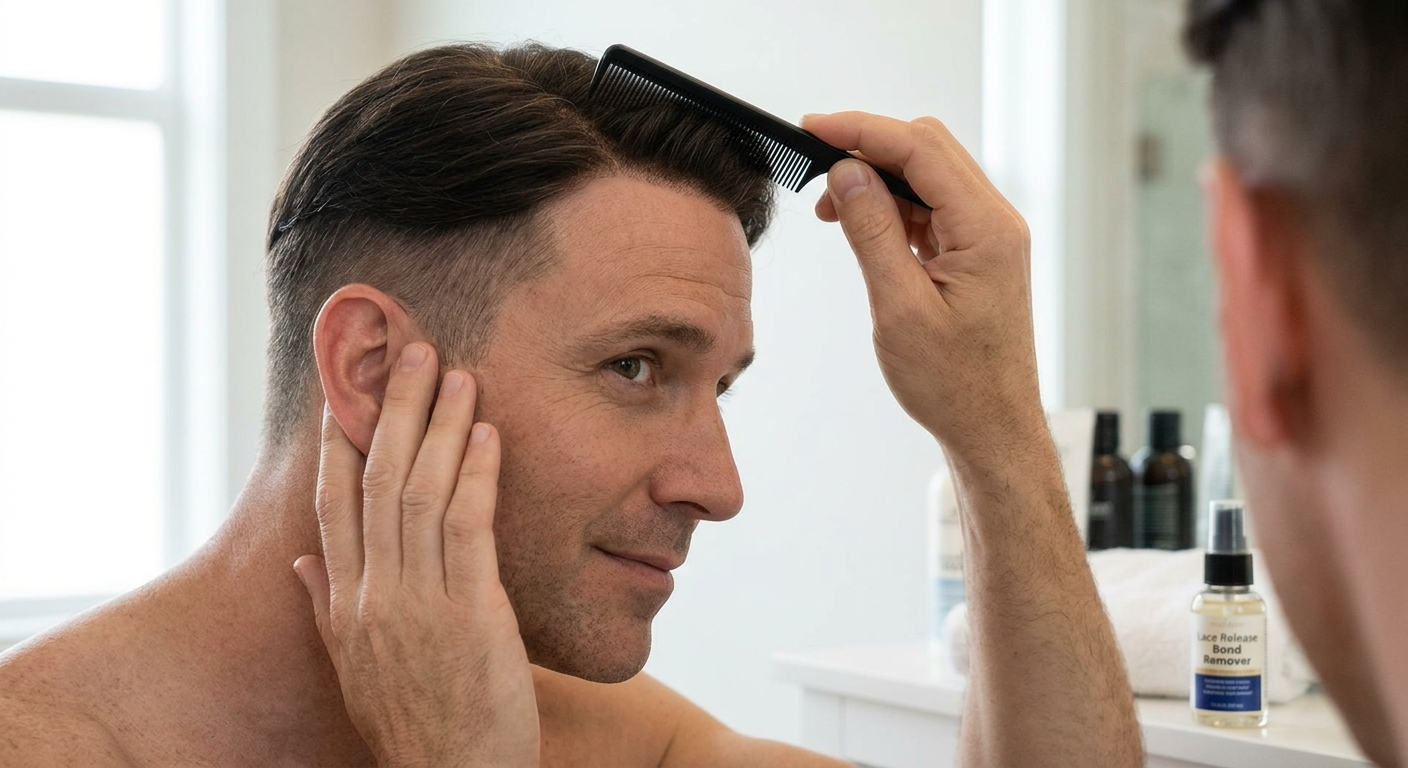
The correct removal process uses a citrus-based bond remover applied to the bond edge, allowed to penetrate for one to five minutes, and then the base is gently lifted away. When adhesive is properly dissolved before removal, there is no gripping force on the surrounding natural hair and no damage to the follicles.
If you are removing your system at home between professional re-bond appointments, using the correct remover and the correct technique is not optional. It is what protects the natural hair at the perimeter that your system relies on for blending. Our complete maintenance and aftercare guide covers the full removal process in detail.
Leaving the bond overdue
A bond that has been left significantly past its expected lifespan begins to lift at the edges. As the perimeter lifts, the base can flex and move in ways it does not when freshly bonded. In this state, the base edge can intermittently press against or grip the natural hair at the transition zone rather than sitting cleanly away from it.
This is not a dramatic event. It is subtle, cumulative, and easy to miss. But a consistently overdue bond is the condition most likely to produce the kind of low-level mechanical friction on perimeter hair strands that causes breakage over time.
Re-bonding at the correct interval, not when the bond has visibly failed but on schedule, protects the perimeter hair as well as the system itself. See our guide to how long hair replacement systems last for the expected re-bond intervals by attachment method. If your edges are already starting to rise, read why a hair system lifts at the hairline and why your hair system may not be sticking.
Product build-up at the hairline
Styling products applied near the hairline, particularly oil-based pomades, heavy waxes, and anything that creates a coating on the hair shaft, accumulate at the transition between the system and the natural hair over time. This build-up can cause the natural hair at the hairline to stick together and create a situation where combing or brushing at the perimeter puts more tension on individual strands than it otherwise would.
The fix is maintaining a clean product routine: keeping oil-based products away from the hairline and washing on schedule rather than extending the interval. Our guide on how to clean a hair system shows the correct washing steps, and the product rules are covered in full in our maintenance guide.
Aggressive detangling at the perimeter
The area where the system meets your natural hair at the perimeter requires careful handling during washing and styling. Dragging a comb or brush through this transition zone from root to tip, particularly when hair is wet and more elastic, creates mechanical stress on the natural hair strands closest to the system edge.
The correct technique is always to work from the ends upward, holding the hair below the section being worked to prevent tension transferring to the root. This applies to both the system hair and the natural hair at the transition zone. If your hair has already started to tangle, our guide on how to fix a matted hair system walks through the safe way to work it out.
Incorrect base sizing
If the system base extends over areas where natural hair still grows, because it was not sized correctly to the actual loss area, the adhesive makes contact with existing hair follicles rather than bare scalp. Adhesive on the hair shaft, and particularly adhesive removal from hair-covered scalp, can cause breakage and follicular stress.
This is a fitting issue rather than a maintenance issue, and it underscores why correct base sizing at the consultation stage matters. A system sized precisely to the actual loss area bonds to scalp rather than to hair-covered skin.
What Does Not Damage Existing Hair
The adhesive itself on bare scalp
Medical-grade hair system adhesives are formulated to bond to skin safely. When applied to bare scalp, which is the correct application surface, they do not damage hair follicles in that area. The scalp in the loss area has no active follicles producing hair, so adhesive contact with that skin is not a follicular concern.
Adhesive applied to skin outside the loss area, on scalp where hair is still growing, is a different situation. This is why correct base sizing matters: the adhesive should only contact bare, hair-loss-affected scalp, not follicle-populated skin at the edges.
The weight of the system
Hair systems are lightweight. The weight of the base and hair does not create a sustained pulling force on existing hair. The system is bonded to the scalp rather than hanging from or gripping surrounding hair. Unlike clip-in extensions or certain wig attachment methods where weight is distributed through clips on natural hair, a bonded system transfers its weight directly to the scalp through the bond.
Normal daily movement
Everyday head movement, such as turning, tilting, and lying down, does not create mechanical stress on natural hair from a correctly bonded system. The bond holds the system securely against the scalp, and there is no dynamic force transferring to surrounding natural hair during normal movement. You can read more in our guides on sleeping in a hair system and showering with a hair system.
What About Hair Growth Under the System?
A common question from first-time wearers is whether the scalp under a bonded system can still produce hair normally, or whether covering the scalp inhibits growth.
Hair follicles in the loss area that are still producing hair, in early-stage thinning rather than complete baldness, continue their growth cycle regardless of the system sitting above them. A bonded system does not suppress follicle activity or prevent hair from growing. The follicle produces the hair shaft, which simply pushes upward into or under the base material as normal.
For wearers with early-stage diffuse thinning who retain some active follicles in the coverage area, the system does not accelerate or decelerate the natural progression of that loss. What it does is provide immediate cosmetic coverage regardless of what is happening at the follicle level.
The natural hair at the perimeter of the system continues to grow normally between appointments, which is one of the reasons the styling blend needs periodic adjustment at re-bond appointments. The surrounding natural hair changes in length and the blend needs to be re-established.
Can You Use Minoxidil or Finasteride While Wearing a System?
Yes. Both topical minoxidil and oral finasteride are compatible with wearing a hair system.
Topical minoxidil applied to the exposed scalp outside the bonded area, and to accessible areas of the scalp at re-bond appointments when the system is off, can be used as normal. The bonded area itself is not accessible for topical application during wear, but this does not prevent using minoxidil on the surrounding scalp where active follicles are present.
Oral finasteride works systemically and is not affected by what is happening at the scalp surface, so wearing a system has no interaction with finasteride use at all.
If you are using either treatment to slow or address hair loss alongside wearing a system, continue your existing approach. There is no conflict. If you are weighing up a system against other options, see our comparison of a hair replacement system vs hair transplant.
How to Protect Your Existing Hair While Wearing a System
The practical steps that prevent damage are all within the maintenance routine:
- Use the correct bond remover at every removal. Never force the base away without first dissolving the adhesive. Citrus-based bond remover, applied to the edge, penetrating for one to five minutes before the base is lifted, every time.
- Re-bond on schedule. Do not let the bond become overdue. A fresh, secure bond sits cleanly against the scalp. An overdue, lifting bond creates mechanical friction at the perimeter.
- Keep oil-based products away from the hairline. Product build-up at the transition zone is the most consistent cause of perimeter hair sticking and breakage. Light, water-based styling products used away from the hairline are the correct approach.
- Brush and comb from the ends upward. At the perimeter where system hair meets natural hair, always work upward from the ends, holding the hair below the section you are working to prevent tension at the root.
- Maintain correct base sizing. If your loss pattern has changed since your last system, raise it at your next consultation. An updated base size ensures the adhesive continues to contact bare scalp rather than encroaching on hair-covered skin.
The full maintenance routine, covering washing, detangling, heat styling, scalp care, and professional servicing, is in our maintenance and aftercare guide.
Quick Answers
Does wearing a hair system damage existing hair?
Not when fitted and maintained correctly. A bonded hair system attaches to the scalp in the area of hair loss. It does not grip or bind to existing hair strands. Damage that does occur is almost always caused by incorrect removal technique, an overdue bond, product build-up at the hairline, or a base that has been incorrectly sized over hair-covered scalp. All of these are avoidable with the correct maintenance approach.
Can adhesive damage hair follicles?
Medical-grade adhesive applied to bare scalp, the correct application surface, does not damage follicles in that area. Adhesive applied to scalp where hair is actively growing is a concern, which is why correct base sizing to the actual loss area matters. Adhesive removal using the correct bond remover technique prevents any mechanical stress on natural hair at the perimeter.
Will wearing a hair system make my hair loss worse?
No. A bonded hair system does not accelerate or worsen the underlying hair loss pattern. The system sits over the area of loss without affecting follicle activity in surrounding areas. Your hair loss continues or stabilises according to its own progression regardless of whether you are wearing a system.
Can hair grow back under a hair system?
Yes. Follicles in the loss area that retain activity continue their growth cycle under a bonded system. The system does not suppress follicle activity. For wearers with early-stage diffuse thinning who retain some active follicles in the coverage area, those follicles continue to produce hair normally.
Can I use minoxidil while wearing a hair system?
Yes. Topical minoxidil applied to the exposed scalp outside the bonded area is fully compatible with wearing a system. The bonded area itself is not accessible during wear, but surrounding scalp where active follicles are present can be treated normally. Oral finasteride is unaffected by wearing a system.
What is the safest way to remove a hair system without damaging natural hair?
Use a citrus-based bond remover applied directly to the bond edge. Allow it to penetrate for one to five minutes depending on adhesive strength. Gently lift the base away without forcing. If there is resistance, apply more remover and wait. Never pull or peel the base away without first dissolving the adhesive.
Book a Consultation at The Hair Standard
If you are concerned about protecting your existing hair while wearing a system, or if you are experiencing any issue you think may be affecting your natural hair, a check-in appointment is the most efficient way to assess what is happening and adjust the approach.
Book a consultation at The Hair Standard. We assess the system, the bond, and the natural hair at the perimeter in person and advise on any adjustments needed to protect your existing hair going forward.
For the full maintenance routine that protects both the system and your natural hair, see our maintenance and aftercare guide. For guidance on what to expect from the fitting process from the start, see our guide on getting your first hair system. For the broader picture of how hair replacement systems work and who they suit, see our do hair replacement systems work guide