
A matted hair system is almost always fixable and almost always avoidable once the cause is identified. Matting occurs when individual hair strands tangle around each other and the tangles compress into a dense, knotted mass that resists normal brushing. It is caused by a specific combination of factors: friction, dryness, product residue, and incorrect detangling technique none of which are permanent problems. The correct process for addressing a matted system is slow, methodical, and starts at the ends rather than the roots. Done correctly, most matted systems can be fully restored without cutting. Done incorrectly by pulling a brush through from root to tip the matting worsens, the base is stressed, and hair strands are lost unnecessarily. This guide covers the complete process for fixing a matted hair system, what caused it, and how to make sure it does not happen again.
Why Hair Systems Mat More Than Natural Hair
Natural hair is continuously lubricated by sebum produced at the scalp. This natural oil coats each strand, reduces friction between strands, and prevents the cuticle roughening that leads to tangling. Hair systems have no scalp to produce this lubrication; the hair strands are dry by nature, and without active conditioning and care, the cuticle surface becomes rough, friction between strands increases, and tangling progresses faster than it would on natural hair in the same conditions.
This is why a hair system that is neglected for even a few days not conditioned, not brushed, slept on with friction mats in a way that equivalent natural hair on a healthy scalp would not. The same neglect on natural hair might produce tangles. On system hair, the same neglect produces matting.
Understanding this also explains why the same approach that works for detangling natural hair does not always work for a matted system. Natural hair has oils providing slip. Matted system hair is dry, the cuticle is roughened, and strands are locked together in a way that requires the right products and process to reverse without damage.
Assessing the Matting Before You Start
Not all matting is the same severity, and the right approach depends on what you are dealing with.
Surface matting tangles concentrated at the ends and mid-length, with the hair near the base still relatively free. This is the most common presentation and the most straightforward to address. The matting has not yet reached the point where strands are locked together throughout their length.
Mid-shaft matting tangles extending from the ends up to the mid-shaft. More time-consuming to address than surface matting but fully resolvable with correct technique and products.
Root matting tangles extend all the way to the base, with strands locked together at the point of attachment. This is the most serious presentation and requires the most careful approach working near the base risks stressing the hair attachment points and the base material. If matting has reached the base, patience and a specific technique are essential.
Felted matting where the hair has compressed into a dense, felt-like mass that no longer has visible individual strands at the surface. This is the result of significant neglect often from extended time without any brushing or conditioning, sometimes from sleeping repeatedly with a wet system. Felted matting is significantly harder to address and sometimes requires professional intervention rather than a home detangling process.
Before starting, separate the matted area from any hair that is still free. Work only on the matted section, keeping free hair out of the way with a clip or loose band.
What You Need Before You Start
Do not attempt to detangle a matted hair system dry. The correct products provide slip they reduce the friction between locked strands and allow them to separate without breaking. Attempting to detangle without slip products forces strands apart by tearing rather than sliding, which breaks hair and worsens the visual result.
What you need:
- A detangling spray or leave-in conditioner specifically designed for human hair or hair systems something with silicone or emollient ingredients that coat the hair shaft and provide slip
- A wide-tooth comb for initial separation work
- A soft-bristle or paddle brush for finishing once the comb has worked through
- Sectioning clips
- Patience this process cannot be rushed without causing damage
For synthetic hair systems: Standard conditioners and detangling sprays designed for human hair are not suitable. Synthetic fibres respond differently use a product specifically designed for synthetic hair to provide slip without coating the fibres in a way that causes long-term build-up.
The Correct Process for Fixing a Matted Hair System
Step 1 Saturate the matted area with detangling product
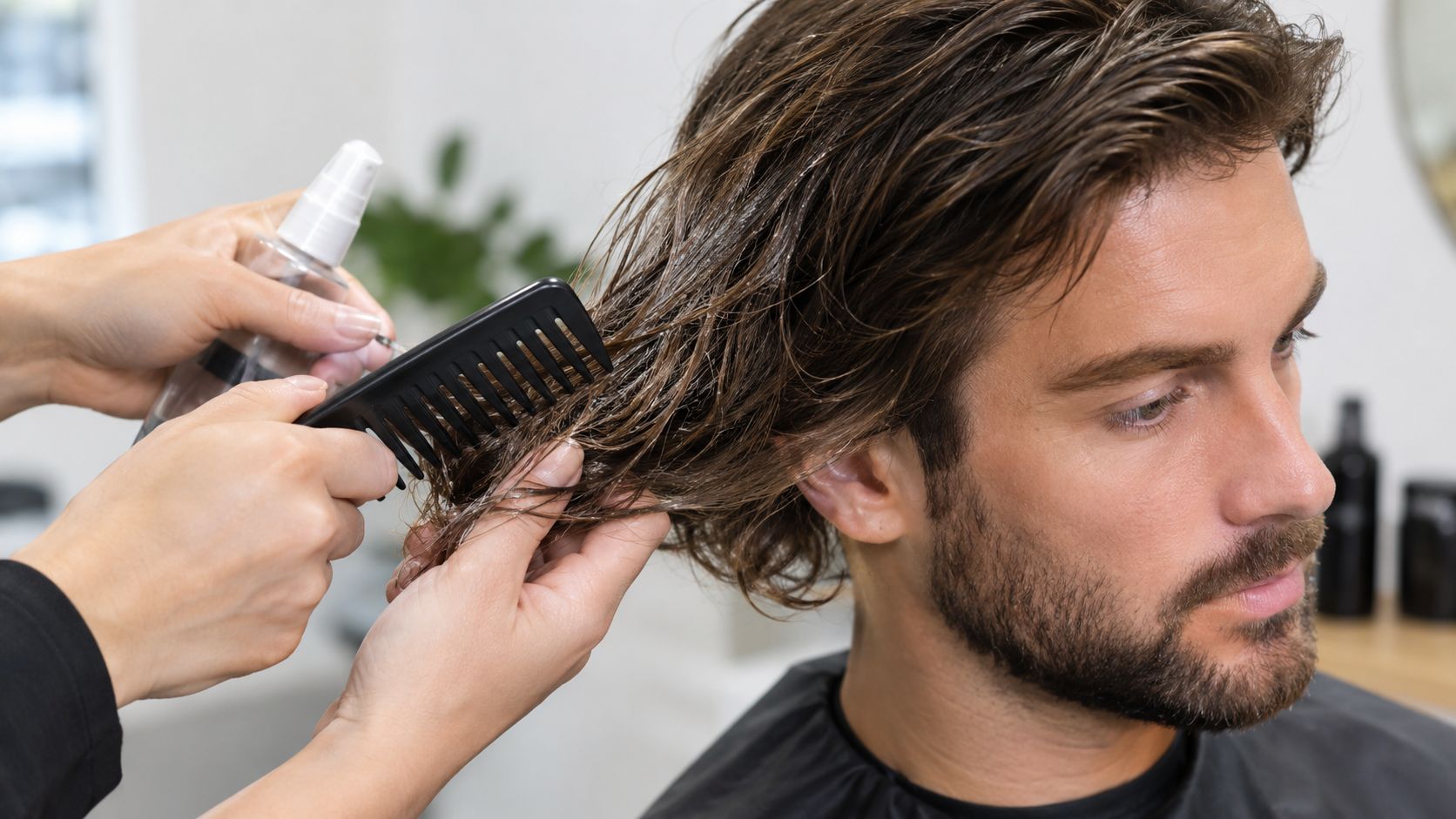
Apply detangling spray or diluted leave-in conditioner generously to the matted section. Do not be sparing the product needs to penetrate into the centre of the mat, not just coat the surface. Work the product gently with your fingers, trying to separate the outer layers of the mat enough to allow the product to reach the inner strands.
Allow the product to sit for two to five minutes before beginning any mechanical detangling. This dwell time allows the product to coat the individual strands and begin reducing the friction between them.
Step 2 Separate with your fingers first
Before touching the comb, work through the mat with your fingers. Start at the very outermost edge of the matted section not the centre and gently separate individual strands or small groups of strands from the perimeter of the mat. The goal at this stage is to reduce the overall size and density of the mat, not to fully detangle it.
Use a pulling-apart motion rather than a pulling-through motion. You are separating the mat from the outside in, not dragging anything through it. This preserves the hair strands that are already free at the edges of the mat and reduces the tension on the locked inner strands.
Reapply product as needed the mat should remain wet and slippery throughout this process. Dry detangling at any stage causes the cuticle to roughen further and the strands to lock back together.
Step 3 Work with a wide-tooth comb from the ends upward
Once your fingers have loosened the outer layers of the mat, begin with the wide-tooth comb. Start at the very ends of the last centimetre or two of the hair and work only through that section until it is completely free of tangles. Then move up one centimetre and repeat.
This is the fundamental rule of detangling a matted system: always work upward from the ends toward the base, never downward from the base toward the ends. Combing from the roots downward forces all the tangles together and compresses the mat further. Combing from the ends upward clears each section before encountering the section above it, so the comb never has to fight through accumulated tangles.
Hold the hair below the section you are working on between your fingers and the base so the tension from the comb is not transferred to the base material. This is particularly important near the base, where the hair attachment points are stressed by any pulling force.
Apply more product whenever the comb encounters resistance. Resistance means friction, and friction means the product has been absorbed or has dried more is needed before continuing. Never force the comb through resistance.
Step 4 Work inward and upward progressively
Continue the pattern end section free, move up one section, comb through, hold below, apply product if needed progressively working toward the mid-shaft and then toward the base. At each level, only move up when the section below is completely free. Do not advance into a new section while the previous one still has tangles those tangles will compress with the new ones and produce a worse mat than you started with.
At the base, the technique shifts. Near the attachment points, use your fingers rather than the comb separating individual strands gently rather than drawing the comb through. The base material and the attachment points are the most vulnerable areas and require the least mechanical force.
Step 5 Finish with a soft-bristle brush
Once the wide-tooth comb has worked through the full length of the hair, finish with a soft-bristle or paddle brush. Again, work from the ends upward. The brush smooths the cuticle of each strand which the comb has freed but not smoothed and produces the finished, natural appearance.
Step 6 Rinse and condition
After detangling, wash the section with a sulphate-free shampoo to remove the detangling product build-up, then condition from mid-length to ends. Allow the conditioner to sit for three to five minutes to restore moisture to the hair strands that have been stressed by the detangling process. Rinse thoroughly.
The correct conditioning and washing process is covered in full in our complete maintenance and aftercare guide and our guide to cleaning a hair system without damaging it.
When to Stop and Seek Professional Help
Stop the home detangling process and book a professional service if:
- The mat is not reducing despite correct technique and adequate product
- The hair is breaking rather than separating as the comb works through
- The mat has compressed into a felted mass without visible individual strands
- The base material is being stressed or pulled during the detangling process
- The mat is concentrated at the base and separation near the attachment points is not possible without significant force
A professional detangling service at The Hair Standard gives the technician access to professional-grade products and tools that are not typically available at home, alongside the experience to assess whether the unit can be fully restored or whether replacement is the more practical option given the severity of the matting and the unit’s remaining lifespan.
What Caused the Matting and How to Prevent It
Identifying the specific cause of the matting is what prevents it recurring. The most common causes:
Sleeping without brushing first
This is the most frequent cause of overnight matting. Sleeping with unbrushed hair even for a single night allows friction against the pillow surface to lock individual strands together. A cotton pillowcase significantly worsens this because the fibrous texture of cotton grabs and tangles hair in a way that satin or silk does not.
Prevention: Brush or finger-detangle the system before sleep, every night. Use a satin or silk pillowcase to reduce friction during sleep. Our guide to sleeping in a hair system covers the complete approach.
Sleeping with a wet system
A wet system that is slept on produces matting at a rate that a dry system does not. Wet hair strands are more pliable, the cuticle is more open, and friction from the pillow locks wet strands together in a way that is significantly harder to reverse than dry tangling. The resulting mat is often concentrated at the nape or the area of the head that contacts the pillow most.
Prevention: Allow the system to dry fully before sleeping air dry for at least 30 to 45 minutes after washing, with a low-heat hairdryer on the base area if needed. Never sleep with the system wet regardless of how tired you are or how convenient it would be to skip the drying step.
Inadequate or incorrect conditioning
Hair system hair that is not regularly conditioned dries out between wash cycles. Dry hair has a roughened cuticle surface, and strands with roughened cuticles catch on each other far more easily than strands with smooth, conditioned cuticles. The longer a system goes without conditioning, the more prone to matting it becomes not because anything has gone wrong with the system, but because its moisture level has dropped below what is needed to keep strands moving freely past each other.
Prevention: Condition the hair from mid-shaft to ends after every wash with a lightweight, silicone-free conditioner. Between washes, a light leave-in conditioning spray applied mid-length and combed through maintains moisture levels and keeps the cuticle surface smooth. See our showering with a hair system guide for the correct conditioning process.
Product build-up
Styling product that accumulates in the hair over multiple days, particularly oil-based products, heavy pomades, and dry shampoo used at the roots, creates a tacky coating on the hair strands that causes them to stick together rather than sliding freely. Product build-up matting tends to develop gradually rather than overnight, and is concentrated in the areas where product is most heavily applied.
Prevention: Use lightweight, water-based styling products rather than oil-based formulas. Wash regularly on schedule to remove build-up before it accumulates enough to cause sticking. Following the product rules in our maintenance guide, keeping oil-based products away from the hair entirely is the most effective preventive measure.
A unit approaching the end of its lifespan
As a hair system ages, the cuticle of the hair strands degrades. The outer layer that normally provides some protection and smoothness becomes rougher and more porous, increasing friction between strands and making the hair more susceptible to tangling and matting. A unit that is matting regularly despite correct care is often a unit that has reached or passed the end of its useful lifespan.
Prevention: Replace the unit within its expected lifespan typically three to six months depending on base type and care routine. Our guide to how long hair replacement systems last covers the expected lifespan by base type and the signs that a unit is ready for replacement.
A matted hair system is almost always fixable and almost
Frequently Asked Questions
Can you fix a matted hair system without cutting it?
Yes, in most cases. Surface matting, mid-shaft matting, and even relatively severe root matting can be resolved with the correct detangling process: saturating the hair with a detangling product, gently separating the outer layers of the mat with your fingers, and progressively combing through from the ends upward. Cutting should generally only be considered for severe felted matting that has not responded to a thorough professional detangling attempt. Most matted hair systems can be restored without cutting.
What is the best product to use on a matted hair system?
A detangling spray or leave-in conditioner with silicone or emollient ingredients designed for human hair or hair systems is usually suitable. These products provide slip by coating the hair shaft and reducing friction between locked strands, helping them separate without unnecessary breakage. Apply the product generously and allow it to penetrate before beginning mechanical detangling. For synthetic hair systems, use a product specifically formulated for synthetic fibres.
Why does my hair system keep matting?
The most common causes are sleeping with the system unbrushed or wet, sleeping on a cotton pillowcase rather than satin or silk, inadequate conditioning between washes, product build-up creating a tacky coating on the strands, and a unit approaching the end of its useful lifespan. Identifying the specific cause and adjusting your maintenance routine can help prevent the matting from recurring.
Can you detangle a matted hair system at home?
Yes, most mild to moderate matting can be addressed at home using the correct products and the end-to-root detangling technique described in this guide. Professional intervention is recommended when the mat has compressed into a dense, felted mass without visible individual strands, when hair is breaking rather than separating during detangling, or when the mat is concentrated at the base near the attachment points and cannot be addressed safely without risking the base material.
Should I detangle a wet or dry hair system?
Neither purely dry nor soaking wet is ideal. The correct approach is to saturate the matted section with a suitable detangling spray or leave-in conditioner and work through it while the hair is coated and slippery. Dry detangling can increase friction and worsen the mat, while plain water does not provide the same level of slip as a dedicated detangling product. Apply the product generously before beginning the detangling process.
Why does my hair system mat overnight even when I brush it before sleep?
If brushing before sleep does not prevent overnight matting, two likely causes are friction from the pillowcase and sleeping with the system damp rather than completely dry. Cotton pillowcases can create enough friction to cause strands to tangle during sleep, while damp hair can be more prone to locking together. Switching to a satin or silk pillowcase and ensuring the system is fully dry before sleeping can help reduce overnight matting.
How do I know if a matted system needs to be replaced rather than fixed?
Replacement may be more practical when the hair is breaking during detangling rather than separating, the mat has compressed into a dense felted mass that professional products and techniques cannot penetrate, or the system is already at or beyond its expected lifespan and showing other signs of wear. Replacement may also be appropriate when matting is severe and concentrated at the base and attempting to detangle it would risk damaging the attachment points or base material.
Book a Professional Detangling Service at The Hair Standard
If the mat is beyond what the home process can address or if you want a professional assessment of whether the unit is worth restoring or should be replaced, a service appointment at The Hair Standard gives you an accurate answer alongside the best chance of restoring the system if restoration is viable.
Book an appointment at The Hair Standard in London. We assess the severity of the matting, apply professional-grade detangling products and technique, and advise honestly on whether the unit can be fully restored or whether replacement is the better option given the system’s current condition.
For the full routine that prevents matting from developing in the first place, see our complete maintenance and aftercare guide. For guidance on the specific sleep habits that most consistently produce overnight matting, see our sleeping in a hair system guide.