
Yes, and honestly, most men who wear a system get fitted well before they reach that point. There’s a common assumption floating around that a hair system is some kind of last resort, something you only turn to once there’s genuinely nothing left to work with. That’s just not how most men actually approach it, and it’s not really how it works best either. Fitting a system while you still have a reasonable amount of natural hair generally gives a more natural result, not a less natural one, because there’s existing hair to blend with rather than a completely bare scalp to cover from scratch.
So let’s actually get into why fitting earlier tends to work better, what the process looks like at a partial thinning stage compared with full hair loss, what’s worth checking medically first, and the practical stuff, like Norwood stages, cost, and how blending actually works, that most guides skip over.
Do You Have to Wait Until You Are Fully Bald
No, not at all. Waiting isn’t the safer or more sensible choice it might seem at first glance. Male pattern baldness usually progresses gradually over years rather than happening all at once, and a system fitted at a moderate thinning stage, crown thinning or a receding hairline, blends with your remaining natural hair instead of needing to replicate a full head of hair from nothing. That blend is often exactly what makes the end result look genuinely natural rather than obviously artificial.
Think about it from a practical angle. If you wait until there’s no natural hair left at all, the specialist fitting your system has nothing to reference or blend against. Everything about colour, texture, density and growth pattern has to be reconstructed from memory, old photos, or guesswork. That’s a much harder starting point than simply matching what’s already growing on your head right now.
What Stage Do Most Men Actually Get Fitted At
There’s no single answer, but it’s a lot earlier than most people assume. A good chunk of men we see are somewhere around Norwood stage two to four, noticeable hairline recession or crown thinning, but still with plenty of hair elsewhere on the scalp. Very few wait until stage six or seven, which is where hair loss becomes extensive and there’s genuinely little left to blend with.
Part of this comes down to confidence rather than necessity. Thinning hair affects how a lot of men feel about themselves well before it becomes severe, and there’s really no rule that says you have to wait until it’s “bad enough” before doing something about it. If it’s bothering you now, that’s reason enough to look into it now.
Why Fitting Earlier Can Actually Give a Better Result
Colour and density matching is considerably easier when there’s existing natural hair to match against. A specialist can match the system hair to your actual current colour, texture and density directly, rather than working from old photos or guesswork about what your hair used to look like before it thinned out completely.
The transition is also a lot less noticeable to people around you. Getting fitted while you still have visible natural hair means the change from thinning to fuller coverage happens gradually and blends in, rather than going from visibly bald to suddenly having a full head of hair overnight, which is a much bigger visual jump for people who already know you to notice and comment on.
There’s a confidence factor too, and it’s honestly one of the biggest reasons men come to us in the first place. Many start looking into systems specifically because early thinning is already affecting how they feel day to day, not because they’ve hit some fixed threshold of hair loss severity. Waiting until you’re fully bald to address something that’s already bothering you now doesn’t really serve any practical purpose, and it just means living with the frustration longer than you need to.
Is There Any Reason to Wait
Sometimes, yes, though it’s more about your own comfort with the decision than any technical requirement. If your hair loss is very minor and genuinely isn’t bothering you day to day, there’s no rush. A system is worth getting when it solves a problem you’re actually experiencing, not on some fixed schedule someone else sets for you.
Rapidly progressing hair loss is also worth discussing openly at a consultation, since a system fitted around your current pattern may need adjusting again sooner if things change quickly. That’s not a reason to avoid getting fitted early, it’s just something worth talking through honestly based on what we actually see, rather than guessing about beforehand.
How Fitting Differs at a Partial Thinning Stage
At a partial thinning stage, the base is designed and positioned to work with your existing hair rather than replace all of it. This usually means a smaller or more targeted base covering just the thinning area, crown, hairline, or both, with the surrounding natural hair left untouched and blended in around the edges. Our guide on hair systems for crown thinning covers exactly this kind of partial coverage if that matches where you’re noticing it most.
Once hair loss is more extensive or total, the approach shifts toward a full system covering the whole scalp, since there’s no longer natural hair around the edges to blend into. Our wider guide to whether a hair system is worth it for male pattern baldness covers both stages and how the decision changes depending on where you actually are right now.
What Does Blending Actually Involve
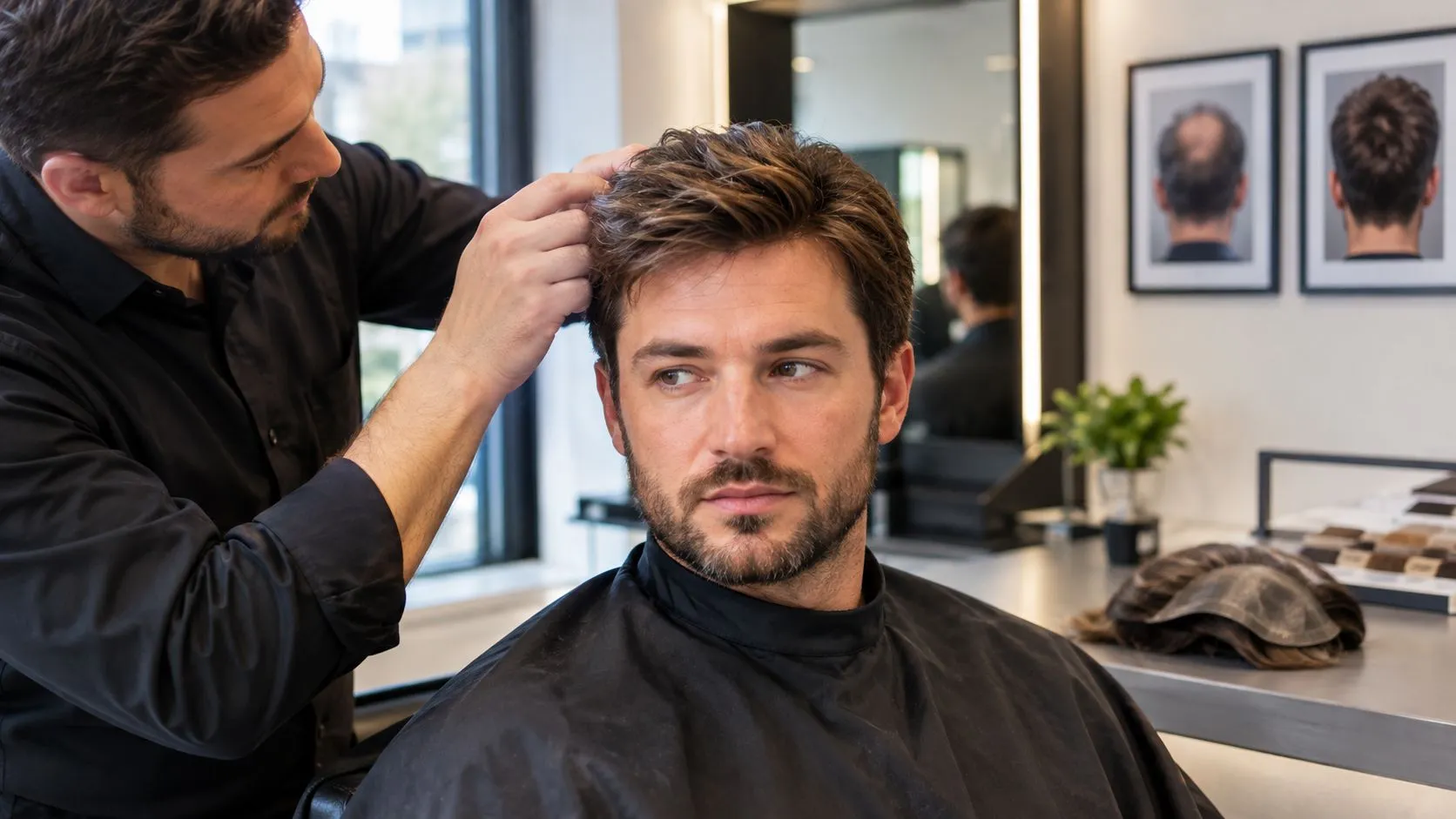
This is the part most guides skip over, and it’s genuinely worth understanding. Blending isn’t just picking a similar hair colour off a shelf. A skilled fitter looks at how your existing hair grows, the direction, the density, whether there’s any natural greying, and builds the system hair to match that pattern rather than just the general shade. Done well, the line between your natural hair and the system becomes genuinely difficult to spot, even up close.
This is also why earlier fitting has a practical edge beyond just aesthetics. Your natural hair growth pattern is still fully visible and intact, which gives the fitter more to actually work with. Wait until it’s mostly gone, and a lot of that reference disappears along with the hair.
Should You See a Doctor Before Getting a System
Worth considering, yes, particularly if your hair loss has been sudden, patchy, or doesn’t fit the typical gradual pattern of male pattern baldness. Some causes of hair loss are treatable or even reversible, including certain nutritional deficiencies, thyroid issues, and some forms of alopecia areata, and it’s worth ruling those out with a GP or dermatologist before deciding a system is the right route for you. A hair system is a cosmetic solution, not a treatment, so it doesn’t address an underlying medical cause even while it covers the visible result of one.
We’re not able to diagnose the cause of your hair loss ourselves, and we’d always rather you get checked properly first if there’s any real doubt about what’s actually causing it.
What Type of System Suits Early Stage Thinning
Depends entirely on exactly where and how much you’re losing. Our guide to the different types of hair replacement systems covers the range available, and our comparison of human hair versus synthetic systems is worth reading too, since the right choice at an early thinning stage isn’t always the same as what suits someone with more extensive loss further down the line.
Is It Worth It if My Hair Loss Is Still Fairly Minor
Genuinely depends on how much it’s actually affecting you rather than any fixed rule about severity. Our honest look at whether hair replacement systems actually work and whether they’re genuinely good both cover this properly, including situations where a system might genuinely be more than you actually need right now. We’d rather tell you honestly that you don’t need one yet than sell you something ahead of when it actually makes sense for your situation.
What About a Hair Transplant Instead
Worth considering as an alternative, particularly at an earlier stage where there may still be enough donor hair available. A transplant is a genuinely different solution, surgical, more permanent, and dependent on having sufficient healthy donor hair, which becomes more limited the further hair loss has progressed. Our comparison of hair replacement systems versus hair transplants lays out the practical differences if you’re weighing up both options before deciding which route actually suits you.
What Do Men Usually Wish They Had Known Sooner
Honestly, the most common thing we hear is regret about waiting too long rather than acting too soon. Men often tell us they wish they’d looked into it a year or two before they actually did, once thinning had already become a daily source of stress. It’s rare to hear the opposite, someone wishing they’d waited longer once they’ve actually seen what a well fitted system at an early stage looks and feels like.
That’s not to say everyone should rush into it. It’s just worth knowing that the fear of acting “too early” is usually a bigger worry in someone’s head than it turns out to be in practice.
What Does Getting Started Actually Involve
Starts with a proper consultation rather than a straight sale, looking at where you’re losing hair, how much, and what result you’re actually after. Our page on getting your first hair system and our full process page both cover what that first appointment is like and what happens from there through fitting and ongoing care.
Cost is worth checking honestly too, and it can genuinely vary depending on how much coverage you actually need at your current stage versus what a full system would cost later on. Our hair system prices page sets that out clearly, so there’s nothing sprung on you partway through the process.
London Men We Help
We fit men at every stage of hair loss across London, from early crown thinning someone’s only just started noticing to full coverage for more advanced loss. Our hair replacement systems for men London guide, best hair systems in London page and non surgical hair replacement page for London cover what we offer more broadly, our reviews page has honest feedback from men across the full range of hair loss stages, and you can read more about who we are or browse our full hair systems page if you’re still deciding what’s right for you.
Hair System FAQs
Is it too early to get a hair system if I still have most of my hair?
Not necessarily. If thinning is already bothering you, even at an early stage, it’s a reasonable time to at least have a consultation and understand your options, rather than waiting until it becomes more severe than it needs to be.
Will a system look obvious if I still have natural hair around it?
Not when it’s fitted properly. A well matched system at a partial thinning stage is designed to blend with your existing hair, which often makes it look more natural than a full system fitted later with no natural hair left to blend into at all.
Does getting a system early stop hair loss from progressing?
No, a system is cosmetic and doesn’t affect the underlying cause of hair loss. It covers the visible result rather than treating what’s actually causing it, so your natural hair loss pattern can continue regardless of whether you’re wearing a system or not.
How do I know if my hair loss is genetic or something else?
You can’t always tell from appearance alone, particularly if the pattern is unusual or sudden rather than the typical gradual thinning of male pattern baldness. A GP or dermatologist can properly assess this and rule out other causes that might be worth treating separately.
Can I switch from a partial system to a full one later if my hair loss progresses?
Yes, this is a normal part of the process for a lot of men. As natural hair loss continues, coverage can be adjusted or increased at future fittings to match your current pattern rather than sticking with an outdated setup that no longer fits.
Is it more expensive to get a system at an early stage than waiting?
Cost depends more on the type and amount of coverage needed than on timing specifically. A smaller, targeted system for early thinning is sometimes less involved than a full system, though this genuinely varies by individual situation.
Will a specialist tell me honestly if I don’t need a system yet?
Yes, that’s exactly what a proper consultation is for. We’d rather assess your actual situation honestly than push a system on someone whose hair loss doesn’t yet warrant one.
Does early fitting mean more frequent adjustments later?
Possibly, if your hair loss continues to progress, since the system may need updating to keep matching your changing pattern. This is normal and expected rather than a sign anything went wrong with the original fitting.
Can a hair system hide the fact that I’m losing hair from people who already know me?
To a large degree, yes, particularly when fitted at an earlier stage where the visual change is more gradual and blends with hair people already know you have, rather than being an abrupt and obvious shift overnight.
Should I try medical treatments first before considering a system?
Worth discussing with a GP or dermatologist if you haven’t already, particularly if there’s any chance your hair loss has a treatable cause. A system and medical treatment aren’t mutually exclusive either, and some men genuinely use both alongside each other.
Is there an ideal stage of hair loss to get fitted at?
Not really a single ideal point, it depends on when it starts affecting you and what result you want. Some men prefer to address it very early, others wait until thinning is more established. Both are completely valid approaches.
Does a system work differently for a receding hairline compared to crown thinning?
The principle’s the same, matching and blending with existing hair, but the specific base shape and positioning differ depending on where you’re losing hair, which is exactly what gets assessed properly at a consultation before anything’s fitted.
Can I bring in old photos to help match my system to how my hair used to look?
Yes, that can genuinely help, particularly if your hair’s already thinned significantly in the area being matched, though matching against your current remaining hair is usually the more reliable reference point for us to work from.
Will people be able to tell I have a system if I get one while my hair loss is still mild?
Not if it’s fitted and matched properly. A subtle, well blended system at an early stage is often harder to spot than people assume, precisely because there’s less contrast between the system and your natural hair to begin with.
What if I am not sure whether I am ready to get one yet?
A consultation doesn’t commit you to anything, it just gives you accurate information about your options and what to expect. A lot of men find it genuinely useful just to understand where they stand before deciding either way, even if they end up waiting a while longer.
Talk to Us About Your Options
Whether your hair loss is just starting or has been progressing for a while, we can talk through what fitting now would actually involve for your specific situation. Get in touch through our contact page and we will arrange a consultation.