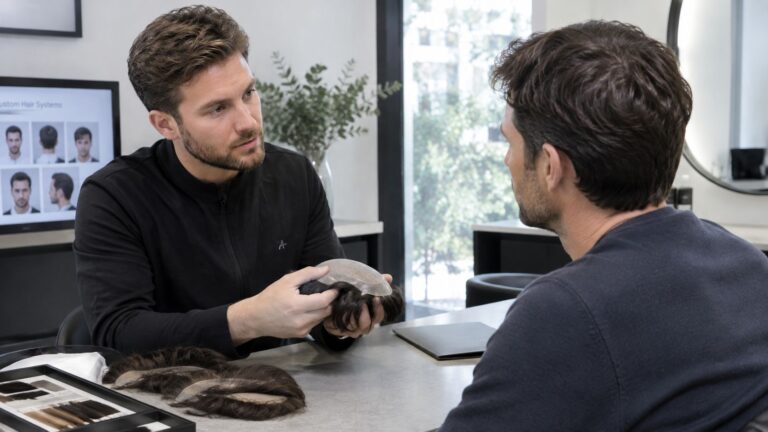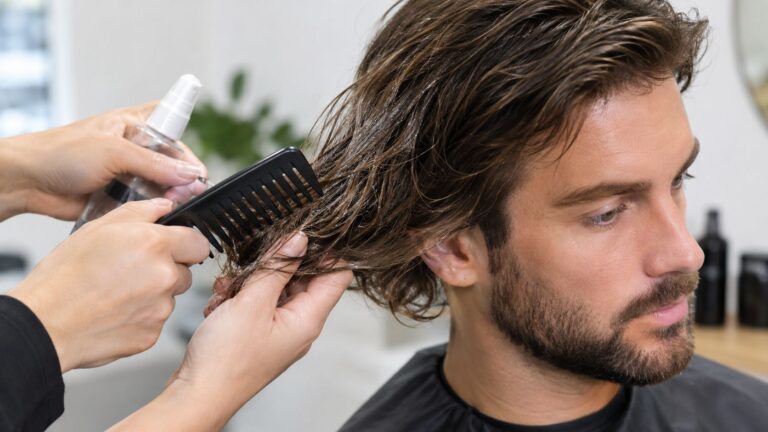


Yes, hair replacement systems are a genuinely good solution for the right person. When custom-fitted and properly maintained, a modern system delivers a natural-looking, full head of hair immediately, with no surgery and no recovery period. They are not, however, the right solution for everyone, and “good” depends entirely on what you need from them. This is an honest assessment of what they do well, where they fall short, who they genuinely suit, and what real results look like written without the bias of a clinic trying to sell you one specific option.
What “Good” Actually Means for a Hair System
Before getting into pros and cons, it’s worth being specific about what you’re evaluating. A hair replacement system is not trying to be a hair transplant, and it’s not trying to be a medical treatment. It is a non-surgical cosmetic solution that covers hair loss immediately, looks natural when fitted correctly, and requires ongoing maintenance to stay that way.
Judged on those terms immediate coverage, natural appearance, lifestyle compatibility, and ongoing commitment a well-fitted system performs very well. Judged against a standard it was never designed to meet permanence, zero maintenance, or replacing lost follicles it will always disappoint.
The most common source of dissatisfaction with hair systems isn’t the technology. It’s a mismatch between what the person expected and what a system is actually built to deliver.
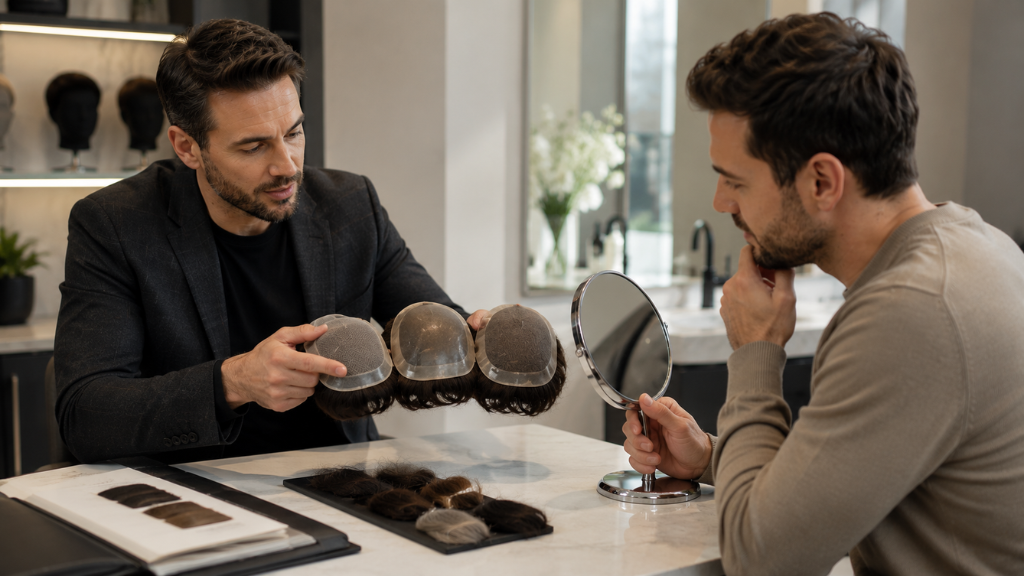
The Genuine Pros
Immediate, same-day results
This is the single most significant advantage a system has over every other hair loss solution. You attend a fitting and leave with a full head of hair. There is no waiting period, no recovery stage, and no phase of looking worse before looking better.
For someone whose hair loss is affecting their confidence, professional life, or mental health right now not in twelve to eighteen months this matters enormously. Hair loss is estimated to affect around 8 million women and half of all men over 50 in the UK alone, according to NHS guidance and for many, the psychological impact is significant well before loss reaches an advanced stage.
Natural appearance when fitted correctly
A properly colour-matched, custom-fitted system is designed to be undetectable. Modern base materials including fine French lace, Swiss lace, polyurethane (PU/skin) bases, and monofilament each replicate scalp texture differently, and the right base choice for your scalp type and lifestyle is as important as the colour match itself. Hairlines move naturally, and the hair itself when European Remy or Indian Remy human hair is used can be washed, cut, and styled exactly like your own.
The caveat is consistent throughout: the quality of the result is almost entirely determined by the quality of the colour-matching, density matching, and base selection, not the technology itself. A well-executed fitting by an experienced technician produces results that are genuinely indistinguishable from natural hair at normal social distances. A poorly matched, off-the-shelf system produces the “obvious hairpiece” result that feeds most of the scepticism around systems.
> Pro Tip: When assessing a studio, ask specifically how they match colour and density and whether they do it in natural daylight or under artificial salon lighting. Daylight matching produces significantly more accurate results.
Works at any stage of hair loss
Unlike a hair transplant, which requires sufficient donor hair and is limited by how much coverage can be achieved from your available follicle supply, a hair system works regardless of how far hair loss has progressed. Early thinning, significant recession, complete baldness in certain areas, and conditions like alopecia can all be addressed with a system. Coverage is not constrained by biology, donor supply, or the stage of loss. We cover how systems work for alopecia specifically in our alopecia solutions guide.
Reversible and low risk
Nothing about wearing a hair system is permanent. If the style, colour, density, or base type isn’t right, it can be adjusted or changed. If you decide a system isn’t for you, you stop wearing one. There is no surgical risk, no anaesthetic, no recovery period, and no decision that cannot be undone.
This makes a system a genuinely useful option for people who want to try having a full head of hair before committing to a permanent solution, something a transplant cannot offer.
Works where transplants cannot
For people with alopecia, insufficient donor hair, or hair loss patterns that a transplant cannot adequately cover, a system is often the only viable cosmetic solution. It does not depend on what follicles remain or whether the scalp can support surgical intervention. Scarring alopecias in particular where follicle damage is permanent are a situation in which hair systems represent one of the few reliable cosmetic options available.
> Key Takeaway: Hair replacement systems offer something no other hair loss solution can: an immediate, natural-looking result with no surgery, no recovery, and no permanent commitment. Their suitability depends on the person, the fitting quality, and a realistic understanding of the ongoing maintenance involved.
The Genuine Cons
Ongoing maintenance is non-negotiable
> Important: This is the most undersold aspect of hair systems and the most common source of dissatisfaction. Read this section carefully before making a decision.
A hair system requires professional re-bonding every one to four weeks, a system-specific washing routine every one to two weeks, and unit replacement every three to six months. There are product rules, lifestyle considerations, and a servicing schedule that becomes part of your routine indefinitely.
This is not a one-off purchase. It is an ongoing commitment in both time and cost. For people who are prepared for this, it becomes routine quickly. For people who expected something closer to “fit and forget,” it is a consistent source of frustration. Our complete maintenance guide covers exactly what the routine involves day to day.
Cumulative cost over time
The upfront cost of a system is relatively accessible, typically a few hundred to around a thousand pounds for the initial fitting and unit. The ongoing cost servicing, unit replacement, and professional appointments over months and years adds up significantly. Over a five-year period, cumulative maintenance costs often exceed the one-off cost of a hair transplant for a suitable candidate.
This does not make systems of poor value, it makes them a different kind of financial commitment than a one-off procedure. For a full cost breakdown, see our London pricing Page.
The unit eventually needs replacing
Every system has a lifespan typically three to six months per unit with proper care. The hair does not grow; it is the same hair at the end of the unit’s life as at the beginning, just subject to months of washing, styling, and environmental exposure. As units age, the hair quality and base integrity decline, and at some point the unit needs replacing rather than servicing.
This is manageable and expected but it is fundamentally different from the experience of natural hair, and it is worth being clear-eyed about that before committing.
Results depend heavily on the fitting quality
A system is only as good as the technician who fits it. Colour-matching done in poor lighting, density that doesn’t match the surrounding hair, a hairline mapped without considering future hair loss progression, an adhesive not suited to your skin type, or a base chosen without factoring in your activity level all of these produce results that underwhelm. The technology is capable of producing excellent results consistently; the execution is what varies.
This is one of the strongest arguments for in-person fitting over mail-order systems, and for doing proper due diligence on the studio before booking. Ask to see real client results not stock photography and specifically results on people with a similar hair type, skin tone, and haircut to your own.
Pros and Cons at a Glance
| Pros | Cons |
| Immediate, same-day results | Ongoing maintenance required |
| Natural appearance when correctly fitted | Cumulative long-term cost |
| Works at any stage of hair loss | Unit needs replacing every 3–6 months |
| Non-surgical no recovery period | Result quality depends on fitting expertise |
| Reversible no permanent commitment | Learning curve with care routine initially |
| Works where transplants cannot | Lifestyle adjustments needed |
| Flexible style and coverage can change | Not a permanent solution |
| Suitable for alopecia and scarring conditions | Adhesive sensitivity possible in some individuals |
What Real Results Actually Look Like
Scalp preparation matters before the conversation about results even begins. A clean, properly prepared scalp free of oil, product residue, and dead skin is the foundation of a bond that holds well and a result that looks natural from day one. Studios that skip a thorough scalp prep at fitting tend to produce shorter bond life and less clean hairlines.
Real results from hair replacement systems sit in three categories and being honest about all three is more useful than only showing the best outcomes.
Strong results: A client with significant hairline recession, properly colour-matched and fitted with the right base for their scalp and lifestyle, leaves the fitting looking like they never lost the hair. Their barber may or may not know often they don’t, particularly with longer styles. Confidence changes measurably. This is the most common outcome from a good studio.
Adequate results: A client whose colour or density match is slightly off, or whose base type wasn’t optimally chosen for their lifestyle, gets a result that looks natural from a distance but draws second glances up close or in certain lighting. This is fixable usually at the next appointment with adjustments but it illustrates why the fitting process matters.
Poor results: A client who ordered a system online without in-person colour-matching, or who chose a studio primarily on price, gets a result that looks obviously like a hairpiece. This is where most of the negative reviews and YouTube horror stories come from not the technology, but the execution.
The common thread in strong results is not the price of the system. It is the quality of the colour-matching and density matching, the experience of the technician, the accuracy of the base and adhesive choice for that person’s specific scalp and lifestyle**, and the thoroughness of the scalp preparation before fitting**.
> Comparison Callout: The gap between a strong result and a poor result is almost never the system itself, it is the studio, the process, and the technician. Two clients with identical hair loss can have entirely different outcomes depending on where and how they were fitted.
Who Hair Replacement Systems Are Genuinely Good For
- Men and women at any stage of hair loss who want an immediate result
- People who are not good candidates for a hair transplant insufficient donor hair, alopecia, ongoing progression, or younger men whose pattern hasn’t stabilised
- Anyone who wants to try a full head of hair before making a permanent decision
- People for whom surgery is not an option due to health, anxiety, or personal preference
- Anyone needing a result on a specific timeline a wedding, a new job, or simply now rather than in eighteen months
- People with sensitive scalps water-based adhesives and skin-friendly bonding options make systems viable for most skin types when the right products are used
Who They Are Not the Right Fit For
- People expecting a permanent, zero-maintenance solution that is a transplant, not a system
- Anyone not willing to commit to a consistent care routine and regular professional appointments
- People who have done no research and expect the result to look natural regardless of fitting quality
- Anyone making the decision reactively without understanding the ongoing commitment involved
The Honest Assessment
Hair replacement systems are good and they are also frequently misrepresented, both by studios that oversell them and by critics who judge them against standards they were never designed to meet.
The honest position is this: for the right person, with the right fitting, and a realistic understanding of the ongoing commitment, a hair system is an excellent solution. The result is immediate, the appearance is natural, and the flexibility is unmatched by any other option. For the wrong person, someone expecting permanence or zero maintenance, the same technology produces frustration rather than satisfaction.
The decision should not be made on enthusiasm alone. It should be made with a clear understanding of what the commitment involves which is exactly what a good first consultation is for. Comparing a system honestly against a transplant is also worth doing before deciding; our hair system vs hair transplant guide covers that in full.
> Key Takeaway: Hair replacement systems are a genuinely effective solution when properly fitted and maintained. Their limitations, ongoing cost, unit lifespan, and maintenance commitment are real but manageable. The strongest predictor of a good outcome is the quality of the studio and technician, not the price of the system.
Frequently Asked Questions
Are hair replacement systems good — answers to the most common questions
Are hair replacement systems good?
Yes, for the right person. A well-fitted, custom-matched system delivers immediate, natural-looking results with no surgery. The trade-off is ongoing maintenance — professional re-bonding every 1–4 weeks and unit replacement every 3–6 months. For people who understand and accept that commitment, systems consistently deliver strong results.
Do hair replacement systems look real?
Yes, when properly colour-matched, density-matched, and fitted by an experienced technician. The most common cause of an unnatural result is poor fitting or colour-matching — not the technology itself. The base material also plays a role — fine French lace produces the most natural hairline appearance, while PU/skin bases offer more durability. In-person fitting produces significantly better results than mail-order systems.
What are the downsides of hair replacement systems?
The main downsides are ongoing maintenance, cumulative long-term cost, and the fact that every unit has a lifespan of 3–6 months before it needs replacing. They are not permanent, and the commitment involved is greater than many people initially expect.
Are hair systems worth the money?
That depends on your timeline and priorities. Upfront cost is relatively accessible compared to a transplant. Over five or more years, cumulative maintenance costs typically exceed the one-off cost of a transplant for a suitable candidate. For people who are not transplant candidates, or who want immediate results, systems represent strong value for what they deliver.
Can a hair system damage your natural hair?
A properly fitted system using appropriate adhesive should not damage remaining natural hair. Poor removal technique — pulling the base away without bond remover — can cause scalp irritation or stress on surrounding hair. If you have a sensitive scalp or existing skin condition, discuss this at your consultation — water-based or hypoallergenic adhesives are available and may be a better fit.
How do hair systems compare to hair transplants?
Systems deliver immediate, reversible results with ongoing maintenance; transplants are permanent but require surgery, 12–18 months to see full results, and sufficient donor hair. Neither is universally better — the right choice depends on your specific situation. Our full comparison guide covers the cost, recovery, candidacy, and long-term reality of both options side by side.
Are hair replacement systems suitable for women?
Yes. The core technology is the same, though density, hairline shape, and styling are approached differently for women. Women’s hair loss patterns and causes also differ meaningfully from men’s — including diffuse thinning, traction alopecia, and hormonal loss — which affects how a system is designed and fitted.
Can I style or colour a hair replacement system?
Yes, if the system uses human hair. European Remy and Indian Remy human hair systems can be blow-dried, straightened, curled, and in many cases toned or coloured — though any chemical treatment should be carried out by your technician rather than at home, as over-processing shortens the unit’s lifespan. Synthetic hair systems cannot tolerate heat tools or chemical colouring under any circumstances.
How do I find a good hair system technician in London?
Look for a studio that offers in-person consultation and colour-matching — not just a system ordered from photos. Ask to see real client results specifically from people with a similar hair type and haircut to yours. A reputable studio will be transparent about the full cost including ongoing servicing, and will build a maintenance schedule into your plan from the first appointment.
Do hair systems cause scalp problems?
Not when fitted and maintained correctly. Keeping the scalp clean between re-bonding appointments, using appropriate adhesives for your skin type, and following a proper removal process all prevent irritation. If you experience persistent redness, itching, or odour under the base, book a check-in appointment rather than continuing to wear the system — these are signs the bond or adhesive needs attention.
Ready to Find Out If a System Is Right for You?
The most useful thing you can do before making any decision is see a properly fitted system in person not in a YouTube video, not in stock photography, but on your own hairline, matched to your own hair. A first consultation at The Hair Standard is free, carries no obligation, and gives you a realistic picture of what a system would look like for your specific hair, scalp, and lifestyle including an honest assessment of whether it is genuinely the right option for you. Book your free consultation here.