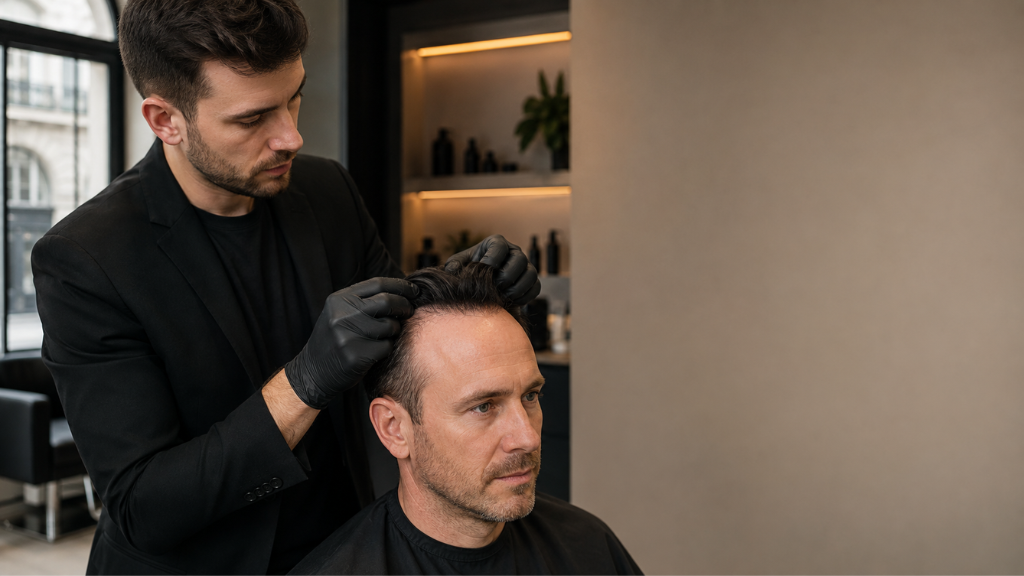

Non-surgical hair replacement systems are custom-made hairpieces built on a lace, skin, or monofilament base that attach to the scalp using medical-grade adhesive or tape, with no surgery, no anaesthetic, and no recovery period. They are the most immediate, reversible solution available for hair loss at any stage. If you are researching hair loss options and want to rule out surgery entirely whether due to personal preference, a medical reason, or simply because you want results now rather than in twelve to eighteen months this guide covers everything you need to know before taking the next step.
Why People Search “Non-Surgical Hair Replacement”
Most people who search this phrase are not yet familiar with the term “hair system” or “hair unit.” They know two things: they have hair loss they want to address, and they do not want surgery. The search is about ruling something out as much as it is about finding something specific.
That matters, because it shapes what this guide needs to cover. If you have arrived here from that starting point knowing you want a non-surgical solution but not yet knowing exactly what that looks like this is the right place to begin. By the end, you will understand what your options actually are, what separates a hair replacement system from other non-surgical alternatives, and what the process of getting one fitted involves.
The Non-Surgical Hair Loss Landscape
“Non-surgical hair replacement” covers a wider range of products than most people realise. Here is how the main options compare and why hair replacement systems sit at the premium end of the category.
Hair fibres and concealers
Products like keratin fibres bind electrostatically to existing hair strands, building the appearance of density in thinning areas. They are effective for early-stage thinning where some hair remains, fast to apply, and completely temporary. They wash out and need daily reapplication. They cannot address significant hair loss or complete baldness in an area there needs to be existing hair for the fibres to cling to.
Hairpieces and clip-in toppers
Toppers are partial hairpieces designed to cover specific areas of thinning most commonly the crown and clip into surrounding natural hair. They are removable daily and suit people with moderate thinning who want to add coverage and volume in one specific area rather than across the whole scalp.
Full wigs
A wig covers the entire head. Modern wigs particularly lace-front wigs can look natural, but they are not fitted to your specific hair loss area, colour-matched to your remaining hair, or blended with your natural hairline in the way a custom system is. They tend to suit people with complete hair loss across the scalp rather than those with partial loss who want seamless coverage.
Custom hair replacement systems
A hair replacement system sits at the top of the non-surgical category. Unlike off-the-shelf options, every element is specific to you: the base size is mapped to your exact area of loss, the hair colour and density are matched to your remaining natural hair in person, and the system is bonded directly to the scalp rather than clipped onto surrounding hair. The result when fitted correctly is indistinguishable from natural hair at normal social distances, including at the hairline.
This is the option this guide focuses on, because it is the one that addresses hair loss at any stage and produces the most natural, seamless result.
What Makes a Hair Replacement System Genuinely “Non-Surgical”
The distinction sounds obvious, but it is worth being specific particularly for anyone who has been researching hair transplants alongside non-surgical options.
A hair transplant is a surgical procedure. It takes place under local anaesthetic, lasts several hours, involves a recovery period of one to two weeks, and produces results that take six to eighteen months to become fully visible. It is permanent, which is both its main advantage and its main limitation.
A hair replacement system involves none of this. There is no incision, no anaesthetic, no healing stage, no period of looking worse before you look better. You attend a consultation, your system is custom-made, and you attend a fitting appointment where the system is bonded, cut, and styled. You leave with a full head of hair the same day.
For a full side-by-side comparison of what each option delivers and what it costs over time, see our hair system vs hair transplant guide.
Who Non-Surgical Hair Replacement Is Best Suited To
The non-surgical route suits a wider range of people than most assume:
People who cannot have a transplant: A hair transplant requires sufficient donor hair follicles at the back and sides of the scalp that are genetically resistant to hair loss and can be transplanted into thinning areas. If your donor supply is insufficient to cover the area of loss, or if your hair loss is still actively progressing (making a transplant premature), a system is often the only viable cosmetic option.
People with alopecia: Alopecia areata, alopecia totalis, scarring alopecias, and traction alopecia each present differently, but all can be addressed with a hair replacement system regardless of the pattern of loss. Transplanting into scalp affected by active alopecia is generally unreliable; non-surgical systems work independently of what is happening at the follicle level.
People who want immediate results: The most common reason people choose a system over a transplant when both are technically available to them is timing. A transplant takes a year or more to show its final result. A system produces a result the same day as fitting.
People who want to try before committing permanently: Because a system is completely reversible, it allows someone to live with a full head of hair to understand what that actually feels like day-to-day before deciding whether a permanent surgical solution is worth pursuing. This is a genuinely useful option that a transplant cannot replicate.
People for whom surgery is not an option: Health conditions, medication, anxiety around surgery, or simply a preference to avoid it entirely are all entirely valid reasons to choose the non-surgical route. The system does not require surgery to work.
Women: Female hair loss is systematically underserved by transplant clinics. The diffuse thinning pattern common in women makes donor extraction more complex, and many women are not straightforward transplant candidates. Non-surgical systems are well-suited to women’s hair loss patterns and are available in densities and coverage areas designed specifically for female use. Our dedicated women’s hair replacement guide covers this in full.
The Non-Surgical Fitting Process
For anyone coming to this completely fresh, here is what the process actually involves from first enquiry to leaving with a fitted system.
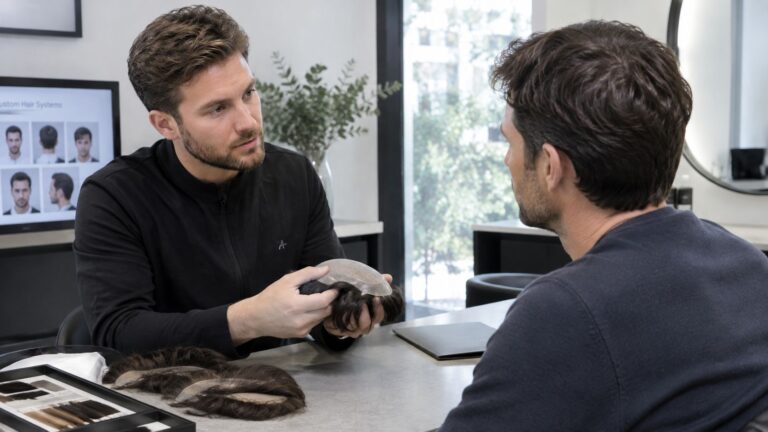
Consultation: The starting point. Your hair loss pattern is assessed, your lifestyle is discussed (sport, swimming, work environment), and your goals are established. This is also where colour and density matching begins — your remaining natural hair is used as the reference point.
System selection: Based on the consultation, the right base type is chosen for your scalp and lifestyle. The three main options are lace (most natural-looking hairline, more delicate), skin or polyurethane (more durable, thinner profile), and monofilament (a balance of both). Each has different care requirements — covered in full in our types of systems guide.
Custom manufacturing: Your system is made to specification — the base size matched to your area of loss, the hair matched to your colour and texture. This typically takes a few days to a few weeks depending on the system specification.
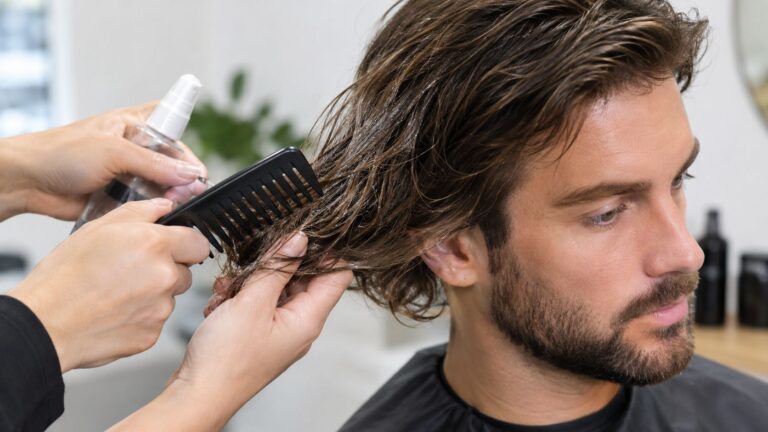
Fitting: The system is bonded to the scalp using medical-grade tape or liquid adhesive, then cut and styled on your head not pre-styled. This is what produces a result that looks like your own hair rather than a hairpiece. You leave the same day with the system fitted and a full aftercare briefing.
Ongoing maintenance: The bond needs professional re-doing every one to four weeks depending on the attachment method and your lifestyle. The unit itself typically lasts three to six months before replacement. The full maintenance routine is covered in our complete aftercare guide.
Non-Surgical Hair Replacement for Men vs Women
The core technology is identical; the differences are in how systems are designed, fitted, and styled for each.
For men: Male pattern baldness follows a predictable progression, which means a system needs to be planned with future hair loss in mind, not just today’s hairline. Haircut compatibility matters significantly fade haircuts and short crops require more precise blending at the perimeter than longer styles. The men’s London guide covers the male-specific considerations in full.
For women: Female hair loss more commonly presents as diffuse thinning rather than a clearly defined area of recession. Systems for women are typically designed around higher density and natural parting rather than a defined hairline. The causes of hair loss in women — hormonal changes, traction alopecia, diffuse alopecia also differ from male pattern baldness, which affects both the coverage area and the system specification.
What Does a Non-Surgical Hair Replacement System Actually Look Like?
This is the question most people want answered but feel awkward asking.
A well-fitted, correctly colour-matched hair replacement system is designed to be indistinguishable from natural hair. That includes the hairline the base material replicates the appearance of the scalp at the perimeter, so there is no visible edge where the system ends and the skin begins.
The hair itself moves, parts, and catches light the same way natural hair does, because on human hair systems it is real hair matched to your texture and styled on your head rather than pre-set. You can wash it, brush it, and sleep in it.
The honest caveat: the quality of the result is almost entirely determined by the quality of the colour-matching and fitting, not the technology itself. A poorly matched, off-the-shelf system ordered online produces the “obvious hairpiece” result. A properly matched, in-person fitted system from an experienced technician produces a result that your barber, your colleagues, and casual observers will not identify. The difference is the fitting, not the concept.
For a more detailed breakdown of what real results look like strong, adequate, and poor see our guide on whether hair replacement systems are actually good.
How Much Do Non-Surgical Hair Replacement Systems Cost?
Cost has two components: the upfront fitting and first unit, and the ongoing maintenance.
The upfront cost consultation, first unit, and fitting typically ranges from a few hundred to around a thousand pounds depending on the base type, hair quality, and studio. Human hair systems cost more than synthetic. Lace bases are generally higher cost than skin bases at the unit level.
The ongoing cost of professional re-bonding appointments and periodic unit replacement is the larger long-term commitment. Over a year, the total maintenance cost is typically in the range of several hundred to a few thousand pounds depending on how often you re-bond and how long each unit lasts.
Over five or more years, the cumulative cost of a non-surgical system often exceeds the one-off cost of a hair transplant for a suitable transplant candidate. For people who are not transplant candidates or who want immediate, reversible results a system’s value is not purely in the cost comparison.
Our dedicated cost guide covers the full pricing breakdown including what affects the cost, how to compare quotes accurately, and what the ongoing commitment looks like in practice.
Frequently Asked Questions
Non-surgical hair replacement systems, answers to the most common questions
What is a non-surgical hair replacement system?
A non-surgical hair replacement system is a custom made base, typically lace, skin, or monofilament, with human or synthetic hair attached, bonded directly to the scalp using medical grade adhesive or tape. It covers hair loss at any stage with no surgery, no anaesthetic, and no recovery period. The result is visible the same day as fitting.
Who is a non-surgical hair replacement system suitable for?
Anyone with hair loss at any stage including people who are not suitable for a hair transplant due to insufficient donor hair, active alopecia, or ongoing hair loss progression. Non-surgical systems also suit people who want immediate results, those who want a reversible option before committing to surgery, and anyone for whom surgery is not a preference or a medical option.
How natural does a non-surgical hair replacement system look?
When properly colour matched and fitted by an experienced technician, a system is designed to be indistinguishable from natural hair including at the hairline. The quality of the result depends almost entirely on the fitting process rather than the technology itself. In person fitting produces significantly better results than mail order or off the shelf systems.
Is a non-surgical hair replacement system permanent?
No, and that is one of its main advantages. A system is completely reversible. The bond is redone every one to four weeks, and the unit is replaced every three to six months. There is no surgical commitment, and the coverage area, density, and style can be adjusted at any point.
How is a non-surgical system different from a wig?
A wig covers the entire head and is not fitted to your specific area of hair loss. A hair replacement system is mapped precisely to your loss area, colour matched to your remaining hair in person, and bonded directly to the scalp producing a seamless result rather than a full head covering. The distinction is significant in terms of natural appearance, particularly at the hairline.
Can women use non-surgical hair replacement systems?
Yes. Non-surgical systems are well suited to female hair loss patterns, including diffuse thinning, traction alopecia, and hormonal hair loss. Systems for women are designed around different density requirements and parting positions than men’s systems. Our women’s hair replacement guide covers the female specific options in detail.
What is the maintenance commitment for a non-surgical system?
The adhesive or tape bond needs professional redoing every one to four weeks. The system itself is washed every one to two weeks using system specific products and replaced every three to six months. The full routine is covered in our maintenance and aftercare guide.
How do I know if a non-surgical system is right for me?
The most useful first step is an in person consultation where your hair loss pattern, scalp, lifestyle, and goals are assessed and you can see the fitting process in person before committing. Book a free consultation at The Hair Standard in London and we’ll give you an honest assessment of whether a system is the right option for your situation.
Book a Free Non-Surgical Hair Replacement Consultation in London
If you are researching non-surgical options and want to see what a properly fitted system actually looks like on your hairline, not in a photograph, not on a model, but matched to your own hair and scalp, a consultation is the only way to get a genuinely accurate picture.
At The Hair Standard, consultations are free and carry no obligation to proceed. We assess your hair loss pattern, discuss your lifestyle honestly, and show you what the system would look like before you commit to anything.
Book your free consultation here or visit our London hair replacement page for more detail on what a fitting involves.