
Hair Replacement Systems for Men: Male hair loss follows a different pattern than women’s, shows up earlier on average, and comes with its own set of practical concerns: gym culture, sport, short haircuts, beard fade lines, and a daily commute that often involves cycling helmets or a packed Tube in summer heat. This guide focuses specifically on what men in London need to know before choosing a system: why male pattern hair loss behaves the way it does, the hesitations most men have before booking, the lifestyle factors that actually affect which non surgical hair replacement system suits you, real local pricing, and how to vet a studio properly. For the general explainer on how systems work and how long they last, those are covered in full in our foundational guide and lifespan breakdown this post won’t repeat that ground.
Why male hair loss is different
Most male hair loss is androgenetic driven by DHT sensitivity in hair follicles which is why it tends to follow a fairly predictable pattern rather than showing up randomly. It’s also extremely common: a large proportion of men show some visible thinning by their mid-30s, and the majority have noticeably thinner hair by their 50s. This matters for system fitting in a few specific ways:
- The pattern is usually progressive, so a system needs to be planned with future loss in mind, not just today’s hairline. A technician fitting a system around a current widow’s peak, for example, should account for likely further recession rather than fitting tightly to where the hairline sits right now.
- Hairline shape matters more for men’s styles. Many men’s haircuts fades, crops, slicked-back styles put the hairline on full display in a way longer hairstyles simply don’t. There’s nowhere for an imperfect blend to hide.
- Crown coverage is a common blind spot. Men often fixate on the hairline and underestimate how much crown thinning affects overall density and how the hair looks from behind, something barbers notice long before the person wearing it does.
A good London fitting accounts for all three, rather than treating “men’s system” as a single generic product applied the same way regardless of pattern or style.
The hesitations most men have before booking
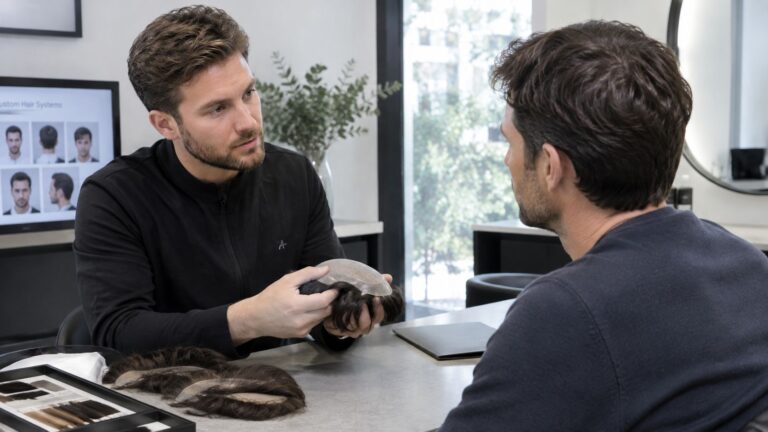
It’s worth naming this directly, because it’s usually the real barrier, not the technology. Common concerns we hear at consultation:
- “Will my mates/colleagues notice?” The goal of a properly fitted, colour-matched system is that they don’t. Most men who notice a hairpiece are noticing a poorly matched one, not the concept itself.
- “What happens in the gym changing room or at the pool?” This is a genuinely fair concern, and it’s exactly why attachment method and base type get chosen around your real lifestyle, not assumed.
- “Is this something only older men do?” no. Hairline recession and early thinning bring plenty of men in their 20s and 30s through the door, often specifically because they want to deal with it before it progresses further.
- “What if I hate it or it doesn’t suit me?” This is one of the genuine advantages systems have over a transplant: nothing here is permanent. If the style, colour, or coverage isn’t right, it can be adjusted or redone in a way surgery can’t be undone.
Talking through these openly at a first consultation, rather than glossing over them, is usually what turns hesitation into a booking.
London lifestyle factors that affect which system suits you
This is where London specifically not just “men” generically actually changes the recommendation:
- Cycling and helmets. A huge number of Londoners commute by bike. A system needs to handle daily helmet pressure and sweat without shifting or rubbing at the bond line, which affects both base choice and attachment method.
- Tube commutes in summer. Central line carriages in July are genuinely hot. Heavy daily sweat exposure points toward a more secure, sweat-resistant adhesive rather than a lighter hold.
- Gym and sport culture. Whether it’s a lunchtime gym session near the office or weekend football, frequent sweating and washing accelerates bond wear, something we plan the servicing schedule around rather than discovering after the fact.
- Swimming and sauna use. Several London gyms include pools, saunas, and steam rooms as standard. Chlorine and heat both affect bond longevity differently, and we factor this into the attachment recommendation if it’s part of your routine.
- Work environment. A finance or corporate role with a sharp, structured haircut has different blending requirements than a more casual, longer style that comes back to the hairline visibility point above.
None of this is exotic it’s just the day-to-day reality of living and working in London, and it’s exactly the kind of detail a generic, mail-order system can’t account for.
Hair Replacement systems for men vs other options men consider
Before landing on a system, most men have already looked at minoxidil, finasteride, or a transplant. Briefly:
- Minoxidil/finasteride can slow loss or partially regrow hair for some men, but results are gradual, ongoing, and not guaranteed for everyone
- Hair transplant permanent, but requires sufficient donor hair, surgery, and months of recovery before full results show
- Hair replacement system immediate, reversible, and works regardless of donor hair availability or how far the loss has progressed
We compare transplants and systems in full detail in our dedicated comparison post if you’re still deciding between the two.
How well do systems work with common men’s haircuts?
This is one of the most underrated parts of fitting a system for men the haircut itself changes what “good blending” requires:
| Haircut | Compatibility | What it needs |
| Buzz cut / very short | Challenging | Extremely precise base edge matching; little room to hide the perimeter |
| Skin fade | Moderate | Careful density tapering to match the fade gradient |
| Crop / textured crop | Good | Natural movement at the fringe; lace or mono bases work well |
| Slicked back | Good | Strong hairline definition; skin or lace base depending on shine preference |
| Quiff | Good | Height and volume at the front; density matched for styling support |
| Longer/structured styles | Easiest | More hair length to blend the base edge into |
Buzz cuts and tight fades genuinely are the hardest to fit well there’s no length anywhere to disguise an imperfect edge which is exactly why an experienced London-based fitting matters more for these styles than for longer hair.
What a London fitting gets you that mail-order doesn’t
It’s tempting to order a cheaper system online, but for men specifically, in-person fitting solves problems mail-order genuinely can’t:
- Matching to your actual haircut, not just hair colour a skin fade needs different blending at the perimeter than a quiff does
- Adjusting for visible scalp tone under short hair, which photos and online colour charts don’t capture accurately
- Beard and eyebrow colour consistency technicians can match your system to your overall colouring, not just an isolated hair sample
- Real-time adjustments if the density or hairline looks slightly off once fitted, it can be corrected on the spot rather than shipped back and forth
What it costs hair replacement for men in London
Men’s systems sit within the same general price bracket as other custom units driven mainly by base type and hair quality rather than gender but London studio fittings typically include the colour-matching, haircut-specific blending, and ongoing servicing described above, which mail-order pricing usually doesn’t. For full price ranges, what affects them, and how packages compare, see our dedicated London pricing guide.
Choosing a studio hair replacement system for men in London
Before booking anywhere, it’s worth checking:
- In-person consultation and colour match versus a system ordered sight-unseen from photos alone
- Experience with male hairlines and short styles specifically not just systems in general; fades and crops need a different skill set than longer styles
- Real client results from men, not just generic stock photography
- Clear servicing plans ongoing re-bonding and check-ins should be part of the offer, not an afterthought
- Upfront cost transparency, including ongoing maintenance not just the headline price of the first unit
What changes after your first fitting
Most men describe the same general shift after a successful first fitting: less time thinking about their hairline day-to-day, more confidence in photos and video calls, and somewhat unexpectedly more willingness to try haircuts they’d avoided for years. None of that requires the result to be “perfect,” just consistently natural enough that it stops being something to think about.
Frequently Asked Questions
Can I still go to the gym, cycle, or play sport with a hair system?
Yes — most systems are designed to handle sweat and physical activity. Liquid adhesive tends to hold up best for high-activity lifestyles, including regular cycling or gym use; we’ll recommend the right attachment method based on your routine.
Do hair systems work with very short or faded haircuts?
Yes, but the hairline blending needs far more precision with short styles since there’s nowhere for the edge to hide. This is one of the main reasons in-person fitting matters more for buzz cuts and fades than for longer hair.
Is there a difference between systems for men and women?
The core technology is the same, but density, hairline shape, and styling are approached differently. Men’s systems are usually built around shorter, structured styles, while women’s systems are covered separately in our women’s guide.
I’m in my 20s/30s — is this too early to consider a system?
No. Plenty of younger men choose systems specifically to address early hairline recession before it progresses, rather than waiting until loss is more advanced.
Will people at work or the gym be able to tell?
Not if it’s properly colour-matched and fitted to your actual haircut. The most common reason a system looks unnatural is poor matching, not the system itself.
How do I find a reputable hair system specialist in London?
Look for in-person consultation, visible real male client results, haircut-specific experience, and a clear servicing plan — see the checklist above.
Book your consultation in London
If you’re ready to see what a properly fitted system looks like on your hairline and your haircut, book a free consultation with The Hair Standard in London.