
Custom fitting is the difference between a system that looks like it belongs on you and one that just looks like hair sitting on a head. That’s really the whole article in one sentence.
Everything below is the long version. Why that gap exists, and why London specifically makes it worse if you skip it.
Picture a packed Tube carriage. Someone’s elbow near your head. Rain that wasn’t there twenty minutes ago. A generically sized base has more room to move in moments like that. A properly fitted one doesn’t move at all, which is sort of the entire point.
People ask us why custom fitting costs more and takes longer than grabbing something closer to standard size. Fair question. Here’s the actual answer.
What Happens During a Custom Fitting
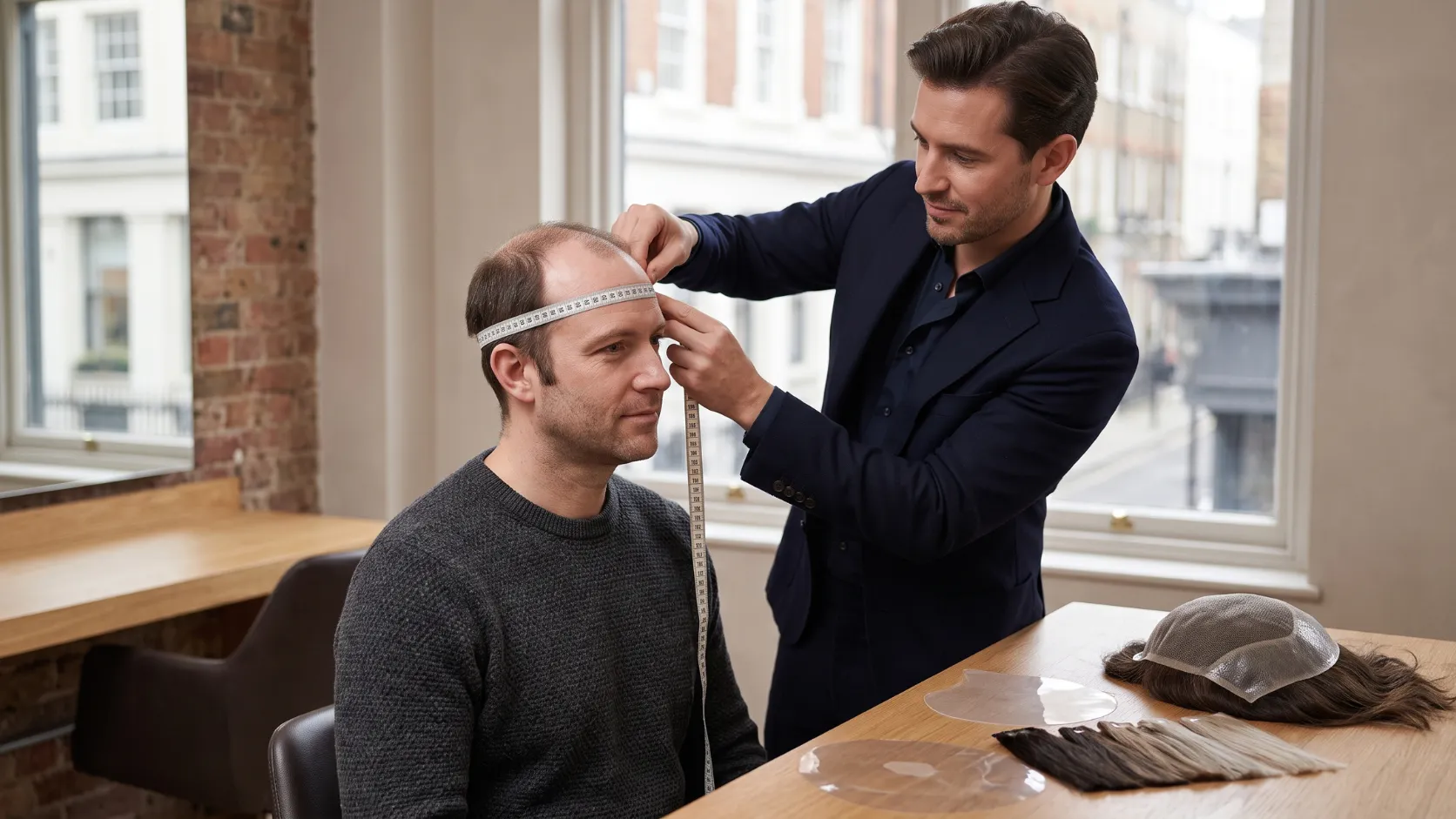
Someone measures your scalp. Your actual head, not a size that’s close enough. That happens in person at a consultation, or from detailed photos and measurements if getting to us isn’t realistic.
From there, three things get built around you specifically:
- The base gets shaped to fit your scalp, not a standard mould
- The hairline gets designed around how your own hair used to grow
- The colour gets matched, sometimes blended across two or three shades, to whatever natural hair you’ve still got
None of that happens off the shelf. A standard size works fine for some men, genuinely. But close enough isn’t fitted. That gap shows up fast the moment someone’s standing a few feet away instead of glancing across a room.
London Doesn’t Make This Easy
Long commutes. Long hours. Weather that changes its mind four times before lunch.
A generically sized base has more room to shift, lift at the edges, or feel insecure at exactly the wrong moment. Usually on a packed platform. Or halfway through a meeting you can’t leave.
A properly fitted base moves with you instead of against you. That matters here because city life doesn’t hand you a quiet five minutes to fix something that’s slipped. Our guide on hair replacement systems for men in London gets into what daily city life actually demands from a system.
The Hairline Is Where Bad Fitting Shows First
This is the biggest tell there is. A standard base comes with a standard hairline shape, and standard rarely matches a real one.
Real hairlines are uneven. Slightly asymmetric. Shaped by years of individual growth, not one neat curve someone drew on a template.
Custom fitting lets a technician build a hairline around your actual growth pattern, face shape, and age, instead of stamping the same curve on every head that walks through the door. How to make a hair system look more natural and why some hair systems look fake both go deeper into what separates convincing from obvious. Most of that groundwork starts right here, at fitting.
Comfort Isn’t a Bonus Feature
A base that doesn’t match your scalp puts pressure somewhere it shouldn’t. Sometimes that’s genuinely uncomfortable.
More often it’s quieter than that. Just a low hum of not-quite-right you don’t notice until you’ve worn a properly fitted system and felt the difference side by side.
Security runs alongside comfort here. A base shaped to your exact measurements holds evenly, which cuts the edge lifting that happens when a standard size is doing a job it was never really built for on your head specifically.
Feels tighter than expected after fitting? Our guide on why a hair system might feel tight after installation covers what’s normal settling and what’s actually worth flagging.
Does Custom Fitting Make a System Last Longer?
Mostly, yes.
Less about the base material itself, more about how evenly the wear spreads across it. A standard size that keeps getting trimmed and nudged into a better fit takes more stress at the edges over time than one built right from day one.
Our guide on how long hair replacement systems last covers the full picture. Short version, a well fitted base just has less working against it.
What Actually Goes Wrong Without It
A few things stack on top of each other pretty fast:
- An ill fitting base shows at the edges first, dragging exactly the attention you don’t want there
- Poor fit means more adjustments
- More adjustments means more handling
- More handling wears through adhesive and base material faster than it would otherwise
There’s a confidence cost too, and it’s real even though it’s harder to put a number on. Men who’ve worn a poorly fitted system before describe a background awareness of it. Checking mirrors more. Avoiding wind. Second guessing a moment a properly fitted system wouldn’t make them think about twice.
One of our clients told us he’d stopped cycling to work entirely. Nothing dramatic happened. He just never fully trusted the fit in traffic, so he quietly swapped the bike for the bus and never mentioned it to anyone until he came in for a refit. That’s the whole case for getting this right the first time, in one small story.
The Follow Up Visit Matters More Than People Expect
Fitting isn’t really a one time event, whatever it might look like from the outside.
There’s usually a follow up a few weeks after the first appointment. Scalps shift slightly during that stretch. Swelling from the initial fitting settles. A base that felt perfect on day one can need a small tweak by week three, and that’s completely normal.
This is also the appointment where a technician sees how you’ve actually been living in the system. Sleeping in it or not. How you’ve been washing it. Whether you’ve been swimming, or doing anything that’s put unusual stress on one particular edge.
A touch more tension at the nape here, a slight trim near the temple there. These small calls tend to matter more for long term comfort than most of what happens at the very first fitting.
Skip the follow up, and you’re guessing whether the fit that worked in a quiet consultation room still holds up after three real weeks of London life. Most men who skip it end up booking an unscheduled fix later anyway, usually for something a five minute adjustment would’ve sorted at the proper appointment.
Fitting and Base Type Are Two Different Decisions
They work together, but they’re not the same choice. Our guide on types of hair replacement systems runs through the base options, lace, poly, skin, and combinations of each. Custom fitting is what makes whichever one you pick actually sit the way it’s meant to, instead of just approximating it.
Hair choice follows the same logic. Human hair versus synthetic hair replacement systems is worth reading next to this one, since colour matching and density both depend on the fitting process to look right once everything’s actually put together.
Does Every Stage of Hair Loss Need This Level of Fitting?
It matters more the more coverage a system has to carry.
Crown thinning usually still has plenty of natural hair surrounding it, so fitting precision mostly decides how well things blend at the edges. Further along, getting a system before going completely bald or beyond that point, fitting carries even more weight. There’s simply less natural hair left to cover for a fit that isn’t quite right.
Is the Extra Cost Worth It?
Generally, yes, given it takes more time and far more individual attention than fitting something standard off a shelf.
Our hair system prices page sets out what’s usually involved cost wise. Whether it’s worth it to you specifically comes down to how long you plan on wearing a system and how much fit actually matters to your daily life. Most men who wear one regularly land on yes eventually. A proper consultation is really the only honest way to know for your own case.
Is a Hair System Worth Getting at All?
Worth settling before getting deep into fitting specifics. Is a hair system worth it for male pattern baldness and do hair replacement systems actually work both tackle that bigger question directly. Our non surgical hair replacement guide is a reasonable starting point if you’re still weighing this against other routes entirely.
My Current System Doesn’t Fit Right. Now What?
Often it’s a fitting problem wearing an adhesive problem’s clothes. Our guide on why a hair system isn’t sticking walks through the real causes. More often than people expect, refitting fixes it. Not a different adhesive brand. The fit itself.
Custom Fitting FAQs
How long does a custom fitting consultation take?
Long enough to measure properly, talk through base and hair options, and actually understand what you need day to day. Rush it, and that shows up later in how the finished piece fits.
Can I get custom fitting if I’m not based in London?
Often, yes, through detailed photos and measurements sent our way. Coming in person tends to get you the more accurate result, if that’s workable for you.
Will custom fitting fix a hairline that already looks obvious?
For a new system, yes. For an existing one that already looks off, that’s usually a refit, not a quick tweak.
Does choosing custom fitting lock me into one base type?
No. Separate decisions. A future system can run a completely different base if your needs change down the line.
Is custom fitting only relevant for full coverage systems?
No. It matters at every stage, early crown thinning through to significant hair loss. How much it changes the final look scales with coverage, but it’s never irrelevant.
Does a custom fitted system need adjusting as often as a standard one?
Less often, generally, since it’s built to your actual measurements from the start rather than needing ongoing correction for a fit that was never quite right to begin with.
Does London weather really affect how well a fitted system holds?
Less than it would on a poorly fitted one. A properly fitted base resists the lifting and shifting that weather and moisture tend to trigger on something looser.
Does a custom fitted system feel different to wear?
Yes. Most men notice it sits more securely with less edge awareness, especially once the initial settling in period has passed.
Does fitting take into account how I actually style my hair?
It should. A proper consultation covers your usual styling habits, since that shapes density, parting, and how the hairline’s designed to work with what you already do day to day.
Is custom fitting the same thing as a custom base?
Related, not identical. The base is built to your measurements. Fitting is the wider process, hairline design, density planning, colour matching, that makes that base actually work for you.
What if my head shape changes over time, say through weight change?
Worth raising at your next consultation or maintenance visit. A base fitted a while back might need reassessing if your scalp shape’s genuinely shifted since.
Can I ask for a specific hairline style?
Yes, within what’s realistic for your face shape and hair type. A good technician will steer you toward something that reads as natural rather than just building whatever’s asked for without context.
Does custom fitting help if I’m self conscious about wearing a system at all?
Often, yes. Most of that self consciousness comes from worrying the system looks obvious. Proper fitting is the direct answer to that specific worry.
How soon after my first consultation can I get fitted?
Depends whether you’re going custom straight away or starting closer to standard while you decide. Our guide on
getting your first hair system
covers what that first stretch usually looks like in practice.
Does custom fitting work the same for human hair and synthetic systems?
Yes. Fitting is separate from hair type. Whichever you choose, it goes through the same careful measuring and design process either way.
Book Your Consultation in London
Weighing custom against something off the shelf? Get in touch through our contact page and we’ll talk through what custom fitting would actually mean for your head and your hair, specifically, not generically. You can also browse our full range of hair systems, read about our process, check our maintenance guide for London, or find out more about who we are before booking in.