
Alopecia totalis is complete loss of scalp hair, caused by the immune system attacking the hair follicles. It’s different from traction alopecia or male pattern baldness in one important way: there’s usually no hair left anywhere on the scalp to work with. That changes what a hair system needs to do and how it’s built. Instead of blending into existing hair, a full system has to cover the whole scalp on its own, which means the base, the attachment and the skin underneath all matter more than they would for partial thinning.
This guide covers what alopecia totalis actually is, Our alopecia hair system page explains the options for patchy and total loss. what a full hair system involves, and what to expect from wearing one day to day. Hair Standard fits hair systems for men in London. It’s general information, not medical advice, and a dermatologist should confirm the diagnosis and discuss treatment options before you look at cosmetic coverage.
What alopecia totalis actually is
Alopecia totalis sits within a group of conditions called alopecia areata, where the immune system mistakenly attacks hair follicles. In its mildest form, alopecia areata causes small, round bald patches. Alopecia totalis is more severe: it means the loss of all hair on the scalp. A related condition, alopecia universalis, extends that loss to eyebrows, eyelashes and body hair as well.
It isn’t caused by anything the person did. It isn’t related to diet, stress alone, or hairstyles, though stress can sometimes be a trigger alongside genetic and immune factors that aren’t fully understood. Follicles affected by alopecia totalis are usually still alive, just switched off by the immune response, which is why some people do see regrowth over time, sometimes years later, while others don’t. There’s no way to predict which path any individual will take, and no treatment guarantees regrowth. A dermatologist can talk through options, which may include topical or injected treatments, and can also give a realistic sense of prognosis for your situation.
How alopecia totalis is usually diagnosed
Diagnosis typically starts with a GP or dermatologist looking at the pattern and speed of the hair loss. Alopecia areata often begins as one or more round, smooth patches, and in some people that progresses to cover the whole scalp over weeks or months. In others it stays as small patches for years and never progresses further. There’s no blood test that confirms alopecia areata on its own, so a clinician usually diagnoses it by examining the scalp, sometimes taking a closer look at the hair and follicles, and ruling out other causes of hair loss that can look similar, such as fungal infections or other autoimmune conditions.
Because the pattern varies so much between people, it’s worth getting a proper diagnosis rather than assuming. Some conditions that cause total or near total hair loss are treatable in ways alopecia areata isn’t, and some cases of alopecia areata respond to treatment better if caught and treated earlier. Either way, a dermatologist is the right starting point before deciding anything about a hair system.
Why a hair system for alopecia totalis is different
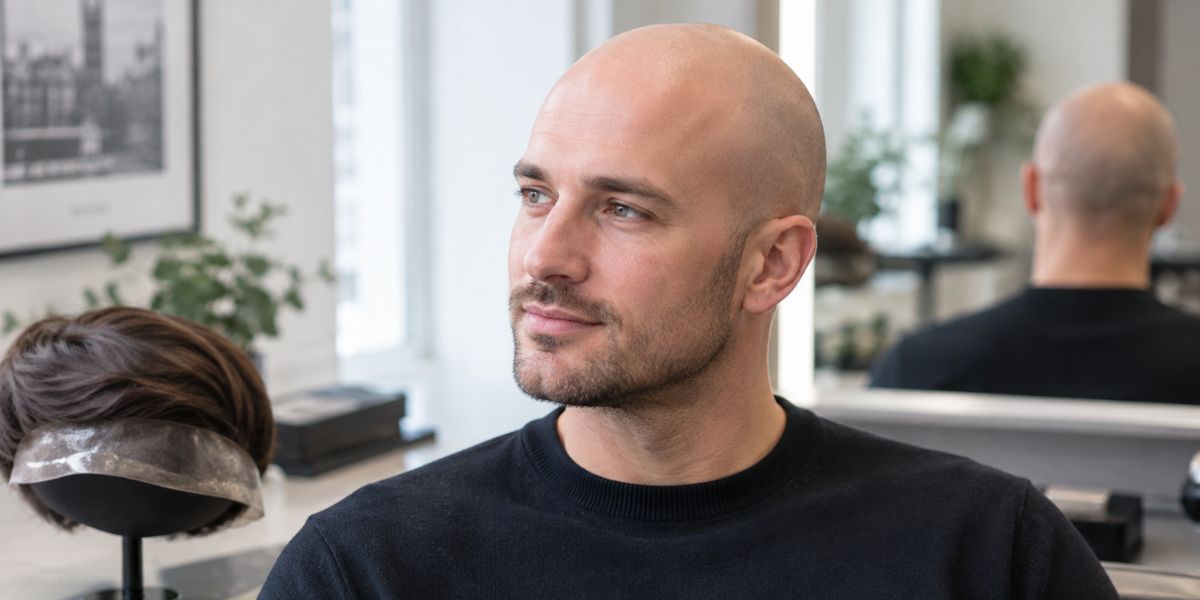
With patchy hair loss or a receding hairline, a system only needs to cover part of the head and blend into the hair that’s still there. With alopecia totalis, there’s no hair left to blend into. The whole scalp is bare, so the system has to look convincing entirely on its own, from every angle, in every light.
That changes several things about how it’s built and fitted. The base needs to cover the full scalp rather than a section of it. The hairline has to be created from scratch all the way round, not just at the front. And because there’s no hair anywhere to help hide the edges, the quality of the base material, the way it’s cut, and how it sits against the skin all carry more weight than they would for a smaller piece.
Skin condition matters more here too. Scalps affected by alopecia totalis can be more sensitive than scalps with follicles still active, and some men notice changes in oil production or skin texture once hair stops growing. A good fitting takes this into account rather than using the same approach as a partial system.
What a full hair system needs to get right
A full cranial system is built differently from a patch or a partial piece. The base usually needs to be light enough to wear comfortably all day, breathable enough that the skin underneath doesn’t overheat, and secure enough to stay in place through normal daily movement, without relying on natural hair to anchor it. Since it’s covering the whole scalp rather than blending at the edges, every part of it is visible, so the hairline, the parting, and the density all need to look right, not just the front.
The attachment method matters just as much. Because there’s no existing hair to hold the system in place, it relies entirely on the base and the adhesive or attachment system used. If skin sensitivity is a concern, that’s worth raising at the consultation, since it affects which materials and methods are suitable.
Colour, density and hair direction also need to be chosen rather than matched, since there’s no existing hair to match against. This is where a good consultation makes the biggest difference: getting these choices right the first time avoids a system that looks technically fine but doesn’t look like you.
Eyebrows, eyelashes and the wider picture
Alopecia totalis affects the scalp specifically, but some men with the condition also lose eyebrow and eyelash hair, particularly if the underlying condition progresses toward alopecia universalis. This isn’t something a scalp hair system addresses, but it’s worth mentioning at a consultation if it applies to you, since it can affect how a finished look reads overall. Options for eyebrows are a separate specialism to scalp hair systems, so if that’s relevant to you, it’s worth asking specifically rather than assuming it’s covered by the same process.
It’s also worth saying plainly that hair loss from alopecia totalis affects people in very different ways emotionally. Some men are mainly looking for a practical solution and don’t think about it much beyond that. Others find it genuinely difficult, particularly if the loss happened quickly or at a younger age. Both are completely normal responses, and a hair system doesn’t have to be the only thing you do about it. If the emotional side is weighing on you, that’s worth raising with a GP too, alongside the dermatology side of things.
Sensitivity, skin health and what to check before fitting
Because the whole scalp is involved, skin health deserves a proper look before anything is attached. If there’s any redness, irritation, flaking or soreness across the scalp, that needs addressing first, ideally with a dermatologist, before a system is worn.
Once the skin is settled, it’s worth asking specifically about breathability and how the system handles heat, since a bare scalp regulates temperature differently to one with hair. Ask how long the system can comfortably be worn between removals, what the attachment involves, and whether a patch test is available if you have any history of skin sensitivity or allergies. None of this is unusual to ask, and a good provider will expect the questions.
Getting used to wearing a full system
The first few days are usually the biggest adjustment. A full system feels different to how your own hair used to feel, and it takes a little time to stop noticing it. Most men find the awareness fades within one to two weeks as it becomes part of the daily routine rather than something new.
Day to day habits matter more with a full system than a smaller piece, simply because there’s more of it and it’s doing more work. Our guides on how to maintain a hair replacement system and how to clean a hair system cover the basics of keeping it looking right. For everyday questions, see can you sleep in a hair system and can you shower with a hair system. If you notice itching, our guide to why a hair system itches is worth reading early, since with full scalp coverage, itching is worth tracking rather than ignoring.
Making it look like it’s really yours
With no hair to blend at the edges, a full system stands or falls on how naturally the hairline and parting are built. A soft, slightly irregular hairline reads as real far more convincingly than a perfectly straight one, and the direction the hair grows around the crown and temples needs to look the way hair actually grows, not just lie flat in one direction.
Colour matching against nothing is harder than colour matching against existing hair, so it’s worth bringing reference photos of how your hair looked before, if you have them, or being clear about the colour, style and density you’re aiming for. Our guides on making a hair system look more natural, why a hair system can look fake and why a hair system doesn’t look natural in photos go through the details that usually give a system away, and the same points apply, often more so, to a full head system.
Styling a full system day to day
One thing men often don’t expect is that a full system can actually be styled much like real hair once it’s fitted well. It can be cut, shaped and adjusted over time to suit changing preferences, in a way that a static wig can’t. That means the first style you choose doesn’t have to be the one you’re stuck with permanently.
Day to day styling is usually simpler than people assume, since a well fitted system holds its shape without needing constant attention. Product choice matters though. Heavy oils, waxes and some styling products can affect adhesive or shorten how long a system stays looking fresh, so it’s worth asking your provider which products are safe to use and which to avoid. This is a small detail, but it makes a noticeable difference to how the system performs between maintenance visits.
What changes as you get more experienced wearing one
The first system is usually the hardest one to get exactly right, simply because you and your provider are still learning what works for your scalp, your routine and your preferences. Most men find that later systems, or adjustments to the same one, fit more comfortably and look more natural as everyone involved understands the details better.
Confidence tends to build the same way. Early on, it’s common to be very aware of the system, checking it in mirrors and windows more than feels necessary. Over weeks, that awareness usually fades as it becomes simply part of getting ready in the morning, no different to shaving or brushing teeth. That shift matters more than any single technical detail of the system itself.
Human hair or synthetic for full coverage
Both human hair and synthetic hair are used in full systems, and each has trade offs around look, feel, styling and upkeep. For full scalp coverage, how the hair sits and moves matters more than it might for a smaller piece, since there’s more of it and nothing else on the head to distract from it. Our comparison of human hair vs synthetic hair replacement systems and our guide to types of hair replacement systems cover the options in more detail, and a consultation is the best place to work out which suits your skin, your routine and the look you want.
What a consultation covers
A consultation for alopecia totalis usually takes a bit more time than one for partial thinning, simply because there’s more to plan. We look at the scalp and skin condition, discuss what caused the loss if that’s known, and talk through what you want the end result to look like, including colour, style and how natural you want the hairline to read.
From there we go through base options, attachment methods suited to full scalp wear, and hair type. Our process page outlines the general steps, and getting your first hair system explains what a first fitting involves. You can read what past clients say on our reviews page, and find out more about Hair Standard.
Hair Standard works with men. If you’re in or near the city, our non-surgical hair replacement in London page and hair systems page describe what we offer, and the hair replacement systems for men in London guide and best hair systems in London are useful starting points. When you’re ready to talk it through, contact Hair Standard.
Alopecia Totalis & Hair System FAQs
Is alopecia totalis the same as alopecia areata?
No. Alopecia totalis is a more severe form within the alopecia areata group of conditions. Alopecia areata typically causes patchy hair loss, while alopecia totalis means all scalp hair is lost. Alopecia universalis goes further still, affecting eyebrows, eyelashes and body hair too.
Can hair grow back after alopecia totalis?
Sometimes, although regrowth is not predictable. Hair follicles may still be present but affected by the immune response, and some people experience regrowth while others do not. A dermatologist can advise on treatment options and give you a more realistic view of your individual situation.
Do I need to see a doctor before getting a hair system?
Yes. A dermatologist can confirm the diagnosis, check that your scalp is healthy enough for a system to be worn, and discuss any medical treatment options separately from cosmetic hair coverage.
Does a hair system treat alopecia totalis?
No. A hair system covers the hair loss cosmetically but does not affect the underlying immune process. Any medical treatment for alopecia totalis should be discussed separately with a dermatologist.
Is a full head system different from the pieces used for a receding hairline?
Yes. A system for a receding hairline is designed to blend into existing hair around the edges. A full system for alopecia totalis needs to cover the entire scalp and create a convincing result without natural hair available to blend into.
Can I wear a full system if my scalp is sensitive?
Often yes, once a dermatologist or clinician confirms that the skin is settled and suitable. Scalp sensitivity can affect the choice of base material and attachment method, so it is important to discuss this clearly during your consultation.
Will a full system feel hot or make my scalp sweat more?
It can, depending on the base material and how much of the scalp is covered. Breathability is an important consideration with full coverage, particularly because a bare scalp regulates heat differently from a scalp covered by natural hair.
How long does it take to get used to wearing a full hair system?
Many men adjust within one to two weeks. The first few days can feel unusual, but awareness of wearing the system often fades as it becomes part of your normal daily routine.
How often does a full system need to come off?
That depends on the attachment method and your skin, so your provider can recommend a maintenance schedule suited to you. Regular removal for cleaning and a scalp check is an important part of caring for a full system properly.
Can I match the system to how my hair used to look?
Often, yes. Reference photos can help when matching the colour, style and density you previously had. Without existing hair to match against, being specific about your preferred look during the consultation can make a significant difference to the final result.
Does the hairline look natural with no hair around it to hide the edge?
It can, when the hairline is designed with a soft, slightly irregular edge rather than a perfectly straight one. The quality of the base, hairline design and fitting all play an important role in creating a natural-looking result.
Can I sleep and shower normally with a full system?
Generally, yes, with the right routine. Our guides on sleeping in a hair system and showering with a hair system cover the practical details.
How much does a full hair system cost?
It depends on the base, hair type and how the system is maintained, and a full system is generally a larger undertaking than a smaller piece. Our hair system prices page explains what to expect, while a consultation can provide a more specific quote for your situation.
How long does a full hair system last?
How long a full hair system lasts depends on the materials used, how it is maintained and your lifestyle. See our guide to how long hair replacement systems last for more detail. Regular servicing and careful aftercare can help keep the system looking its best over time.
Does The Hair Standard fit hair systems for women with alopecia totalis?
No. The Hair Standard specialises in hair systems for men.
Can a full hair system be styled and cut like real hair?
Yes, within the limits of the hair type used. A full system can be trimmed and shaped over time, so the style you choose initially does not have to remain permanent.
Does alopecia totalis always progress from smaller patches?
Not always. Some people develop total scalp hair loss relatively quickly, while others experience smaller patches for years without progressing further. The pattern varies between individuals, which is one reason a proper diagnosis is important.
Will hair products affect how long a full system lasts between visits?
Some can. Heavy oils, waxes and certain styling products may affect adhesives or make a system look less fresh between maintenance visits. Your provider can recommend products that are suitable for your particular system and attachment method.
Talk to us about your options
If you’re living with alopecia totalis and want to know what a full hair system involves, book a consultation. We’ll look at your scalp, talk through what you want the result to look like, and explain the options honestly. Get in touch with Hair Standard.