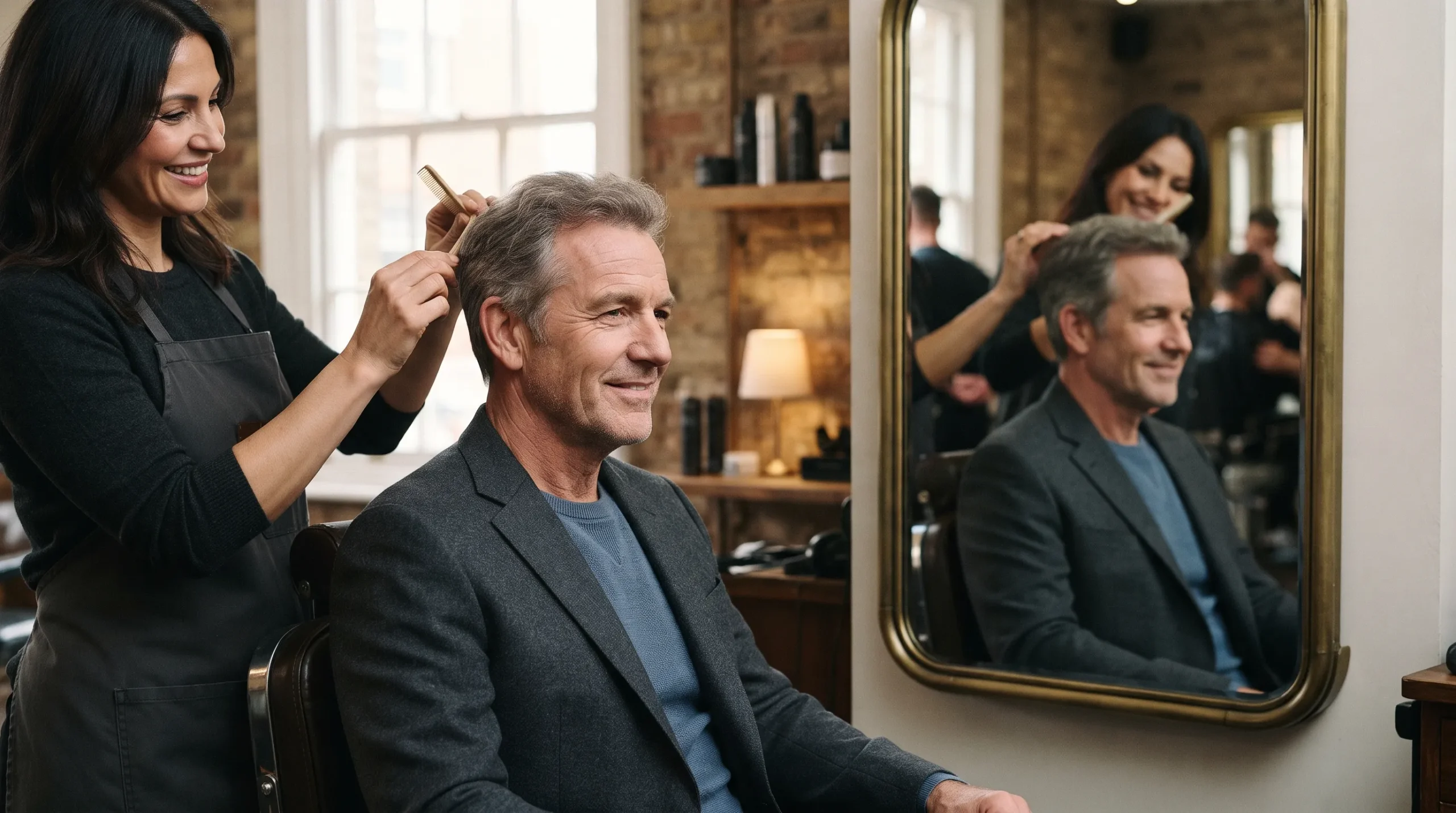

A client walked in a few months back, late fifties, hair combed thin and back for years. He’d told himself it worked. What actually got him through our door wasn’t a mirror. It was his daughter’s phone, catching candid shots at family get-togethers that didn’t match the version of himself he had in his head. Nothing new had happened to his hair. He’d just hit the point where pretending it was fine stopped being possible.
Picking a system past 50 isn’t the same job as picking one at 25. Skin doesn’t behave the same way. Whatever hair’s hanging on tends to be greyer, finer. And life’s usually shifted too, more time outside, more swimming, grandkids who grab at everything within reach. Add it up and there’s a longer list to think through before settling on something that has to sit on your scalp every single day for months at a time.
Your Skin at 50 Isn’t Your Skin at 30
Most men don’t see this coming. Tape or adhesive that sat fine on your scalp for years can suddenly start irritating it now, and the product hasn’t changed one bit. Skin thins with age. That’s the whole story. Thinner skin just reacts more to anything left on it for hours at a stretch.
So we check this first, before anything else gets discussed. Three bases exist: lace, skin, and mono, and age has a real say in which one suits you. Lace breathes best, which helps if your scalp runs warm, but it’s also the most delicate of the three and needs handling with care. Skin base sits tighter and flatter, gives the closest hairline, though it holds a touch more heat than lace does. Mono splits the difference, durable, breathable, and generally the one people find simplest to live with. Our guide on the types of hair replacement systems goes into the materials in more depth.
Had a bad reaction to adhesive before? Noticed your skin’s gotten fussier over the years? Mention it at the consultation. We’ll run a patch test rather than guess, same as we would for anyone with a known sensitive scalp, age aside. Our piece on wearing a system with a sensitive scalp walks through what that test involves.
Grey Hair Is Harder to Match Than You’d Guess
Here’s where a lot of men get caught out. A system has to blend into whatever’s left growing, not just match a colour chip off a card. Grey almost never comes in evenly. Most men over 50 end up with a patchwork: more grey at the temples, pockets of the original colour elsewhere, and sometimes a different texture entirely where things have thinned the most.
Getting that blend right takes more than pointing at “silver” on a swatch. We match in person, against your actual hair, under daylight, not the fluorescent lighting that skews how grey reads. For a lot of men at this stage, going fully custom beats trying to force a stock piece onto hair that’s still shifting in colour and texture at the same time. Our comparison of custom versus stock hair systems lays out when each route makes more sense.
Texture changes too. Usually finer, sometimes drier than it used to be. A piece built for someone’s thick twenty-something hair won’t blend naturally onto hair that’s spent thirty years thinning and changing character. We’re looking at what you’ve still got just as closely as what we’re adding.
Already Mostly Bald? Still Worth a Consultation
This is likely the single most common question we get from this age group, and the short answer is no, it’s not too late. Male pattern baldness has no interest in your birthday. It just keeps going, and a lot of men simply live with it for years, sometimes decades, before finally booking something.
What surprises people most: a system genuinely doesn’t need hair on top to work from. It needs coverage at the sides and back, because that’s where it attaches and blends at the edges. With the right base and a careful fit, even very advanced hair loss can end up looking entirely natural. It just takes extra attention around the hairline and temples so the whole thing reads as a gradual shift, not a sudden switch. One of our clients hadn’t had hair on top in over a decade before his first appointment with us. The finished result held up exactly as well as it does for men who’ve still got hair of their own to work with.
Our article on systems for men with significant hair loss goes deeper into this exact case, and the piece on getting a system before going completely bald is worth a look if you’re weighing up whether to wait any longer.
Maintenance Visits Look a Bit Different Now
Age changes how your skin and hair behave, so it changes how often a system needs servicing. Not a huge shift, just a real one. Four to six weeks is the usual stretch between visits: re-attachment, a clean, a check over the base for wear. Exactly where you land in that window comes down to your skin, how active you are, and how quickly what’s underneath is still growing.
Retired, or spending more time working from home these days? Fitting in appointments tends to get easier, since a flexible week books around things far more smoothly than a fixed job schedule ever did. Golf, long walks, regular swimming, anything that means more sweat or more sun, pulls the other direction and can shorten the stretch between services. Nobody gets the same fixed plan here regardless of what their week actually looks like. Yours gets built around your routine specifically. Our page on system maintenance covers a typical appointment, and our guide on maintaining a system long term is worth reading before your first fitting.
Photos, and People Who’ve Watched You Change
Two things worry men at this stage more than almost anything else: how it’ll look in a photo, and whether anyone who’s known them for years will clock the difference.
Start with the camera. A mirror forgives in a way a flash photo never does, and a system that looks perfect across the dinner table can suddenly look off in a candid shot caught from the side, exactly what happened to the client from our opening story. Nine times out of ten it comes down to one of three things: density that’s too uniform across the hairline, colour that shifts under a different light, or a parting drawn too perfectly straight to look real. Real hair’s never that tidy. Build in a bit of irregularity at the hairline instead of chasing flawless density, and the photo problem mostly disappears. Our piece on why a system might not look natural in photos covers those exact fixes, nearly all handled at the fitting stage rather than anything you’d try at home.
Then there’s the people. A properly fitted system, matched carefully to your remaining hair and skin tone, isn’t something most people are actively hunting for unless they already have a reason to suspect it. Our article on whether people can tell you’re wearing a system covers what actually tips people off, which usually isn’t what you’d assume.
Some men at this age still prefer going gradual regardless. Instead of showing up with a full head of hair after years of visible thinning, easing into a slightly less dramatic density first, then building up over a few months, sits easier with the people around them. Not essential, but worth raising at your first consultation if it’s on your mind.
Will It Damage What Hair You’ve Got Left?
Fair worry, especially if you’re trying to hang onto what’s still growing. A properly fitted, properly maintained system shouldn’t damage anything underneath, provided the base is sized correctly and adhesive gets removed with care rather than ripped off. Where problems actually come from: a system that’s too tight, adhesive left on far too long between visits, or a base that’s a poor match for the hair underneath, causing friction. Our guide on whether systems damage existing hair separates what actually causes damage from what’s just an old myth.
Tried a Toupee Years Ago and Gave Up on It?
This age group’s the most likely to have already been down this road once. An off the shelf toupee, bought without a proper fitting, worn a handful of times and then quietly binned. Sound about right? If so, it’s worth knowing that what’s available now has nothing in common with what was on offer back in the eighties or nineties.
Most of the old complaints, visible edges, a flat and shiny look, adhesive that gave out within days, trace back to stock pieces that were never matched to anyone’s actual hairline, skin tone, or hair pattern in the first place. Custom fitting, better materials, and proper colour matching under real light solve most of what put people off the first time around. Clients who tried something decades ago and gave up on the whole idea are often genuinely surprised by how different a properly fitted piece feels. What we always ask first in these cases: what exactly went wrong last time? That tells us precisely what to do differently now.
Would a Transplant Make More Sense at This Point?
A question that comes up a lot from men over 50, usually because they’ve read that transplants give a permanent result and wonder if that beats a system outright. Age changes that equation more than most people expect going in.
Transplant success rides heavily on the donor area, the back and sides it all gets harvested from. By your fifties or sixties, that area’s often thinned out too, not just the top. Less to harvest means less coverage overall, so a transplant that would’ve given dense results at 30 might only manage a partial one decades on. Recovery takes longer as skin ages as well, and that matters more if you can’t easily take a week or two off work the way you might have been able to younger.
None of that rules a transplant out entirely. Plenty of men are still solid candidates well into their sixties if the donor area’s held up reasonably well. But a system gives you an immediate, adjustable result with no surgery, no recovery time, and no dependence on how much donor hair’s left to work with. For a lot of men over 50, that trade off beats permanence outright. Our comparison of systems versus transplants breaks down both sides properly.
What Actually Happens at the Fitting?
Your first consultation’s free, and it starts with a look at your scalp, whatever hair’s left, and what you’re actually hoping to get out of this. From there we go through base options, colour matching under real light, and density, then either take measurements for a custom piece or fit you with a stock option if that’s the better fit for you. Our page on getting your first hair system covers what to expect walking in for that first appointment.
We’re based in NW10, London, and we’ve been at this for over five years now, working with men across every stage of hair loss, not only the fifties and sixties crowd. That range matters more than it might seem. A piece built for a 25 year old dealing with early crown thinning has nothing in common with one built for a 58 year old carrying significant loss and ageing skin, and the fitting process has to account for that difference rather than running everyone through the same process.
Quick Answers
Can you still get a hair system in your sixties or beyond?
Yes. Age by itself isn’t a deciding factor in whether a system will work. What actually matters is the state of your scalp and remaining hair, both of which get assessed at the consultation.
Does pricing go up for older clients?
No. Pricing comes down to base type, density, and whether it’s custom or stock, not your age. Our pricing page covers the full breakdown, though a consultation gives you the most accurate number for your own case.
Hair loss still progressing?
The system still works just fine. The area it attaches to can shift as that loss continues, which is exactly why maintenance appointments exist, so the fit gets adjusted alongside your natural hair over time. As for how long a system lasts before it needs replacing, that depends on how it’s worn and cared for, though a well maintained one tends to go the distance. Our guide on how long systems last has the specifics.
Human hair or synthetic, which suits an older client better?
Human hair tends to blend better with real grey and ages more convincingly over time, which matters most when your own remaining hair is grey or heading that way. Our comparison of human hair versus synthetic systems covers the trade offs on both sides.
Book a Free Consultation
Past 50 and thinking seriously about a hair replacement system for the first time? Not sure which base would even suit your skin and hair at this point? Book a free consultation with us in NW10, London. We’ll take a proper look at what you’re working with, talk honestly about what’s realistic, and build a plan around your actual hair and lifestyle rather than handing you a generic recommendation. Get in touch through our contact page to arrange a time.