
Can you wear a hair system and still get a skin fade and a clean edge up? Yes. Men with tight curls ask us this almost every week. It usually comes up in the first few minutes of a consultation, and they often look a bit nervous when they ask. They’ve seen a system with an obvious join somewhere, or a lineup that looked drawn on with a marker, and they don’t want that.
Fair enough. A fade and an edge up on a system can look brilliant or look off. Most of that is decided before the clippers are even switched on. Plan the cut around the system and it blends in so well you forget about it. Bolt it on afterwards and you get a tiny step where your own hair meets the base. That step is what people spot.
So here’s what we’d tell you if you were sitting in our chair. We only work with men, and all of it comes from our studio in London.
What’s the difference between a fade, a taper and an edge up?
Barbers use these words loosely, and the same word can mean two slightly different things in two different shops. Let’s pin them down.
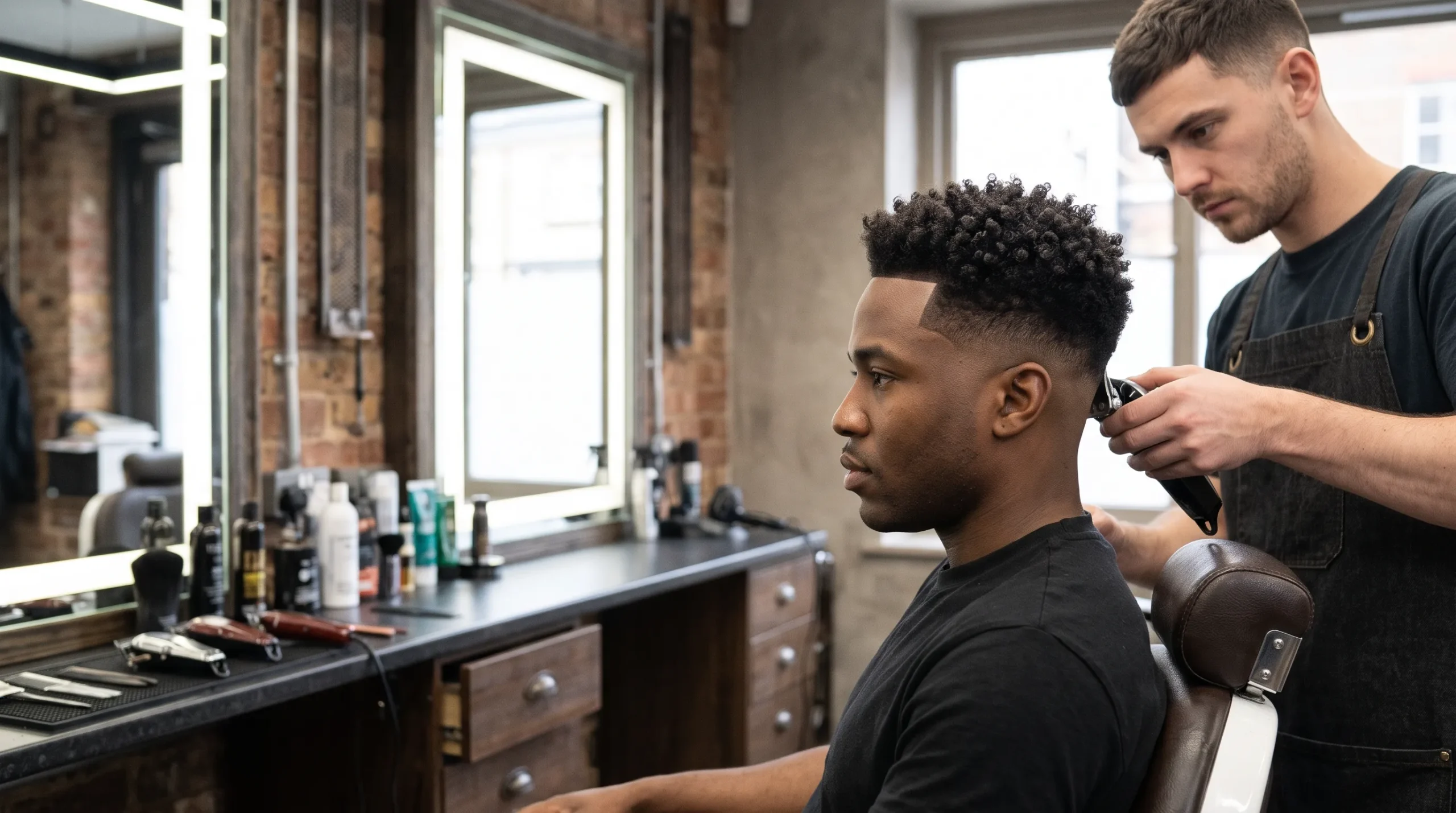
A fade is when the hair gets shorter and shorter down the sides and back. It ends at the skin or at very short stubble. A taper does a similar job, only gently. The hair shortens round the ears and the neck but never drops to bare skin, so the result is softer.
Where the fade starts gives it its name. Low means near the ear and the neckline, mid means around the temple, and high means up towards the top of the head. Any of them that finishes on bare skin is a skin fade. You’ll also hear bald fade, which is the same cut.
The edge up is a separate job, and people mix it up with the fade all the time. It’s the sharp outline along your front hairline and round the temples, and you’ll hear it called a lineup or a shape up too. The barber draws it with a trimmer, sometimes finishing with a razor, and either rounds the corners at the temples or squares them off. The sideburns and the back of the neck normally get the same treatment so the whole outline matches.
With tight curls, that outline matters more than it does on most hair types. Curls sitting against skin have nowhere to hide. A line that’s a couple of millimetres out shows in the mirror, and a patchy fade shows just as quickly. It’s a big reason men with afro textured hair are so picky about who holds the clippers, and they’re right to be.
Not sure how to ask for it? Two details do most of the work. Say where you want the fade to start, and say whether it should end at skin or stubble. “Low skin fade with a rounded lineup” tells a barber, or us, nearly everything. A photo does the same job if the words don’t come.
Can you get a skin fade with a hair system?
You can, and plenty of our clients do. The fade is cut into your own hair at the sides and back, then blended into the edge of the system.
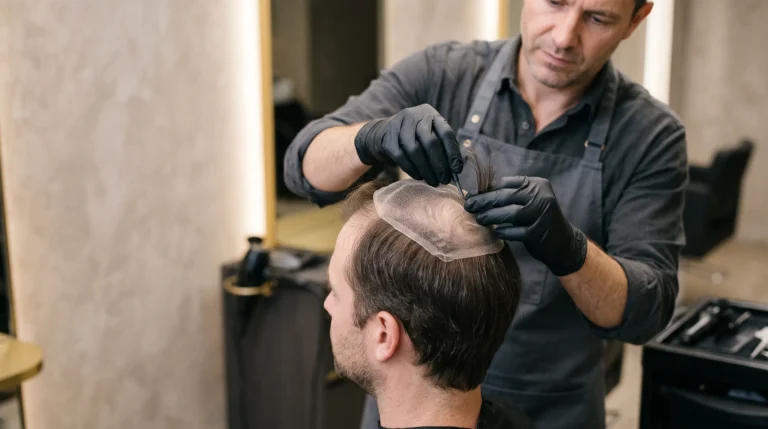
On most systems the sides and back are your own hair, and the base covers the top and the front. That means the fade isn’t being cut into the system at all. What we’re doing is blending your hair into the base so there’s no line where one stops and the other starts. That blend is the first thing the eye goes to, so it’s where we spend our time.
Some men worry that a system will limit the cut. It limits it less than you’d think. Low fades, mid fades, tapers and skin fades all work. What changes is how much planning goes in beforehand, because the base has to sit in the right place for the blend to hide.
Longer curls on top show more of the system than a short crop does, so they need a closer match to your own hair. Our pages on curly hair systems and afro textured hair systems explain how we match texture.
A few men ask about a hard part, which is a line shaved or trimmed into the top so it looks like a parting. It’s a popular detail on afro styles. Whether it holds on a system comes down to the hair length and the way the base is made, so ask before you book. We’d rather tell you now that it won’t hold than have you find out after the cut.
How high should the fade go?
It comes down to how much of your own hair you want to blend with. A low, soft fade leaves plenty of your hair to cover the join, so it’s the forgiving choice. A high, close fade leaves less to hide behind, so the match and the placement need to be better.
A high skin fade can still be done on a system. We just agree the height with you first, and we look at where the base sits on your head before anyone picks up the clippers. A very high fade can leave less hair to blend than the base needs. It’s far better to find that out in a chair with a mirror than after the cut.
Some men like a low or mid taper because it’s softer and easier to live with. Others want the bold skin fade and love it. Neither is wrong, and the choice is yours.
Can’t decide? Bring a photo of a cut you like. We’ll say whether it works with a system. Sometimes an ordinary good haircut would do the job without one, and if that’s the case we’ll tell you.
What should the front line look like?
A ruler straight line looks great in a photo and a bit strange in real life. At arm’s length it can look drawn on with a pen, because real hairlines wobble. The corners are soft and a little rounded, and there are a few finer hairs right at the front.
Copy that and the edge looks like yours. Rounding the temple corners usually looks more natural than squaring them. A hairline set a touch higher is also easier to believe than one set very low. But it’s your face, so you decide. Just make the call before the trimmer comes out, because a line is hard to take back.
Some men want the opposite, a crisp line they can keep sharp. That’s fine too. A very sharp edge needs more upkeep, and we’ll be straight with you about how it wears and how often it needs freshening up.
Your temples and sideburns normally come from your own hair, so the edge there is an ordinary one. The line across the front can be part system and part your own hair, based on how far forward your hair grows. A photo can’t show that, which is why we like to look at the shape in person.
There’s a simple test you can do at home. Check your hairline by a window in daylight, as well as in the bathroom mirror. Bathroom lights flatter almost any edge, and daylight is far harsher. Happy with what you see by the window? Then the line is doing its job. A photo taken outside about a week after each visit also helps you catch small changes early.
You’ll find most of the slips that give away a front edge in the guides to making a hair system look more natural and why a hair system looks fake. A badly placed hairline sits near the top of both lists. Wondering whether anyone will notice? The guide on whether people can tell you’re wearing a hair system is a fair read. So is the page on custom fitting, because a base made to fit you makes a natural edge much easier.
How long does a fade and edge up last?
Less time than you’d like. Hair grows, so a fresh fade starts to soften within a couple of weeks. The neckline goes first, and then the sides lose their crisp look. That’s true of every fade, with a system or without one.
The edge up is the quickest to fade. It looks its best for about the first week, and after that the fine hairs creep back and the line softens. Men who love a razor sharp outline usually want it redone more often than the rest of the cut.
A system adds one more thing to think about. The hair on top doesn’t grow, but your own hair at the sides and back does, so the blend between the two slowly shifts. It’s one reason we see our clients every four to six weeks. At a visit we clean the system, put on a fresh bond, and tidy the fade and lineup, and then everything looks right again.
A small habit helps. After each visit, note on your phone how many weeks the cut looked its best. After two or three visits you’ll know your own rhythm. Tell us, and we’ll book you in just as the fade starts to soften, before it has grown out. Men who love a sharp line tend to land near four weeks, and men who like it softer can stretch towards six.
Between visits, a spritz of water and a little light cream keep the top fresh. A satin cap at night helps too, because it stops the top rubbing on the pillow and stops your own hair drying out. There’s more in the post on how to maintain a hair replacement system and on our maintenance page.
Which fade goes with which top?
There’s no rule book here, but the same few pairings keep coming up in the studio.
Most men with short curls on top go for a skin fade, and it’s easy to see why. Tight curls above bare sides make a sharp, clean contrast. The price of that contrast is the blend. It has to be smooth, because nothing soft sits in between to forgive a rough join.
If you’d like something gentler, a low or mid taper with the same short curls is kinder to a fresh join. We often suggest it to men who’ve never worn a system before, since it’s easier to get used to.
Longer curls on top are a different story. You get more body and more shape to play with, but the system shows more too, so the texture, thickness and colour all have to match your own hair closely. Fancy twists, coils or a bigger top? Tell us early. Then we can say whether the system can do it and how it will wear.
Thinning at the temples or the crown changes the plan a little. We cut the fade and the edge so they frame the system and don’t fight it. You can read more about a receding hairline or crown thinning if either one sounds like you.
Bring a photo and we’ll tell you straight whether it works, whether it doesn’t, or whether it would with a small tweak.
Why do razor bumps show up on an edge up?
Because an edge up is cut very short, right where the hair is curly. A short curly hair can bend back and grow into the skin instead of out of it. That’s more likely with tightly curled hair, and it’s more common in men of African descent along the beard line, the neck and the hairline. The hairline is exactly where an edge up goes.
The bumps are red, sore or itchy, and now and then there’s a little spot with a hair trapped inside. On a fresh edge they look rough, and picking at them can leave a scar.
You can cut the odds a fair bit. A warm shower beforehand softens the hair. Go with the direction the hair grows, use a clean single blade and swap it often, and don’t pull the skin tight or go closer than you need to. If the bumps keep coming back, see a doctor about them, since there are treatments that work.
They tend to show in the first day or two after a fresh edge. If your skin is touchy, ask for a slightly softer line and leave it alone afterwards. Rubbing it, picking at it and wearing a tight collar will all make it worse. Let your barber know if you get them, or let us know. We can change how close the line goes, and a softer edge usually sits better on sensitive skin.
Bumps on the hairline aren’t the same as irritation under a system. If the skin under the base turns red, sore or itchy, take the system off and see a doctor. You can read more about a sensitive scalp and eczema and psoriasis if that sounds like you.
Can a barber or clippers at home cut a hair system?
A barber can cut your own hair, but leave the system itself to us. And please don’t do the lineup at home with clippers.
Lots of men use a barber between visits, and that’s fine. Tell the barber you wear a system before they start. Ask them to keep clippers, razors and hot tools away from the base and the bond. Ask them not to tug the edge or press hard along the hairline. A razor or trimmer can cut the hair on the system or catch the edge of the base. A cut in the wrong place can’t be put back.
Home clippers are tempting, and we get why. A fresh edge up feels like part of getting ready on a Friday night. But it’s easy to nick the system or cut into the bond. A mistake like that costs more to fix than it would have cost to wait.
If you want the system trimmed or the lineup changed, bring it to us. We shape it with your own hair so the two stay matched.
What about your own hair and edges?
The sides and back are your own hair, and they carry most of the fade. If that hair is dry, brittle or thin, the fade looks rough however good the system is.
Afro hair is dry by nature, because the oil from the scalp has a hard time travelling down tight curls. Keep your own hair moisturised, because it’s the part people see every day. Go gently round the ears and the back of the neck, where it breaks easily. A little leave-in or light cream on the sides helps, as long as you keep it away from the edge of the base. Tight hats and headbands that press on the same spots every day are best skipped.
Tight styles need a word of their own. Braids, cornrows, ponytails and buns pull on the hairline, and they’re the main cause of traction alopecia. A thin hairline doesn’t need any more tension. Two posts go through it in detail: traction alopecia and hair systems, and whether a hair replacement system damages your existing hair. If the edge ever lifts, read about a system lifting at the hairline.
Losing hair at the sides and back as well as on top? Tell us, because it changes how we plan the fade. The page on alopecia and the guide for men in London explain the options.
What happens when you come to see us?
First, bring a photo. Pictures of the cut you want, from the front and the side, save a lot of guessing. A photo of your own hair from before it thinned is useful too, since it shows where your hairline used to sit.
Tell us how you want the edge to look and how often you’re happy to come in. Mention anything that affects your skin, like razor bumps, eczema or a sensitive scalp. Say if you wear hats or helmets for work, play sport or sleep in a satin cap, because those change how the cut wears. And if a close fade makes you nervous, say so. It’s much easier to talk it through before the cut than after.
The consultation is free, private and one to one, in a men only studio. We look at your hair, your curl pattern and your hair loss. We talk about the cut you want, and we tell you whether a system suits you. If it doesn’t, we say that too.
A first system starts from £495, and that includes the consultation, the fitting, the cut and the styling. The final price depends on the base, the thickness and the curl pattern, and we confirm it at your consultation. The prices page has more.
You can read the whole process, see how the fitting works, and read what clients say in our reviews. New to this? Getting your first hair system is a good place to start.
Our studio is at Unit C, Dorset House, 845 Harrow Rd, London NW10 5NH, near Willesden Junction. We’re open Monday to Friday from 9:00 to 18:30 and Saturday from 9:00 to 16:00. For the wider picture, see non-surgical hair replacement in London and about Hair Standard.
FAQs: Hair System Fades and Edge Ups for Black Men
Can you get a skin fade with a hair system?
Yes. The fade is cut into your own hair at the sides and back, and blended into the system. The higher and closer the fade, the more the placement matters, so we plan the height with you.
What is an edge up?
An edge up, also called a lineup or shape up, is a sharp line cut along the front hairline and around the temples. A barber draws it with a trimmer or razor. It’s often done on the sideburns and neckline as well.
Can a hair system have a sharp lineup?
Yes. The front edge can be shaped sharp or soft, to suit how you wear your hair. Some men want a crisp line they can keep every few weeks, and others prefer a softer, more natural one. We shape it with you in the chair.
How often should you get an edge up with a hair system?
A fresh edge looks sharpest in the first week or so, then softens as the fine hairs return. Men who like a very crisp line often want it freshened more often than the rest of the cut. We tidy the fade and lineup at your visit every four to six weeks.
How long does a fade last on a hair system?
Your own hair keeps growing, so a fade starts to soften within a couple of weeks. The system hair on top stays the same length. So the blend between the two shifts over time and gets tidied at each visit.
Can a barber cut a hair system?
A barber can cut your own hair at the sides and back, but tell them you wear a system first. Ask them to keep clippers, razors and hot tools away from the base and bond. If you want the system itself trimmed or the lineup changed, bring it to us.
Can you use clippers on a hair system at home?
We’d say no. It’s easy to nick the system or cut into the bond, and a cut in the wrong place can’t be put back. Bring it to us and we’ll shape it with your own hair.
Is a taper or a skin fade better with a hair system?
Neither wins outright. A low or mid taper is a gentler blend, and a skin fade is a bolder look with more contrast. Both work. We look at where your base sits and plan the height with you.
How do you stop razor bumps after an edge up?
Soften the hair before it’s cut, cut in the direction of growth, use a clean single blade and don’t go closer than you need to. Cutting hair very short makes it more likely to grow back into the skin. If bumps keep coming back, see a doctor.
Will a lineup damage the base of a hair system?
It can, if the trimmer or razor catches the edge of the base. We’d rather do the system’s lineup ourselves. A barber can do the rest of the cut, as long as they know about the system.
How much does a hair system cost at Hair Standard?
A first system starts from £495, and that includes the consultation, the fitting, the cut and the styling. The final price depends on the base, the thickness and the curl pattern, and we confirm it at your free consultation.
Where can you get a fade and lineup with a hair system in London?
Our studio is at Unit C, Dorset House, 845 Harrow Rd, London NW10 5NH, near Willesden Junction. We’re open Monday to Friday from 9:00 to 18:30 and Saturday from 9:00 to 16:00. The consultation is free and private.
Book a free consultation
Want a fade and edge up that works with a hair system? Come and talk to us. The consultation is free and private. Use our contact page, call 0203 393 1235, or message us on WhatsApp. You can also read about our alopecia hair systems and afro textured hair systems.