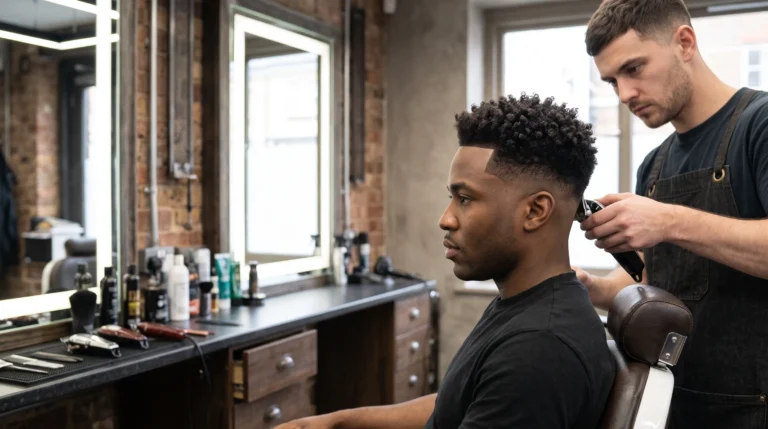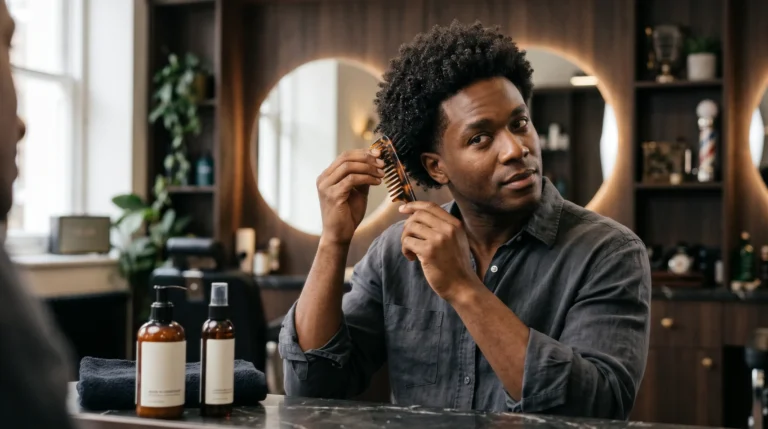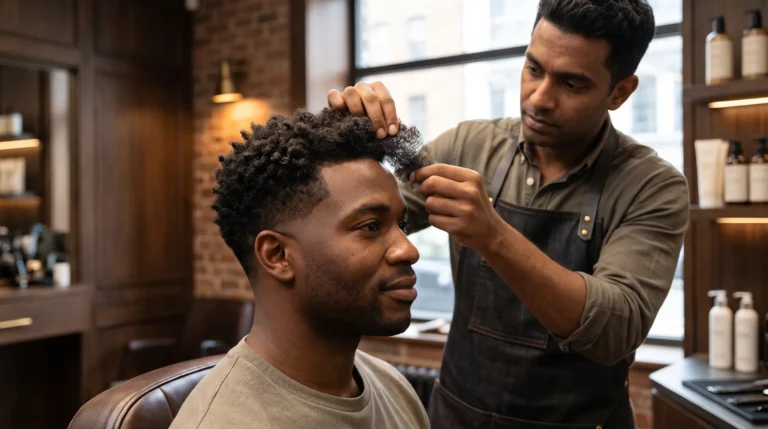
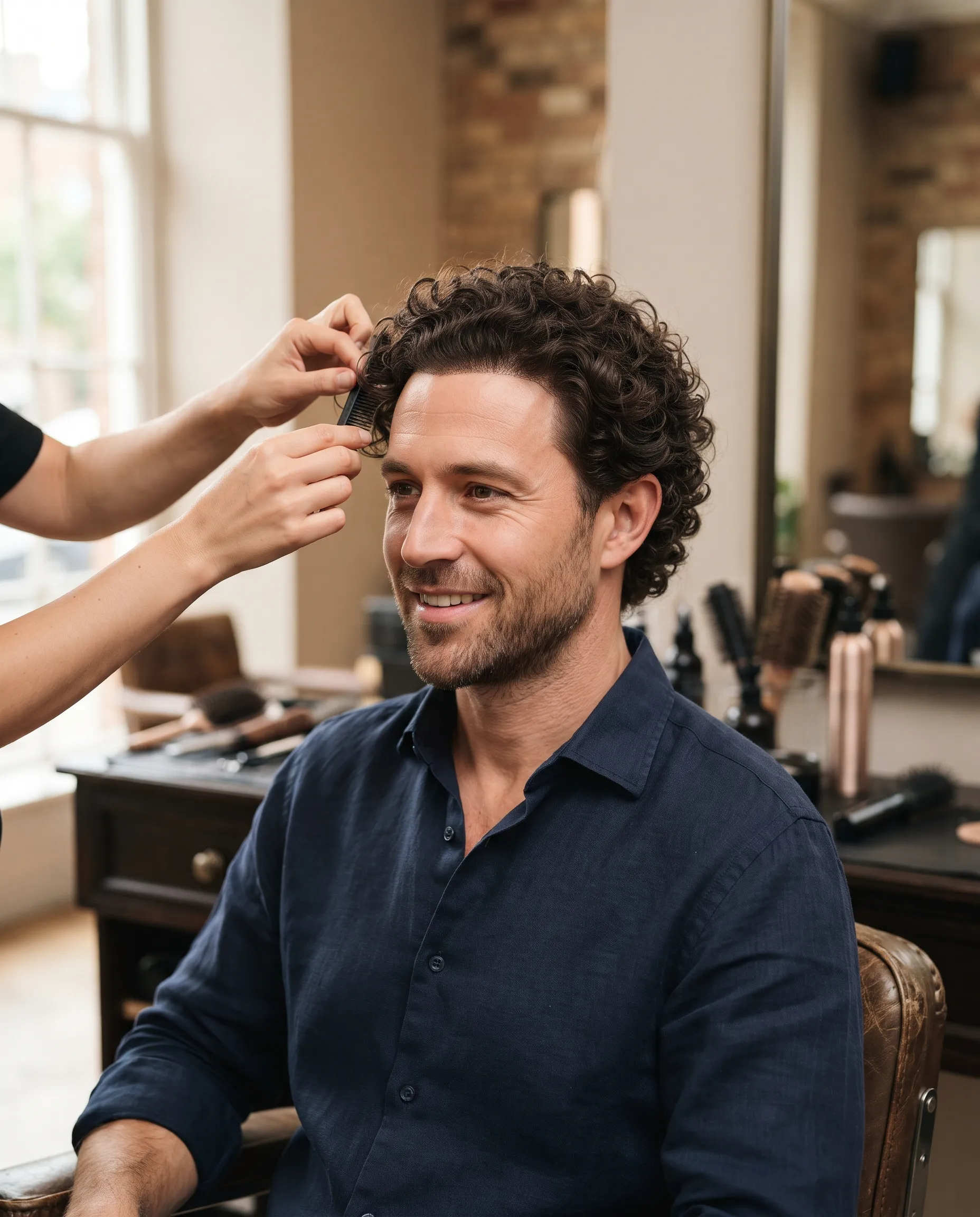

Yes, you can get a hair replacement system that matches curly hair well, and it doesn’t have to look like a wig that’s trying too hard. Curly systems exist, that’s not the hard part. The hard part is getting the curl pattern, density, and base all working together so it moves and sits like your own hair, not like one uniform curly shape sitting on top of your head.
I don’t get asked about this as much as straight or wavy hair. Fewer men realise it’s even an option done well. So let’s go through what changes when the hair’s curly, where things go wrong, and what to ask for when you’re getting fitted.
Curl Pattern Has to Match, Not Just the Colour
Most men assume colour matching is the hard part. It matters, sure. But curl pattern is where a lot of curly systems fall down. Loose waves, tight coils, everything in between, none of it’s interchangeable. A system built with the wrong curl type sits noticeably different from your own remaining hair, even when the colour’s spot on.
Curl pattern gets described on a loose scale from wavy through to tightly coiled. For tight coils, see our page on an afro textured hair system in London. Getting an accurate read on where your hair sits matters more here than with straight hair, where one strand looks much like the next. A proper consultation means someone actually looking at your remaining hair’s curl pattern up close. Not asking you to describe it. Not picking the closest option off a sample chart.
And curl isn’t static the way colour mostly is. Your natural curl loosens with humidity, holds tighter after a fresh cut, and varies strand to strand in ways straight hair just doesn’t. A good fitter accounts for that variation instead of chasing one perfect curl measurement that won’t show up every day.
Human Hair Holds Curl Better Than Synthetic, Usually
Human hair responds to heat, humidity, and styling products in a way that behaves close to your own curls. That matters a lot more for curly systems than straight ones. A straight synthetic system can pass reasonably well in plenty of conditions. A curly synthetic system tends to show its limits faster, since synthetic curl doesn’t always react to weather and moisture the way real curl does.
That’s not a blanket rule against synthetic hair for curly men though. Some synthetic fibres hold curl shape well and work fine for certain budgets or lifestyles. My guide on human hair versus synthetic hair replacement systems covers that choice in more depth. Worth reading with curl in mind, since the trade offs shift a bit compared to straight hair.
Does Curly Hair Need a Different Base Type?
Not fundamentally, no. But a few things matter slightly more. Curly hair tends to sit with more volume and lift at the root than straight hair does, so density and how the hair’s distributed across the base needs thought. Not just a standard density pattern designed with straight hair in mind.
Breathability matters a touch more too, with curlier, denser styles. More hair sitting closer together can trap heat against the scalp if the base material isn’t right for it. My overview of types of hair replacement systems covers base options generally, and a fitter who’s worked with curly hair will usually steer you toward whichever base handles density and airflow best for your curl type and lifestyle.
Custom Versus Stock for Curly Hair
Curly hair is one of the areas where custom work earns its cost more clearly than straight hair does. Stock systems get built to standard density and curl patterns that skew toward the most common requests. Historically that’s meant straighter, looser patterns getting better coverage in off the shelf ranges than tight coils ever do.
A custom system lets curl pattern, density, even the direction curls naturally fall, get matched to your remaining hair. No compromising toward whatever the stock range happens to offer. My comparison of custom versus stock hair systems goes through that decision generally, but for curly hair specifically, custom closes the gap between “looks like a system” and “looks like your hair” more than it does for straighter textures.
Blending With Your Own Remaining Curly Hair
This is where curly systems get tricky. Trickier than straight hair blending, honestly. Curls don’t lie flat the way straight hair does, so the join between your own remaining hair and the system’s hair has to account for curls sitting at different angles and heights. It’s not just matching colour and texture in a flat plane anymore.
A skilled fitter works the blend zone carefully, sometimes mixing in a touch of irregularity on purpose, since real curly hair is rarely uniform from strand to strand. A system that’s too perfectly curled right at the blend point can look more artificial than one that varies a little, mirroring how real curls behave.
Styling and Maintenance Differences
Curly systems need a bit more thought day to day than straight ones. Mostly around product use and how you dry it. Heavy, greasy products that work fine on straight systems can weigh curls down and flatten the pattern you’re paying for. Lighter, curl specific products work better here.
Air drying or diffusing instead of rough towel drying matters more too. Aggressive towel drying disrupts curl pattern on a system the same way it does on natural curly hair. My maintenance guide and cleaning guide cover the general routine. If your hair’s curly, ask about products suited to curl instead of following a generic routine built around straighter hair.
Sleeping can be a bigger factor too. Curly hair’s more prone to tangling and frizzing overnight than straight hair, and that applies to system hair just as much as your own. A silk or satin pillowcase, or loosely securing longer curls before bed, keeps the pattern looking fresh without needing a full restyle every morning.
Does Curl Make Attachment Any Different?
Not really. The attachment method works the same whether the hair’s straight or curly. My guide on tape versus glue for hair replacement systems applies regardless of curl type, since attachment is about the base and your scalp, not the hair sitting on top.
What can differ slightly is how obvious a lifting edge becomes. Curly hair sometimes hides a lifting edge better than straight hair does, simply because the texture disguises small irregularities more easily. That’s not a reason to skip regular checks though. A lifting edge left unaddressed causes the same problems no matter what’s growing on top of it.
Common Problems That Are Specific to Curly Systems
Frizz building up faster than expected, that’s probably the most common complaint I hear. Usually it traces back to product choice or drying method, not the system itself being faulty. Switching to lighter, curl friendly products alongside gentler drying habits resolves most of it.
Curl pattern loosening over time happens on both human hair and synthetic systems, though human hair responds better to being reset. A professional reset or light perm style treatment restores pattern on human hair systems that have loosened with wear and washing. Something that’s not really possible the same way with synthetic fibres once their shape starts relaxing.
Uneven curl distribution across the base is a sign of a system that wasn’t built or fitted with enough attention to how curl sits in three dimensions. Not lying flat. This is usually a fitting issue, not something you fix with products at home, so raise it at a consultation instead of assuming it’s just how curly systems look.
A Client Who Nearly Gave Up on Curly
I had a client who’d tried a stock curly system elsewhere before coming to us. He was close to giving up on the idea entirely. The curl pattern was far looser than his own tight natural curl, and no amount of product closed that gap, because the base hair simply wasn’t matched to what he actually had.
We rebuilt him with a custom system. Curl pattern matched directly against samples taken from his own remaining hair, density built up around his crown where his own hair had thinned most. The difference wasn’t subtle. He told us afterward that for the first time, people who knew about his hair loss stopped asking if he’d tried “that hair thing” again. It finally looked like his actual hair, not a curly wig sitting on top of it.
Will My System’s Curl Match as My Natural Hair Changes?
Your remaining hair’s curl can shift slightly over time. With age, with different products, sometimes just with the seasons. A system built once won’t automatically track those small changes, which is part of why regular maintenance visits matter for curly wearers specifically. A good fitter checks the blend against your current hair at each visit, not just at the original fitting, and adjusts where the two have drifted apart.
Is Curly Hair More Expensive to Replace?
Sometimes, yes, particularly for custom work. Sourcing and preparing curly human hair that matches a specific pattern takes more care than straighter hair does. My hair system prices page sets out general pricing. It’s worth discussing curl at a consultation since the exact cost depends on how closely matched and how custom the build needs to be for your pattern and density.
Does This Apply the Same Way to Crown Thinning?
Largely, yes, though crown areas with curly hair bring their own small wrinkle. Curl direction at the crown often swirls instead of falling in one consistent direction, and blending a system’s curl into that swirl takes a bit more attention than a straightforward front hairline blend would. My page on hair systems for crown thinning covers that area if that’s where your thinning is concentrated.
Curly Hair Replacement FAQs
Can a hair system match tight curls, not just loose waves?
Yes, with the right approach. Tighter curl patterns need more careful matching and usually do better with a custom build rather than stock, but they’re achievable.
Will humidity affect a curly system the same way it affects my own hair?
Human hair systems respond to humidity much like natural hair does, sometimes tightening or loosening slightly. Synthetic systems vary more by fibre type.
Does curly hair make a system harder to clean?
A bit more involved, mainly around drying technique, but not dramatically different. My cleaning guide covers the general approach, and curl-specific products help.
Can I switch from a straight system to a curly one if my own hair’s curly?
Yes. If your remaining hair is naturally curly, a matched curl pattern blends better than a straight system ever will.
Does the curl pattern fade or loosen the same way colour does?
It can, gradually, especially with heat styling or rough handling. Human hair systems can usually be reset. Synthetic ones are harder to restore once the pattern relaxes.
Is a custom system always necessary for curly hair?
Not always, but it closes the gap between “looks like a system” and “looks like your hair” more noticeably for curly patterns than for straight ones.
Will products made for curly hair work on a system too?
Generally yes. Lighter, curl-specific products suit system hair the same way they suit natural curly hair, and heavy products flatten the curl pattern on both.
Can a system blend with patchy or uneven natural curl loss?
Yes, and this is exactly where a skilled fitter earns their keep, matching density and curl direction around whatever natural hair remains instead of ignoring it.
Book a Consultation for Curly Hair Matching
Struggled to find a system that matches your curl pattern? Get in touch through my contact page and I’ll talk you through what’s realistic for your curl type and density, instead of steering you toward whatever’s easiest to stock. You’re also welcome to browse the full range of hair systems or read more about our process before booking in.