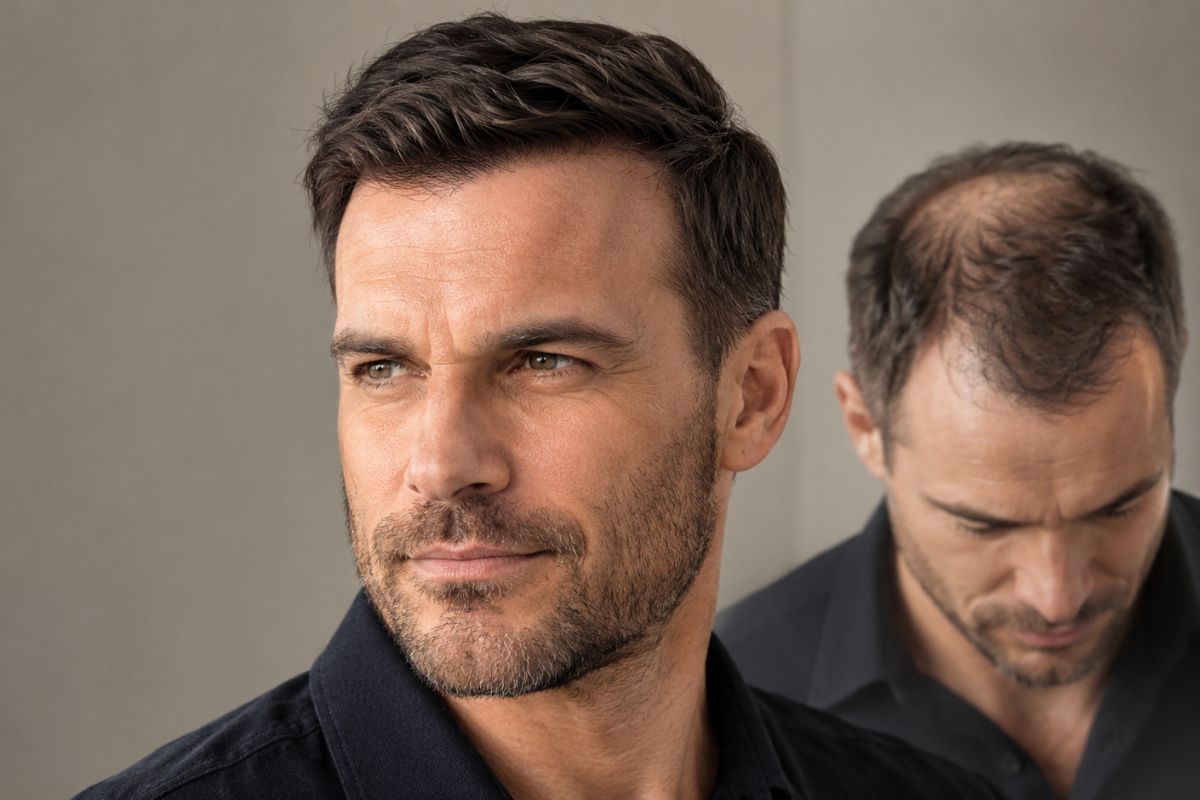

If you’re weighing this up, you’ve probably already tried a few things: different shampoos, a fibre spray, maybe a change of hairstyle to work around a receding line or a thinning patch on top. At some point, most men reach the same question: is a hair system actually worth it, or is it just an expensive way of covering something up?
The honest answer is: it depends. A hair replacement system can absolutely be worth it if you want a fuller, natural-looking head of hair without surgery, without waiting months to see a result, and you’re willing to keep up with a maintenance routine. It’s less worth it if you’re not prepared for ongoing appointments, or if your priority is a completely permanent, one-time fix.
What decides it for most men isn’t the hair system itself it’s how it fits their life. Someone who wants to see a result this week, who doesn’t want to go under a scalpel, and who’s comfortable booking in every four to eight weeks will usually find it a good investment. Someone who wants to set-and-forget, or who’s put off by any level of upkeep, may be better served looking at other routes first.
A few readers land here looking for volume rather than baldness coverage. If that’s you, it’s worth knowing a hair system and a non-surgical hair extension patch solve different problems. A system replaces coverage where hair has been lost; a patch adds thickness to hair that’s still there.
What actually decides whether it’s worth it
Before getting into appearance, cost or comfort individually, it helps to know what the decision really rests on:
- Extent and pattern of hair loss a receding hairline, a thinning crown and more advanced loss across the top all call for different approaches
- How natural you need it to look under office lighting, at the barber’s, up close with a partner
- Budget, both the upfront fitting and the ongoing cost of keeping it looking right
- Willingness to maintain it regular appointments aren’t optional, they’re part of how the system stays natural
- Lifestyle how physically active you are, whether you swim, train, or work outdoors
- Expectations a system changes how you look, not the underlying hair loss itself
- How quickly you want results same-day versus a process that unfolds over months
Nobody scores well on all seven and that’s fine. It’s about which of these matter most to you.
Does a hair system actually look natural?
This is usually the first thing men want reassurance on, and it’s a fair question there’s a lot of dated imagery of obvious, shiny toupees floating around in people’s minds.
A well-fitted modern system looks nothing like that. The realism comes down to two things: the base and the hairline. A lace or skin base sits flush against the scalp rather than sitting on top of it, so there’s no visible ridge or seam. The hairline is then cut and positioned individually following your natural growth direction, your face shape and the density you’d realistically have at your age, rather than a uniformly thick, too-perfect edge.
What actually makes a system look fake is almost always one of these:
- A hairline that’s too straight, too low, or too dense for the wearer’s age
- A colour that doesn’t quite match once you’re out in daylight
- A base that’s visible at the parting or temples because it wasn’t matched to the scalp tone
- A system that’s been left too long between maintenance visits, so the parting has grown out and started lifting
Get the base type and colour match right at fitting, and keep up with maintenance, and it’s genuinely difficult to spot even up close. It can also be cut, styled and parted the same way you’d style your own hair, rather than being locked into one look.
Is it comfortable to actually wear?
Most men expect it to feel obviously “there” like wearing a hat you can’t take off. In practice, once you’re past the first few days of getting used to the sensation, most clients stop noticing it during the day.
A few practical points worth knowing:
- The base is thin by design. Lace, skin (PU) and monofilament bases are built to be light and breathable, not thick or rubbery.
- The scalp can still breathe. This is one of the main differences between a properly fitted system and an old-style toupee; modern bases are designed for airflow, not to seal the scalp.
- There’s an adjustment period. Most people describe the first week as being aware of it, the way you’d notice a new pair of glasses, and then stop thinking about it.
- Adhesive quality matters more than people expect. A poor bond can feel tighter or itchier than it should. Medical-grade adhesive, applied correctly, shouldn’t irritate the scalp.
If you have particularly sensitive skin or a history of reactions, this is exactly what a skin sensitivity test before fitting is for it’s a standard part of a proper consultation, not an optional extra.
Can you actually live a normal life with one?
This is where a lot of the hesitation comes from, so it’s worth answering directly.
Can you shower with it? Yes. It’s bonded to the scalp, not something you take on and off daily, so showering, washing and general day-to-day water contact are normal.
Can you sleep in it? Yes, most clients do. Some choose a silk pillowcase or light covering overnight simply to protect the hairline edges for longer between appointments, but it isn’t something you need to remove before bed.
Can you exercise? Yes. A system fitted with a waterproof, sweat-resistant adhesive is designed to hold through training, not just everyday wear.
Can you swim? Generally yes, though saltwater and chlorine exposure will affect how long the bond stays fresh, so it’s worth asking your fitter about the right maintenance interval if you swim regularly.
The main thing that changes isn’t what you can do, it’s how often you’ll need a maintenance appointment if you’re consistently hard on it through sweat, water or heavy product use.
How long does a hair system last, and how much upkeep does it need?
A system doesn’t wear out overnight, but it also isn’t a wear-forever product. With proper care, most systems last somewhere in the region of 3 to 6 months before the hair itself needs replacing, though the base needs re-bonding well before that.
What actually shortens its lifespan:
- Sweat and physical activity regular training or a physically demanding job puts more strain on the adhesive bond
- Heavy styling products waxes, gels and oils build up on the base over time and weaken the hold
- Sleep habits how you sleep, and whether you protect the edges overnight, affects how long the front stays secure
- Missed maintenance appointments this is the single biggest factor. Skipping visits doesn’t make the system last longer, it just means the bond and hairline degrade unevenly
In between full replacements, maintenance appointments are typically needed every four to eight weeks. These aren’t optional top-ups; this is when the system is removed, the scalp is cleaned, old adhesive is stripped away, and the piece is re-bonded and trimmed back into your natural hairline. Skip this stage for too long and it’s usually the first thing people notice: a visible parting, lifting edges, or a colour mismatch as your own hair grows out slightly darker or lighter underneath.
What does it cost, realistically?
This is where a lot of the “is it worth it” question actually lives, so it deserves a straight answer rather than a vague one.
There are two cost layers to think about:
- The initial fitting this covers consultation, colour matching, density selection, the system itself, and the first fitting and styling session
- Ongoing maintenance regular appointments to clean, re-bond and trim the system, plus eventual full replacement of the piece itself
At The Hair Standard, there are two ways to structure this: a membership route with a lower upfront fitting cost and reduced-rate maintenance every four to eight weeks, or a one-off fitting with maintenance booked separately as needed. Either way, the ongoing maintenance cost is the part people tend to underestimate when they’re only looking at the headline fitting price; it’s a genuine recurring cost, not a one-time purchase.
Compared with a hair transplant, the upfront cost of a system is significantly lower, but it isn’t a single payment, it’s an ongoing one. Whether that works out cheaper over several years depends entirely on how long you plan to wear a system versus the transplant route, which is worth thinking through honestly rather than just comparing day-one prices.
Is it suitable for your stage of hair loss?
Not every pattern of male pattern baldness responds to a system the same way, so it’s worth being specific.
Receding hairline. This is the most common reason men look into hair systems in the first place. A well-designed front edge can restore a completely natural hairline, transitioning invisibly into the scalp rather than sitting as an obvious line.
Thinning crown. Whether it’s an early patch or more established thinning across the top, a skin-base or monofilament system can restore full coverage with no visible boundary against your existing hair around it.
Diffuse thinning. Where hair loss is spread more evenly rather than following a classic pattern, coverage and density need to be matched carefully so the system doesn’t look noticeably thicker than the hair around it.
Advanced loss across the top. This is where a system tends to do the most visible work, since there’s more existing hair to blend with in the first place. It’s also where getting the base type and density right at consultation matters most.
Not every system suits every pattern; a base or density that works well for a receding hairline isn’t automatically right for more extensive crown loss. This is exactly what a proper consultation is for: assessing your actual pattern before recommending a base type, rather than fitting a generic solution.
Hair system vs hair transplant vs doing nothing
These are the three realistic paths most men consider, and none of them is objectively “better” they suit different priorities.
| Hair System | Hair Transplant | Leaving It Alone | |
| Time to result | Same day | 12+ months to see full results | No change, or gradual further loss |
| Cost structure | Lower upfront, ongoing maintenance cost | High upfront (typically £3,000–£8,000+), no recurring cost | None |
| Commitment | Ongoing appointments every 4–8 weeks | One procedure, permanent outcome | None |
| Reversibility | Fully reversible, removed or changed anytime | Permanent, cannot be undone | N/A |
| Risk | No surgical risk | Surgical risk, scarring, graft survival is not guaranteed | None, but hair loss may continue |
| Best suited to | Wanting a fast, flexible, non-surgical result | Wanting a permanent, one-time surgical fix | Being comfortable with visible hair loss |
Medication such as finasteride or minoxidil is sometimes mentioned alongside these options, but it works differently again. It can help slow further loss or support existing hair for some men, though results vary and it doesn’t restore hair that’s already gone the way a system or transplant does. It’s a conversation worth having with a GP or dermatologist rather than treating as a direct substitute for either option above.
Embracing natural hair loss is also a completely legitimate choice. Plenty of men are entirely comfortable with a shaved or closely cropped look, and there’s nothing wrong with that route. Either a hair system is worth considering only if the result you actually want is a full head of hair, not because it’s automatically the “correct” next step from hair loss.
The honest disadvantages
A trustworthy answer to “is it worth it” has to include what doesn’t work in a system’s favour, not just what does.
- It’s an ongoing commitment, not a one-off fix. Missing maintenance appointments affects how natural and secure it looks.
- The cost accumulates over time. Even with a lower upfront price, maintenance and eventual replacement add up across a year.
- There’s an adjustment period. The first week or two involves getting used to a new sensation and a new routine.
- The bond can lift if not maintained properly. Heavy sweating, certain products, or stretching appointments too far apart can cause the edges to loosen.
- It doesn’t stop hair loss underneath. A system covers existing thinning; it doesn’t treat or reverse what’s happening to your natural hair.
- It requires a genuine routine. Cleaning, product choice and appointment scheduling become part of normal life, not a once-and-done decision.
None of these make a system a bad option but anyone telling you there’s zero upkeep or zero cost beyond the initial fitting isn’t giving you the full picture.
What happens to your natural hair underneath?
A properly fitted system is bonded to the scalp rather than to your existing hair, and a maintenance routine that includes gentle cleansing and correct adhesive removal is designed to protect what’s growing underneath rather than damage it. Problems tend to come from poor aftercare, harsh removal, product build-up left too long, or skipping cleaning stages rather than from wearing a system itself. This is one of the reasons professional maintenance matters: it’s not just about how the system looks, it’s about looking after the scalp and hair it’s attached to.
Is it a long-term solution, or just a cosmetic fix?
It’s best thought of as an ongoing cosmetic solution rather than a cure. A hair system changes how your hair loss looks, not the underlying process causing it. For many men, that’s exactly what they’re after, an immediate, natural, low-risk way to have a full head of hair without surgery. But it only stays a genuine long-term option if the maintenance routine is kept up. Treat it as a one-time purchase and skip the appointments, and it won’t hold up the way it’s designed to. Treat it as an ongoing part of your routine regular maintenance visits, proper products, and a fitting done by someone who takes the time to get your pattern of hair loss right and it can genuinely function as a long-term way of managing male pattern baldness.
If you’re still weighing it up, a free consultation is usually the most useful next step not to be sold on anything, but to actually see your hair loss pattern assessed and find out honestly whether a system, and which base type, would suit you.
Frequently Asked Questions
Is a hair system worth it for male pattern baldness?
For most men, yes, provided you’re comfortable with ongoing maintenance and want a natural-looking result without surgery. It’s less suitable if you want a completely permanent, one-time solution with no recurring appointments.
Are hair systems worth the money?
They can be worth it if you value speed, reversibility and a non-surgical result. It’s important to consider the ongoing maintenance and replacement costs from the beginning rather than looking only at the initial fitting price.
Do hair systems look natural?
Yes. When the base type, colour, density and hairline are properly matched, a modern hair system can look very natural. An unnatural appearance is often caused by poor colour matching, excessive density, an incorrectly designed hairline or overdue maintenance.
How long does a hair system last?
With proper care, most hair systems last around 3 to 6 months before replacement is needed. Maintenance appointments are usually required every 4 to 8 weeks to keep the system secure, clean and properly blended.
How often does a hair system need maintenance?
Most hair systems need maintenance roughly every 4 to 8 weeks. The exact interval depends on your lifestyle, hair growth, adhesive type and how long you want the system to remain secure and looking its best.
Can you sleep with a hair system?
Yes. Hair systems are designed to remain attached to the scalp rather than being removed every night. You can sleep normally, although a silk or satin pillowcase may help reduce friction and protect the hair and front edge.
Can you shower with a hair system?
Yes. Showering and everyday water exposure are normally fine once the system has been properly fitted and the adhesive has had enough time to set. Your specialist can advise you on suitable washing products and routines.
Can you swim with a hair system?
Generally, yes. A properly fitted system with a suitable waterproof or sweat-resistant adhesive can be worn while swimming. However, chlorine and saltwater can affect the hair and adhesive, so additional care may be needed.
Can you exercise with a hair system?
Yes. Hair systems can be worn during exercise when they are fitted with a suitable adhesive. Sweat and frequent workouts may affect how long the bond lasts, so active wearers may need more frequent maintenance.
Is a hair system better than a hair transplant?
Neither is universally better. A hair system provides an immediate, reversible and non-surgical solution, while a hair transplant involves surgery and offers the potential for permanent hair growth after the treatment and recovery period. The right option depends on your budget, timeline and preference for or against surgery.
Can a hair system cover a receding hairline?
Yes. Covering a receding hairline is one of the common reasons men choose hair systems. A properly designed front edge can recreate a natural-looking hairline and blend with the surrounding hair.
Can a hair system cover crown thinning?
Yes. Hair systems can provide coverage for crown thinning as well as more extensive hair loss. Depending on your needs, different base materials and construction types can be used to create natural-looking coverage.
What are the disadvantages of wearing a hair system?
The main disadvantages are the ongoing cost, regular maintenance and replacement requirements, plus an initial adjustment period. A hair system also manages the appearance of hair loss rather than treating the underlying cause.
Does wearing a hair system damage your natural hair?
A properly fitted and maintained hair system should not damage your natural hair. Problems are more likely to occur because of poor fitting, incorrect adhesive removal, excessive tension or inadequate cleaning and aftercare.
Is a hair system a permanent solution?
No. A hair system is an ongoing cosmetic solution rather than a permanent fix. It requires regular maintenance and periodic replacement to maintain its appearance, but it can be a long-term way of managing hair loss when properly cared for.