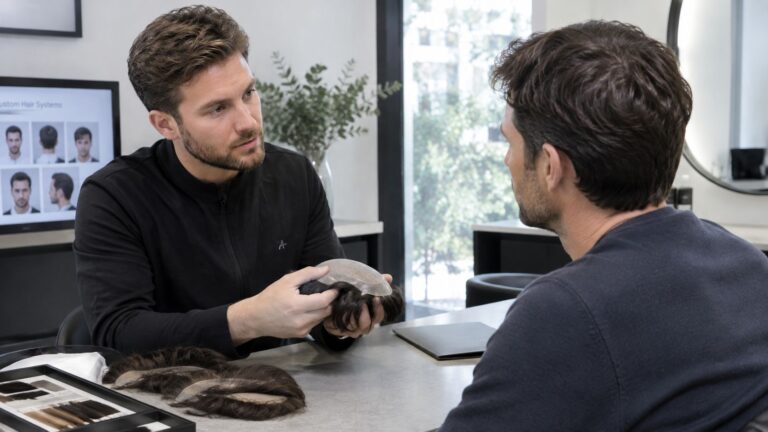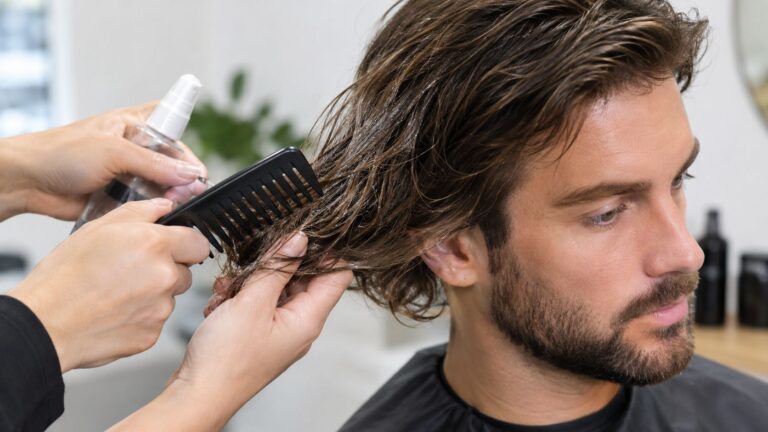
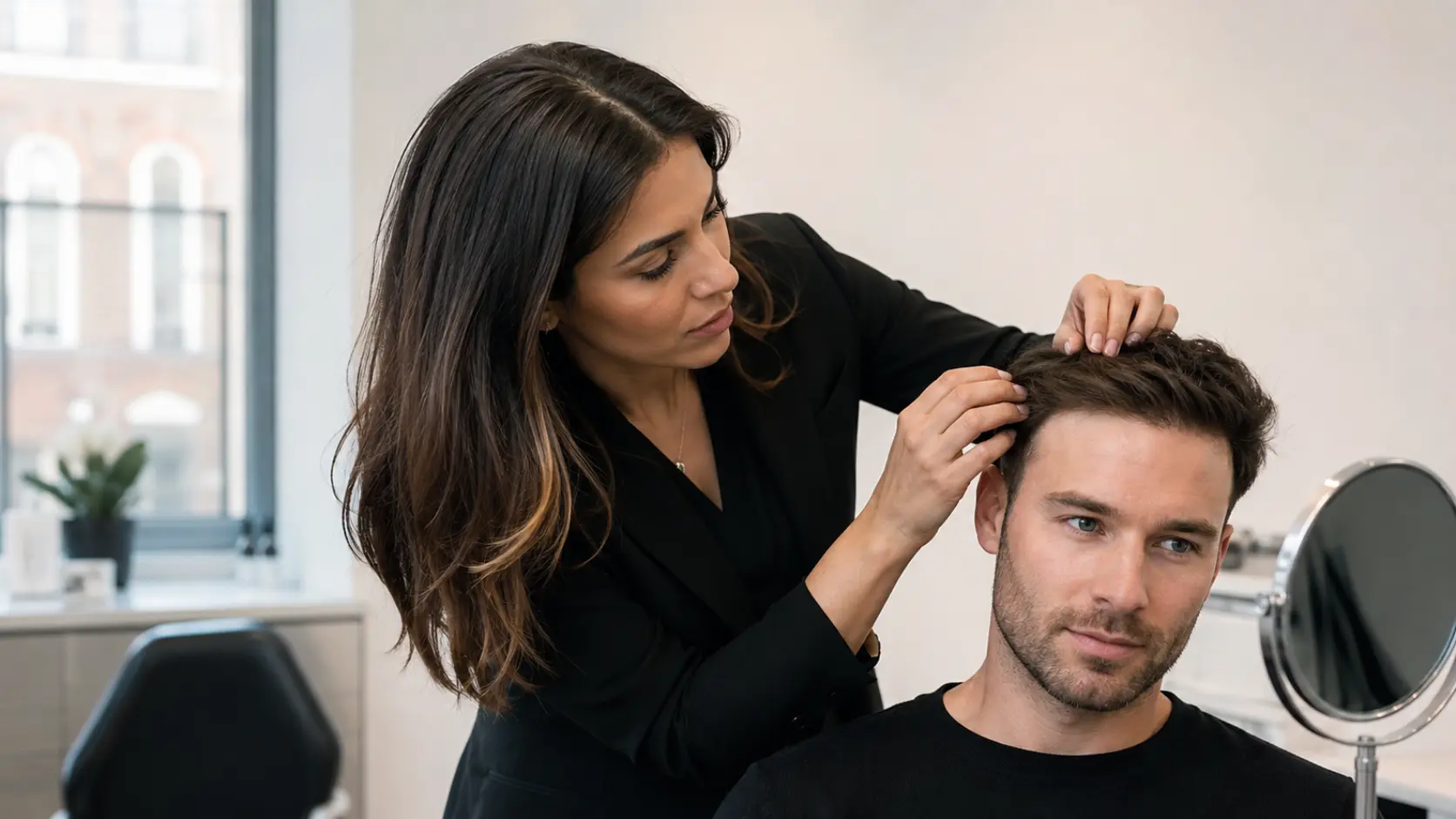

A hair replacement system that looks fake is almost never a problem with the technology; it is almost always a problem with the colour match, the fitting, the base choice, or the maintenance routine. Modern lace and skin systems, when fitted correctly, are designed to be indistinguishable from natural hair at normal social distances. If yours is not looking that way, something specific has gone wrong at one of the stages between manufacturing and the mirror. Here are the ten most common reasons a hair system looks unnatural and what to do about each one.
1. The Colour Match Was Done Under Artificial Lighting
This is the single most common cause of a system that looks “off” and the one most people never suspect because they were not present for the matching process.
Colour-matching under salon or indoor lighting produces inaccurate results because artificial light distorts how hair colour reads. A match that looks perfect under a salon’s overhead lights will look noticeably different in natural daylight, often too warm, too cool, or with an undertone that clashes with your existing hair.
Accurate colour-matching requires natural daylight. If your consultation and matching happened entirely indoors, the mismatch you are seeing is not random, it is predictable.
What to do: Book a colour correction appointment. A proper re-match in natural light, followed by a new unit or a professional toning of the existing one, typically resolves this. At The Hair Standard, every colour match is assessed in natural daylight before any unit is ordered.
2. The Density Is Wrong for Your Remaining Hair
Density of how thick and full the hair in the system is needed to match the density of your own natural hair at the perimeter. If the system is significantly denser than your remaining hair, the contrast between the two creates a visible line where the system ends and your natural hair begins.
This is one of the subtler mistakes and one of the hardest to self-diagnose. It does not announce itself the way a colour mismatch does. Instead, the system looks “too perfect” unnaturally full in a way that draws attention rather than blending.
What to do: Have the density assessed by your technician. On many systems, the perimeter density can be thinned with professional scissors work. If the density difference is significant, a replacement unit ordered to your correct specification will produce a meaningfully more natural result.
3. The Hairline Is Placed Incorrectly
A hairline that sits too low in a position that does not reflect where your natural hairline would realistically fall given your age and hair loss pattern is one of the clearest indicators of a poorly designed system. It reads as artificial because it looks too youthful, too symmetrical, or too perfect.
Similarly, a hairline that is too sharp with no natural variation in the density at the very front looks like a line rather than a hairline.
What to do: Your hairline should be designed around where your natural hairline actually sat, adjusted for realistic hair loss progression, and softened at the front edge with lighter density rather than cut sharply. This is a design decision made at consultation. If yours was not discussed at this level of detail, it is worth raising at your next appointment.
4. You Are Using the Wrong Base Type for Your Haircut
Base type and haircut are more connected than most people realise. Fine French lace produces the most natural result at the hairline but only in haircuts where the hairline is partially concealed by length. In very short styles, tight crops, or fades, the edge of a lace base can become visible if the hair is not long enough to blend over it.
Skin and polyurethane bases are thinner and sit flatter to the scalp, making them more compatible with shorter styles where the scalp is more visible. If your system looks unnatural in a short cut but looks fine when you have more length, the base type may be part of the problem.
We cover how different base types suit different haircuts in detail in our lace, skin, and mono comparison guide.
What to do: Discuss your haircut at your next consultation. The base recommendation should be made in the context of how you actually wear your hair, not as a default choice.
5. The System Was Not Cut and Styled On Your Head
A system that was pre-styled cut before fitting rather than after will never look as natural as one styled in place. The hair needs to be cut on your head, around your face, and blended with your remaining natural hair for the result to look like it grew that way.
Pre-cut systems produce a block shape that sits on the head rather than a shape that suits the individual face. This is one of the biggest quality differences between studios and one of the first questions worth asking before booking.
What to do: At The Hair Standard, every system is cut and styled after fitting not before. If your current system was pre-cut, a session with your technician to reshape it in place will typically improve it significantly.
6. The Base Edges Are Lifting
A bond that is overdue for re-doing lifts at the edges and lifting edges are immediately visible. The base no longer sits flush against the scalp, and even a small amount of lift at the hairline catches light and creates a visible gap between the system and the skin.
This is one of the most common causes of a system that “looked fine for the first few weeks and then started looking fake.” The system itself has not changed. The bond has weakened, and the edges have lifted.
What to do: Book a re-bonding appointment. Do not try to press the edges back down by hand or apply additional adhesive over the existing bond; this creates an uneven surface and shortens the next bond’s holding time. Our complete maintenance guide covers exactly what a re-bonding appointment involves and how to tell when one is due.
7. Product Build-Up on the Base
Styling products, dry shampoo, conditioner applied too close to the roots, and natural scalp oils all accumulate on the base over time. This build-up dulls the hair, changes how it catches light, and can make the base itself visible particularly on lace, where product residue creates a grey or matted appearance at the hairline.
This is a maintenance issue, not a system issue. A unit that looks natural when new often starts to look flat, dull, or noticeably fake within a few weeks if the cleaning routine is inadequate.
What to do: A thorough wash using a sulphate-free shampoo designed for hair systems removes surface build-up. For heavier build-up that has accumulated over time, a professional deep clean at your next service appointment will restore the base and hair to a significantly better starting point. The washing routine we recommend is set out in detail in our aftercare guide.
8. The Hair Texture Does Not Match
Colour is the most visible mismatch, but texture is equally important and more frequently overlooked. If your natural hair is fine and straight and your system uses thicker, slightly wavy hair or vice versa the contrast between the two at the blend line is visible even when colour is accurate.
Texture mismatches are particularly noticeable at the temples and nape, where the system hair and your natural hair sit side by side most closely.
What to do: Texture matching needs to be assessed in person, not from photographs or descriptions. If you have a texture mismatch, it is worth discussing at your next appointment whether the system can be treated or whether a replacement unit with the correct specification is the better solution.
9. You Are Using Heat Styling Incorrectly or on a Synthetic System
Heat styling on a human hair system is fine with the right tools and a heat protectant. But two specific mistakes consistently degrade the appearance of systems: applying high heat directly to the base area, and using any heat on a synthetic hair system.
Heat applied to lace or polyurethane bases changes the material; it can cause lace to become crispy and visible at the hairline, and skin bases to warp or lose their flat profile. Synthetic hair, when exposed to heat, frizzes permanently in a way that cannot be reversed.
If your system’s hairline looks unnaturally shiny, stiff, or kinked or if the hair texture has changed and no longer moves naturally, heat damage is the most likely cause.
What to do: Switch to a low to medium heat setting on human hair systems and use a heat protectant spray. Never apply heat tools to synthetic hair. If the damage is significant, the unit may need replacing and ask your technician at your next appointment whether the damage is cosmetic or structural.
10. The System Has Aged Past Its Usable Life
Every unit has a lifespan typically three to six months with proper care. As a system ages, the hair loses its coating and luster, the colour shifts (often going brassy or flat), and the base begins to thin or stretch at stress points. A system at the end of its life looks noticeably different from the same system at week one.
The most common version of this mistake is continuing to wear a unit past its natural replacement point because it still feels fine and seems to be holding. The bond may be secure, but the appearance has deteriorated. For a full breakdown of how lifespan varies by base type and lifestyle, see our guide to how long hair replacement systems last.
What to do: Replace the unit. A new unit ordered to your now-established specification should look the way your original system looked when it was new and if the colour and texture are dialled in correctly, often better.
The Common Thread Across All Ten Mistakes
Every one of the issues above comes down to one of three things: the fitting process, the maintenance routine, or the wrong system specification for the person wearing it.
None of them are unfixable. None of them mean the technology does not work. What they mean is that somewhere between the consultation and the current moment, something was not quite right and identifying which specific thing is what allows you to correct it rather than conclude that hair systems are not for you.
If you are unsure which of these applies to your situation, a check-in appointment is the most efficient way to find out. A technician who can see the system in person on your head, in natural light can identify the cause far more accurately than any checklist.
For a broader picture of what realistic results look like and what separates strong outcomes from poor ones, our guide on whether hair replacement systems are actually good covers the full range of outcomes honestly.
Frequently Asked Questions
Why does my hair system look fake?
The most common causes are an inaccurate colour match, often made under artificial lighting, incorrect density compared with your natural hair, lifting edges from a bond that needs re-doing, product build-up on the base, or a system that has aged beyond its usable lifespan. In almost every case, there is a specific, fixable reason rather than a fundamental problem with the technology.
Can a fake-looking hair system be fixed without replacing it?
Often, yes, depending on the cause. Lifting edges may need re-bonding, while product build-up may require a professional deep clean. Density issues can sometimes be addressed with careful scissors work, and colour mismatches may be corrected with toning. A technician who assesses the system in person can determine whether servicing is enough or whether replacing the unit is the better option.
How do I stop my hair system from looking obvious at the hairline?
The hairline is one of the most noticeable parts of any system. Common causes of a visible hairline include lifting base edges, a base that is too thick for a short haircut, a hairline positioned too low or too symmetrically, and product build-up on the lace. The right fix depends on the cause, which is why an in-person assessment can be more useful than a general checklist.
Does a more expensive hair system always look more natural?
Not necessarily. A well-matched and properly fitted mid-range system can look more natural than a premium system with a poor colour match or incorrect density. The fitting process and the quality of the technician’s assessment often matter more than the price of the unit when it comes to achieving a natural result.
How often should I replace my hair system to keep it looking natural?
Most units maintain a natural appearance for around three to six months with proper care. Beyond that, colour changes, loss of natural-looking lustre and base deterioration can begin to affect the overall appearance. Regular professional servicing, rather than waiting until the system looks clearly worn, can help keep the result looking natural throughout the unit’s usable life.
If you are unsure which of these applies to your situation, a check-in appointment is the most efficient way to find out. A technician who can see the system in person on your head, in natural light can identify the cause far more accurately than any checklist.
For a broader picture of what realistic results look like and what separates strong outcomes from poor ones, our guide on whether hair replacement systems are actually good covers the full range of outcomes honestly.