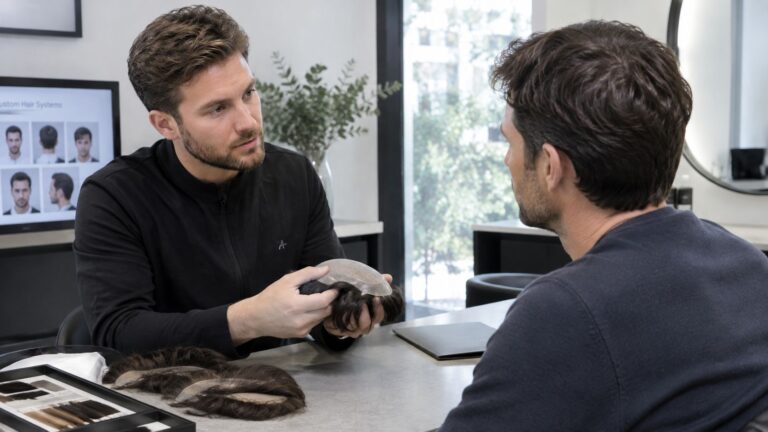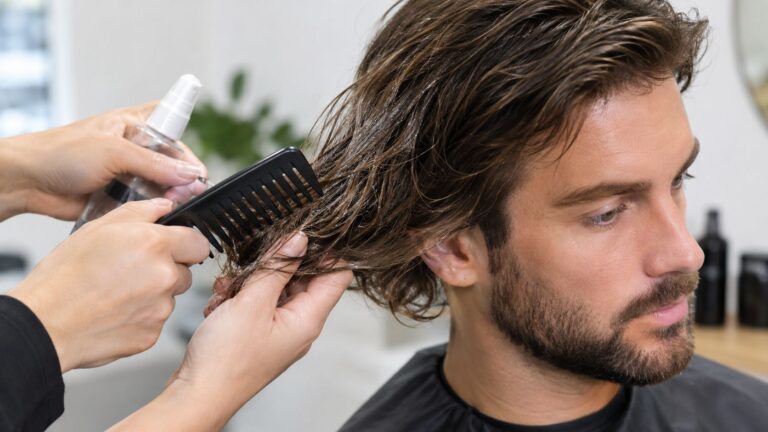
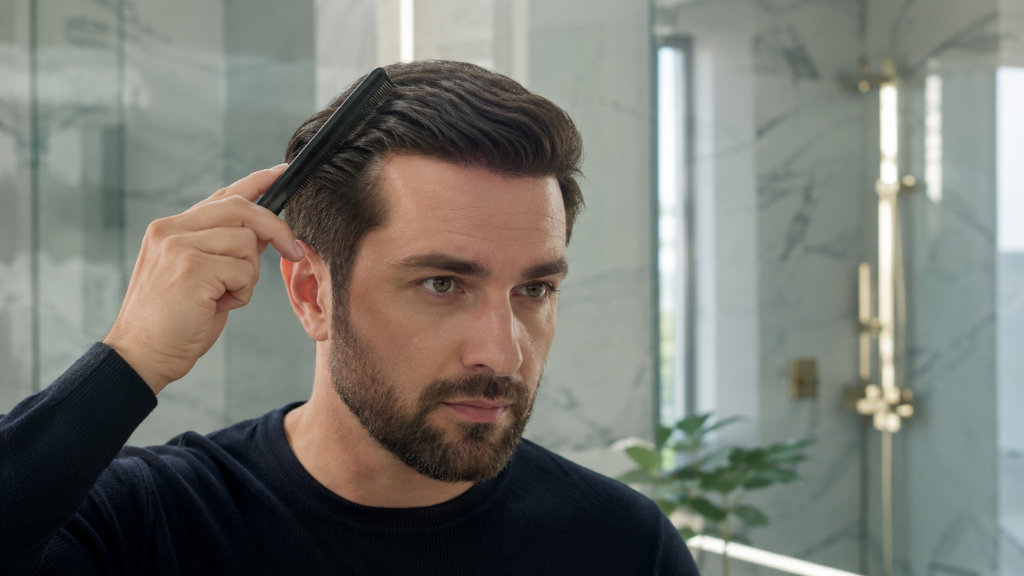

Maintaining a hair replacement system involves three things: a consistent washing routine every 1–2 weeks using the right products, daily habits that protect the base and bond, and professional re-bonding appointments every 1–4 weeks depending on your attachment method and lifestyle. Done consistently, a good maintenance routine keeps your system looking natural, extends the life of each unit, and prevents the most common problems lifting edges, premature shedding, and base degradation. This guide covers everything from daily habits to professional servicing, with specific notes where advice differs between lace and skin/poly bases.
Daily Care
Brushing
Use a wide-tooth comb or soft-bristle brush. Always work from the ends upward toward the roots, never drag from the root down, which puts direct tension on the base and can loosen the bond or pull hair strands from attachment points over time.
For curly or wavy human hair systems, finger-detangling is often preferable to a comb. It preserves the texture without creating friction at the base. Note that synthetic hair has different detangling requirements, handle it more gently still, and avoid pulling through knots, as synthetic fibres cannot be repaired once damaged.
Protecting the bond area
Avoid touching or scratching the hairline and perimeter edges throughout the day. Natural skin oils are one of the most consistent causes of bond breakdown they work into the adhesive from the edges inward and gradually weaken the hold. If you find yourself regularly adjusting the hairline, that is usually a sign the bond needs professional attention rather than something that should be managed by hand.
Sleeping
Sleep on a satin or silk pillowcase. Cotton creates friction against both the hair strands and the base edges over time. For longer hair, loosely tying it back before bed reduces tangling without putting stress on the bond.
Do not sleep with a wet system. Moisture trapped between the base and the scalp weakens adhesive significantly faster than dry wear particularly for skin/poly bases where the bond covers a larger surface area. This is one of the most consistent causes of early bond failure across both base types.
Lace bases specifically: fine lace systems are more susceptible to degradation from overnight friction and sweat than skin/poly bases. If you have a fine lace system and notice the lace weakening faster than expected, speak to your technician about whether nightly removal is advisable for your specific unit.
The Washing Routine
Wash your system every 7–14 days depending on how much you sweat, how many products you use, and your activity level. More frequent washing is fine if needed, but always use the correct products. Standard shampoos break down lace fibres and degrade skin bases faster than system-specific formulas.
On-head vs off-head washing
This is one of the most important decisions in your washing routine and one most guides skip.
- Lace bases with perimeter bonding can generally be washed on the head, provided care is taken around the hairline.
- Skin/poly bases with full-coverage bonding are at higher risk to wash on-head, because water and shampoo can work under the base more easily when the adhesive covers the entire scalp contact area. Many technicians recommend detaching a skin base and washing it off the head to avoid weakening the bond mid-cycle.
Ask your technician which approach is right for your base type. If in doubt, off-head washing is the safer default.
What you need
- Sulphate-free shampoo formulated for hair systems or colour-treated hair
- A lightweight, silicone-free conditioner (for human hair systems only)
- A soft microfibre towel
- A wide-tooth comb
Avoid shampoos containing sulphates, alcohol, or heavy detergents. These strip the hair of its coating, cause colour to fade faster, and break down lace fibres with repeated use. Standard supermarket shampoos are almost always unsuitable.
Synthetic hair systems: Do not use standard conditioner on synthetic hair it coats the fibres and causes build-up that attracts dirt and dulls the appearance. Use only products specifically formulated for synthetic hair. Heat tools are not compatible with synthetic systems regardless of the temperature setting.
Step-by-step process
Step 1 Wet thoroughly with lukewarm water.
Avoid hot water. Hot water softens adhesive bonds and can cause lace fibres to become brittle over time. Wet the hair gently from root to tip, keeping pressure light at the hairline.
Step 2 Apply sulphate-free shampoo from mid-length to ends.
Work gently upward toward the base using your fingertips never nails. Do not scrub at the base or hairline area.
Step 3 Rinse thoroughly.
Rinse until the water runs clear. Product residue left in the base is one of the leading causes of scalp irritation and bond breakdown. Take longer than feels necessary.
Step 4 Condition the hair only (human hair systems).
Apply a small amount of lightweight conditioner from mid-length downward. Never apply at the roots or on the base itself; the conditioner in the bond area softens adhesive and accelerates lifting, on both lace and skin bases. Leave for two to three minutes, then rinse fully. Synthetic systems: skip this step and use a synthetic-specific product if needed.
Step 5 Pat dry, never rub.
Press the hair gently with a soft towel. Rubbing creates friction that roughens the cuticle on human hair and can stress lace fibres. Squeeze sections between the towel rather than pulling through the length.
Step 6 Dry fully before sleeping or activity.
Air dry where possible. If using a hairdryer, use a low to medium heat setting, keep the dryer moving constantly, and do not hold it stationary over one area of the base. Use a heat protectant spray on human hair systems. Do not use heat tools on synthetic hair systems under any circumstances.
Deep conditioning (human hair systems)
Human hair systems have no scalp to produce natural oils, so the hair dries out faster than natural hair over the course of a unit’s life. A monthly deep conditioning treatment applied to the hair length, not the base helps maintain softness and prevents the hair from becoming brittle toward the end of the unit’s cycle.
Bond Management, Removal and Re-application
How long should your bond last?
Tape typically holds for 1–3 weeks; liquid adhesive typically holds for 2–4 weeks. These are indicative ranges; the actual lifespan depends on skin chemistry, adhesive type, base material, activity level, and climate. Neither tape nor liquid is universally longer-lasting; your technician will recommend the right product for your specific combination of factors.
Do not try to stretch the bond significantly beyond its natural lifespan. A weakening bond that is left too long starts to lift at the edges, allowing moisture and bacteria underneath which causes scalp irritation and degrades the base material from beneath.
Signs your bond needs attention
- Visible lifting or movement at the hairline or perimeter edges
- The system shifting when you brush or style
- Redness, itching, or odour under the base
- A pulling sensation that wasn’t there immediately after fitting
At the first sign of any of these, book a re-bonding appointment. Do not try to press edges back down by hand or apply additional adhesive over an existing bond. Layering adhesive without removing the old bond first creates an uneven surface, shortens the next bond’s holding time, and is one of the most common causes of base damage.
Adhesive removal
Use a purpose-made citrus-based bond remover. Apply to the edge of the bond and allow it to penetrate for one to five minutes depending on adhesive strength; lighter tape removal may only need a minute; stronger full-coverage adhesives used on skin bases typically need longer. Never pull or force the base away. If there is resistance, apply more remover and wait.
After removal, clean the base thoroughly to remove all adhesive residue before the next application. Residue left on the base creates an uneven bonding surface and reduces the holding time of the next application.
Scalp care between bond appointments
The scalp under a bonded system still accumulates sweat, dead skin cells, and product residue between professional appointments. Clean accessible areas of the scalp gently using a cotton pad with a small amount of diluted witch hazel or a system-safe scalp cleanser. Avoid working liquid under the base near the bond edges. A clean scalp between appointments also improves the holding time of your next bond application.
Product Guide
| Product type | Safe to use | Avoid |
| Shampoo | Sulphate-free, system-specific | Sulphate-based, volumising, anti-dandruff, clarifying |
| Conditioner | Lightweight, silicone-free (human hair only) | Heavy conditioners, root treatments, synthetic-hair use |
| Styling products | Light-hold sprays, water-based pomades (mid-length only) | Oil-based products near the bond perimeter |
| Heat tools | Low–medium heat with protectant (human hair only) | Any heat on synthetic hair |
| Dry shampoo | Occasionally, mid-length only | At the roots or base causes residue build-up |
The single most important rule: keep oil-based products away from the bond perimeter. Oil seeps into adhesive, softens it, and causes edge lifting before the bond has reached its natural lifespan.
Lifestyle Factors: Swimming, Sport, and Climate
Swimming: Rinse the hair in clean water before entering a chlorinated pool or the sea this reduces how much chlorine or salt the base and hair absorb. Rinse thoroughly again immediately after.
Important base-type distinction: Fine lace systems are significantly more susceptible to chlorine damage than skin/poly bases. If you swim regularly, discuss this with your technician before committing to a lace base; a more durable base type may be the more practical choice for your lifestyle.
Exercise and sweating: Sweat primarily shortens bond lifespan rather than causing immediate failure. If you train heavily five or more times per week, expect to re-bond at the shorter end of the typical window and plan your appointment schedule accordingly.
Climate: Heat and humidity accelerate bond breakdown adhesive softens in high temperatures and weakens faster. In cold weather, some adhesives become more brittle and less flexible at the hairline. If you notice seasonal changes in how long your bond holds, mention it at your next appointment the adhesive type may need adjusting.
Professional Servicing: What It Involves and When to Book
A professional service is not just re-bonding. A proper appointment includes full adhesive removal and scalp cleaning, a deep clean of the unit to remove product and mineral build-up, inspection of the base for early signs of wear, re-application of bond, and a style refresh if needed.
If you’re weighing the maintenance commitment of a system against a transplant, our honest comparison guide covers the long-term reality of both.
Book re-bonding when the bond is due not when it is visibly failing. Schedule a more thorough base inspection every two to three months so a technician can assess the unit itself. Catching a stress point or early lace tear is a quick repair; a base left past its usable life typically requires a full unit replacement earlier than it should.
Storage (for Removable and Clip-in Systems)
If you remove your system daily or between wears, store it correctly to preserve the base and hair:
- Place it on a wig stand or a head-shaped form to maintain the base shape
- Keep it away from direct sunlight, which causes colour fading in both human hair and synthetic systems
- Store in a cool, dry place humidity causes lace to warp and adhesive residue to soften
- Cover loosely with a silk or satin bag rather than storing compressed in a box
Frequently Asked Questions
Hair replacement system maintenance — answers to the most common questions
How often should I wash my hair replacement system?
Every 7–14 days for most wearers. Wash more frequently if you sweat heavily or use a lot of styling products, but always use a sulphate-free, system-specific shampoo. Standard shampoos degrade both lace fibres and skin bases faster than purpose-made formulas, regardless of washing frequency.
Should I wash my system on or off my head?
It depends on your base type. Lace systems with perimeter bonding can generally be washed on the head carefully. Skin/poly bases with full-coverage bonding are safer to detach and wash separately, as water can work under the base more easily and weaken the bond mid-cycle. Ask your technician which approach suits your specific unit.
What shampoo should I use on a hair replacement system?
A sulphate-free shampoo designed for hair systems or colour-treated hair. Avoid volumising, anti-dandruff, clarifying, and standard supermarket shampoos — the active ingredients strip the hair and degrade both lace and skin bases with repeated use. Synthetic hair systems require products specifically formulated for synthetic fibres.
How do I remove adhesive without damaging my system?
Use a citrus-based bond remover. Apply to the edge of the bond, allow it to penetrate for one to five minutes depending on adhesive strength, then gently lift the base away. Never force or pull — if there is resistance, apply more remover and wait longer. For skin bases with full-coverage bonding, patience is especially important as the adhesive surface area is larger.
Can I swim with a hair replacement system?
Generally yes, but it depends on your base type. Skin/poly bases handle swimming well. Fine lace bases — particularly French lace — are more vulnerable to chlorine damage and are not well suited to frequent swimming. Always rinse before and after swimming regardless of base type, and discuss your swimming routine with your technician when choosing a base.
What products should I avoid with a hair replacement system?
Anything sulphate-based, oil-based near the bond perimeter, or high in alcohol. Do not use heat tools on synthetic hair systems. Avoid applying conditioner, oil treatments, or heavy pomades near the hairline — these are the most consistent causes of early bond breakdown across all base types.
How do I know when my bond needs re-doing?
Visible lifting at the hairline or edges, the system moving when brushed or styled, redness or itching under the base, or a new pulling sensation are all signs. Book a re-bonding appointment at the first sign rather than pressing edges down manually or applying fresh adhesive over the existing bond.
Can I sleep in my hair replacement system?
For most bonded systems, yes — but it depends on your base type and how well the bond is holding. Skin/poly bases generally handle overnight wear well. Fine lace systems are more prone to damage from friction and overnight sweat. Use a silk or satin pillowcase, never sleep with the system wet, and speak to your technician if you notice lace degrading faster than expected.