
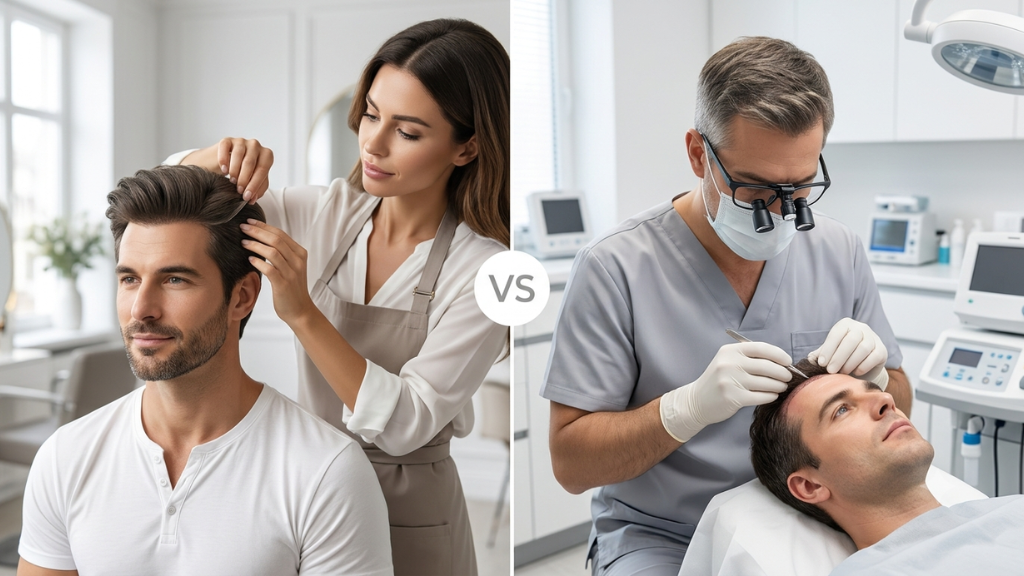

A hair replacement system provides a custom fitting that requires regular maintenance for instant results and is a non-invasive option. A hair transplant redistributes the follicles that you already have, and the results can be seen within 6-18 months. Hair transplants are permanent and invasive. The optimal choice for you is based on your budget, timeline, your attitude toward surgery, and the stage of your hair loss, as neither option is superior.
Quick Comparison: Hair System vs Hair Transplant at a Glance
| Factor | Hair Replacement System | Hair Transplant |
| Results timeline | Same day | 6–18 months |
| Permanence | Temporary ongoing replacement | Permanent (transplanted follicles) |
| Surgery required | No | Yes (minor, local anaesthetic) |
| Upfront cost | £500–£1,500 | £3,000–£10,000+ |
| Long-term cost | Higher (ongoing maintenance) | Lower (mostly one-off) |
| Suitable for all hair loss stages | Yes | No donor supply must be sufficient |
| Recovery period | None | 1–2 weeks, full results 6–18 months |
| Reversible | Yes | No |
| Works for alopecia | Usually yes | Not always |
| Maintenance required | Regular (re-bonding, replacement) | Minimal once established |
What Is a Hair Replacement System?
Definition: Hair replacement systems, hair units, hairpieces, and non-surgical hair replacement systems are all terms for custom bases (made of lace, polyurethane/skin, or monofilament) which are made specifically for an individual and have hair (real or synthetic) bonded to them. They are adhered to the scalp with special tape or adhesive and are blended to the person’s remaining hair.
Hair systems and wigs are very different. A wig is a complete covering for a person’s head. A hair system is for a specific area that has hair loss. The hair system is made specifically to the person’s hair color, texture, and density, and is designed to hair that is styled to the system so that it is undetectable.
Who fits them: Hair systems are made in specialty studios by trained technicians and the hair systems are only as good as the fitting and the hair color matching.
Key takeaway: The biggest benefit is the same day result because Hair replacement systems are non-invasive and hair loss can be very emotionally challenging, so timely solutions are very important.
What Is a Hair Transplant?
Definition: A hair transplant is an elective surgery (done with only local anesthesia) in which a person has hair loss on a large area of their scalp and a donor area with full hair is used to move hair follicles and implanted into thinning or bald areas.
The most widely used modern technique is FUE (Follicular Unit Extraction), in which individual follicles are removed one by one, leaving minimal scarring. The older FUT (Follicular Unit Transplantation, or “strip” method) removes a strip of scalp and leaves a linear scar but can yield more grafts per session.
Transplanted follicles retain the genetic characteristics of the donor site meaning they continue to grow permanently. However, surrounding natural hair can still thin or fall after a transplant, sometimes requiring further procedures or ongoing medical treatment.
Regulatory note: Hair transplants in the UK are classified as a surgical procedure. The Care Quality Commission (CQC) regulates clinics providing surgical treatments. Always verify a clinic’s CQC registration before proceeding.
Key takeaway: A hair transplant permanently relocates your own follicles but results take up to 18 months and depend entirely on donor supply.
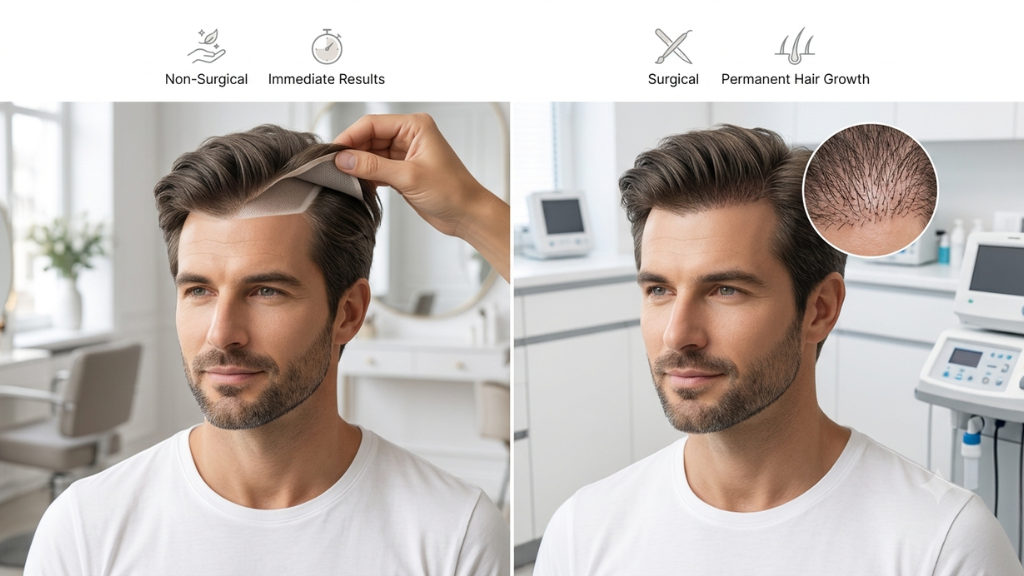
How Do Results Actually Compare?
Does a hair system look natural?
Yes when properly colour-matched and fitted by an experienced technician. The most common cause of an unnatural result is poor colour or density matching, not the technology itself. A well-fitted lace or skin-base system replicates a natural hairline, moves naturally, and is undetectable at normal social distances.
The limitation is that the result depends on consistent maintenance. A system that is overdue for re-bonding or replacement will begin to look less natural as the base lifts or the hair thinns.
Does a hair transplant look natural?
Yes because it uses your own follicles. Transplanted hair grows, sheds in its natural cycle, and can be cut and styled exactly like the rest of your hair. A well-executed FUE transplant by an experienced surgeon produces a hairline that is genuinely indistinguishable from natural growth.
The limitation is graft availability. A transplant can only work with the donor follicles you have. Insufficient donor supply relative to the coverage needed leads to lower density results one of the most common sources of post-procedure dissatisfaction.
Common misconception: transplants always look more natural than systems
Not accurate. A poorly planned transplant whether due to inadequate donor supply, an unnatural hairline design, or progression of hair loss around the transplanted area can look less natural than a well-fitted system. Quality of execution matters in both cases.
Key takeaway: Both options can look completely natural the quality of execution, not the technology, determines the result.
Cost Comparison: Short Term vs Long Term
This is the most misunderstood part of the comparison.
Hair replacement system costs
| Cost element | Typical range |
| Initial fitting and first unit | £500–£1,500 |
| Replacement unit (every 3–6 months) | £300–£800 |
| Professional re-bonding (every 1–4 weeks) | £30–£80 per appointment |
| Annual total (typical ongoing) | £1,500–£4,000+ |
| 5-year cumulative estimate | £7,500–£20,000+ |
Hair transplant costs
| Cost element | Typical range |
| FUE procedure (UK clinic) | £3,000–£10,000+ |
| FUT procedure (UK clinic) | £2,500–£7,000 |
| Second procedure (if needed) | £2,000–£7,000 |
| Ongoing medication (optional, e.g. finasteride) | £150–£400/year |
| 5-year cumulative estimate (single procedure) | £3,500–£12,000 |
The honest comparison: In the first year, a system is cheaper. Over five or more years of ongoing servicing and unit replacement, the cumulative cost of a system typically exceeds the one-off cost of a transplant provided the transplant is a single procedure and produces a satisfactory result.
Important caveat: If a second transplant is needed, or if ongoing medical treatment is required post-procedure, the transplant cost rises significantly. If your hair loss is still progressing, a transplant done too early may require revisiting.
Key takeaway: A system costs less upfront; a transplant typically costs less over the long term but only if you’re a good candidate and one procedure is sufficient.
Recovery and Downtime: A Direct Comparison
Hair replacement system: what to expect
- Attend a consultation for scalp mapping and colour matching
- Wait for custom unit to be manufactured (days to a few weeks)
- Attend fitting appointment the system is bonded, cut, and styled
- Leave the same day with a full head of hair
- Return every 1–4 weeks for re-bonding; every 3–6 months for unit replacement
Total downtime: Zero.
Hair transplant: what to expect
- Pre-procedure consultation and scalp/donor assessment
- Procedure day 4–8 hours under local anaesthetic depending on graft count
- Days 1–7: swelling, redness, scabbing around recipient sites; most patients take at least a week off work
- Weeks 2–6: shock loss transplanted hair sheds (normal and expected, but psychologically difficult)
- Months 3–6: early regrowth begins
- Months 6–12: significant visible improvement
- Month 12–18: final result visible
Total recovery period: 12–18 months to see the full result.
Practical implication: If you need to address hair loss within months before a significant life event, for confidence reasons, or because the psychological impact is affecting you now a hair transplant cannot meet that timeline. A hair replacement system can.
Key takeaway: A system delivers results the same day; a transplant requires 12–18 months and a visible recovery period before results are clear.
Who Is Each Option Best For?
Hair replacement system: best for
- Anyone at any stage of hair loss, including significant baldness
- People who want immediate results with no surgery
- Men and women with alopecia (areata, totalis, or scarring alopecias) where transplants are often unreliable
- Younger men whose hair loss pattern hasn’t stabilised transplanting too early risks surrounding natural hair continuing to recede around permanent grafts
- People who want to try a full head of hair before committing to a permanent solution
- Anyone for whom surgery is not an option due to health, anxiety, or preference
- People with insufficient donor hair for adequate transplant coverage
Hair transplant: best for
- People whose hair loss has stabilised and whose donor supply can adequately cover the area
- Anyone who wants a permanent, genuinely maintenance-free result and can wait 12–18 months
- People comfortable with a minor surgical procedure and a short recovery period
- Anyone with a realistic expectation of what their donor supply can achieve not every degree of coverage is possible for every person
Neither may be the right immediate choice if
- Hair loss is in very early stages monitoring alongside medical treatment (finasteride, minoxidil) is often the most clinically appropriate first step
- You are making a decision reactively, under distress, without proper consultation both options benefit from informed decision-making
Pros and Cons: Side by Side
| Hair Replacement System | Hair Transplant | |
| Pros | Immediate results | Permanent result |
| No surgery | No ongoing professional maintenance once established | |
| Reversible | Your own hair grows and behaves naturally | |
| Works for all hair loss stages | One-off cost | |
| Works for alopecia | No adhesive or bond routine | |
| Cons | Ongoing cost | High upfront cost |
| Regular maintenance required | 12–18 month wait for results | |
| Unit needs periodic replacement | Recovery period with visible shock loss phase | |
| Bond needs professional re-doing | Requires sufficient donor supply | |
| Not permanent | Not reversible | |
| Surrounding natural hair can still thin post-procedure |
The Hybrid Approach: Something Most Guides Don’t Cover
A significant number of people use both options over time a system in the short term while hair loss stabilises, followed by a transplant once the pattern has established and donor supply can be properly assessed.
This approach is particularly common for men in their 20s and early 30s, where transplanting too soon risks surrounding natural hair continuing to recede around permanent grafts creating an isolated patch of transplanted hair that looks increasingly unnatural over time.
Using a system during this window is not a compromise. It addresses the immediate psychological and social impact of hair loss without foreclosing the transplant option or risking an early procedure that may need correcting.
Key takeaway: For younger men with progressing hair loss, a system now and a transplant later is often the clinically smarter sequence not one or the other.
Common Misconceptions
“Hair transplants are always permanent.” The transplanted follicles are permanent but surrounding natural hair can still thin after the procedure, sometimes significantly. Many surgeons recommend ongoing finasteride post-transplant to protect remaining natural hair.
“Hair systems always look fake.” This was true of older, mass-produced systems. Modern custom-fitted systems, colour-matched by an experienced technician, are designed to be undetectable including at the hairline.
“A transplant is always the better long-term solution.” Only if your donor supply is sufficient, your hair loss has stabilised, and one procedure covers the area adequately. For people with progressive loss or limited donor hair, a system may remain the better long-term choice indefinitely.
“Wearing a system rules out a future transplant.” It doesn’t. Your donor supply and hair loss pattern not whether you’ve worn a system determine transplant candidacy.
Decision Framework: How to Choose
Work through these questions in order:
1. How urgent is the result?
If you need a result within months stop here. A transplant cannot deliver within that timeline. A system is your option.
2. Is your hair loss still actively progressing?
If yes a system is usually the wiser short-term choice. A transplant performed while loss is still progressing often requires revisiting.
3. Do you have sufficient donor hair?
This requires an in-person assessment from a qualified hair transplant surgeon. If donor supply is limited relative to the coverage needed a system may be the better permanent solution.
4. What is your five-year budget?
If upfront cost is the constraint, a system is more accessible. If long-term cost is the concern and you’re a good transplant candidate, a one-off transplant cost may work out lower overall.
5. How do you feel about surgery and recovery?
If surgery is not something you’re willing to undergo the answer is a system, regardless of other factors.
6. Do you have alopecia?
If yes consult a dermatologist before pursuing either option. Hair systems typically work well across most alopecia types. Transplants into actively affected scalp can be unreliable.
Expert Insight
The International Society of Hair Restoration Surgery (ISHRS) consistently emphasises that patient selection is the most critical factor in transplant outcomes specifically, that realistic expectations about donor supply and coverage density are essential before proceeding. A transplant performed on an unsuitable candidate, or at the wrong stage of hair loss progression, produces results that are difficult and costly to correct.
This is not a reason to avoid transplants it’s a reason to make sure the assessment is thorough before deciding.
Our Honest Position at The Hair Standard
We fit hair replacement systems. We don’t perform transplants. You should factor that into how you read this page.
What we can tell you from the consultations we carry out is that the clients most satisfied with their outcome regardless of which option they ultimately chose are the ones who understood both properly before deciding.
If you’re genuinely undecided, the most useful next step is two separate conversations: one with a CQC-registered hair transplant surgeon for an honest donor assessment, and one with a hair system specialist for an in-person fitting consultation. Both should be free. Together they give you what neither can provide alone.
Book a free no-obligation consultation at The Hair Standard in London see what a fitted system looks like on your hairline, with no pressure to proceed.
Frequently Asked Questions
Is a hair replacement system cheaper than a hair transplant?
Short-term, yes. A system has a lower upfront cost (£500–£1,500) compared to a transplant (£3,000–£10,000+). Long-term, ongoing system maintenance and unit replacement costs typically exceed the one-off transplant cost over five or more years provided the transplant is successful and a single procedure is sufficient.
How long does a hair transplant take to show results?
Most patients see significant regrowth between 6 and 12 months post-procedure, with final results typically visible at 12–18 months. A shock-loss phase where transplanted hair sheds before regrowing is normal and expected between weeks 2 and 6.
Can I wear a hair system while I decide about a transplant?
Yes and for many people, particularly younger men with progressing hair loss, this is the recommended approach. Wearing a system doesn’t affect your future transplant candidacy, and it addresses the immediate impact of hair loss while your pattern stabilises.
Which is better for alopecia a system or a transplant?
Hair replacement systems generally work well across most types of alopecia and are often preferred where the condition is still active or unpredictable. Transplanting into scalp affected by active alopecia can produce unreliable results. A dermatologist consultation is important before pursuing either option.
Does a hair transplant rule out wearing a system later?
No. If a transplant doesn’t achieve the coverage expected, or if hair loss continues to progress around the transplanted area, a system can address the remaining gaps without any conflict.
What happens if my hair loss continues after a transplant?
Transplanted follicles are permanent they don’t fall out. But surrounding natural hair can continue to thin, potentially leaving the transplanted area looking isolated. This is one reason ongoing medical treatment (finasteride, minoxidil) is often recommended post-transplant, and why having realistic expectations about progressive loss is essential before proceeding.
Is a hair system or transplant better for younger men?
For most men under 30 with actively progressing hair loss, a system is generally the wiser short-term choice. Transplanting too early before the full hair loss pattern has established risks surrounding natural hair continuing to recede around permanent grafts. A system addresses the immediate concern without foreclosing a transplant later.
How do I know if I’m a good transplant candidate?
The key factors are: sufficient donor hair supply relative to the coverage area needed, stable (or stabilising) hair loss, realistic expectations about achievable density, and good general health. This requires an in-person assessment from a qualified hair transplant surgeon not an online form or photo consultation.