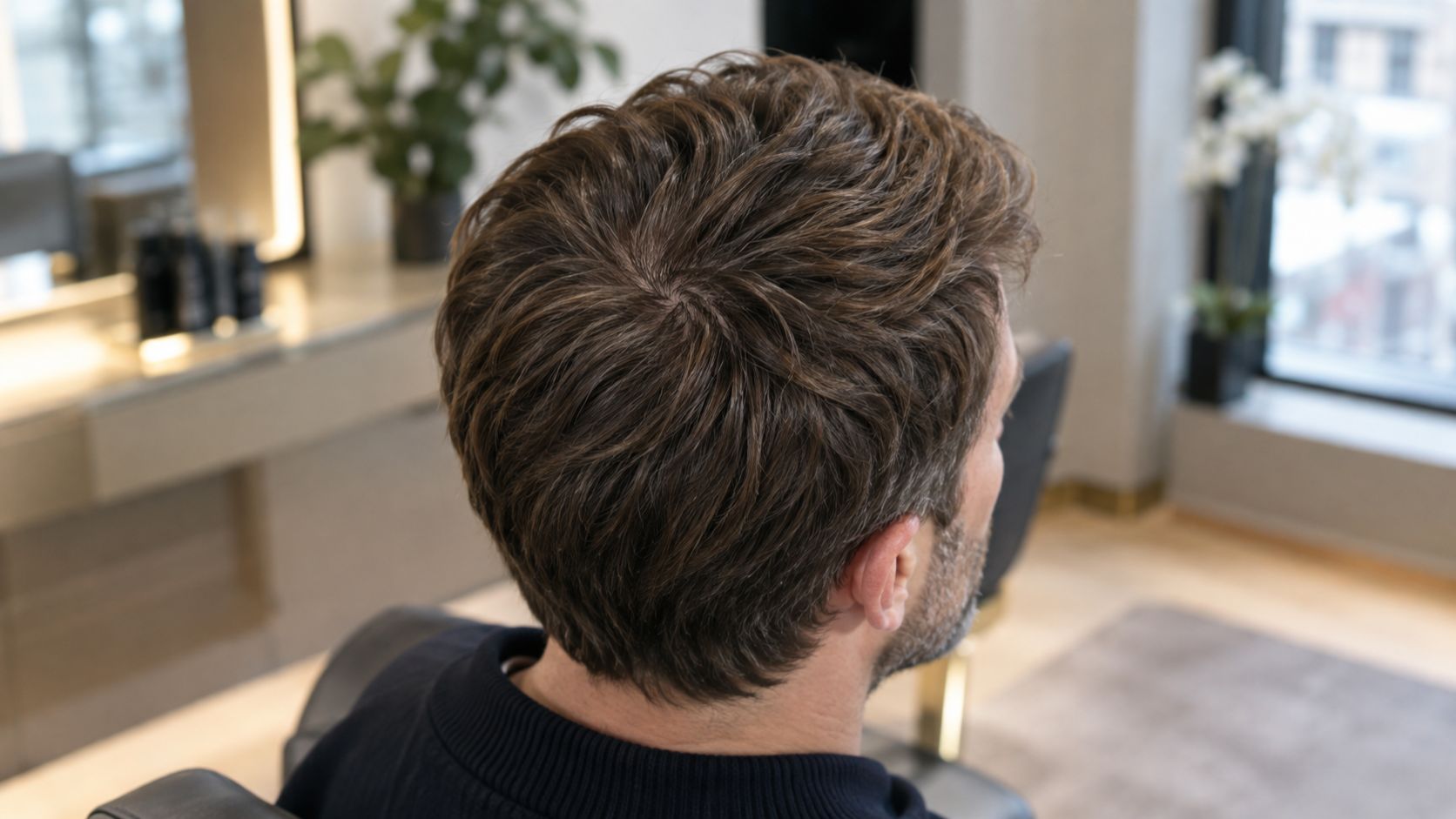

Crown thinning is one of the most effectively addressed hair loss patterns with a hair replacement system; a custom-fitted unit can restore full density at the crown with no surgery, no recovery period, and a result visible the same day as fitting. The challenge with crown thinning specifically is that it requires a different fitting approach from hairline recession, because the area of loss is on the top of the head rather than at a visible front edge, and because the system needs to blend seamlessly with existing hair that surrounds it on all sides rather than just at a defined perimeter. Getting that blend right is what separates a system that looks completely natural from one that looks like a patch and it is almost entirely determined by the quality of the fitting process. This guide covers everything you need to know before choosing a system for crown thinning: how the fitting differs from hairline systems, which base types suit crown coverage, what to expect from the process, and how to maintain the result.
What Crown Thinning Is and Why It Presents Differently
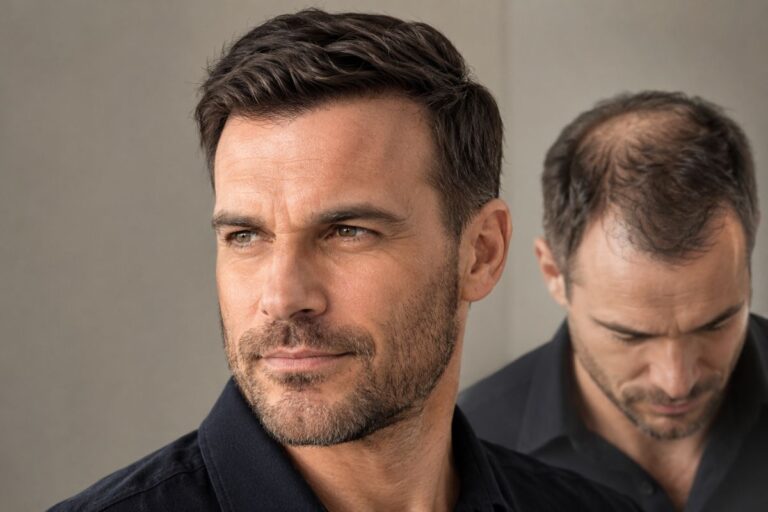
Crown thinning diffuse thinning at the vertex of the scalp, often without significant hairline recession, is one of the most common patterns of androgenetic hair loss.
Crown thinning often develops alongside or after hairline recession. The two loss patterns can exist separately or together; some men have significant crown thinning with a largely intact hairline, while others have both. The crown is often the last area a person notices because it is not visible from the front when looking in a mirror. By the time crown thinning becomes personally noticeable, it has often been visible to others for some time.
Crown thinning from other causes including traction alopecia from tight styling, alopecia areata presenting at the vertex, or post-chemotherapy regrowth that is thin at the crown follows different patterns but can be addressed by the same fitting approach, with the base coverage area and density designed around the specific area and degree of loss.
How Crown System Fitting Differs From Hairline Fitting
This is the most important technical distinction to understand before choosing a studio. Crown thinning and hairline recession require completely different approaches to system design and a studio with extensive experience in hairline work does not automatically have the same expertise in crown coverage.
The blend challenge is different
A hairline system has one critical edge: the front hairline where the system meets the skin and where the transition must be invisible. The rest of the system is surrounded by hair that can overlap and disguise the edges.
A crown system has no defined front edge. It sits in the middle of the scalp, surrounded by existing natural hair on all sides front, back, left, and right. Every edge of the system needs to blend with natural hair. If the density at any edge of the crown unit is slightly too high, or if the hair direction does not match the natural hair around it, the unit will produce a visible contrast to a ring of denser, different-textured hair that identifies exactly where the system sits.
This 360-degree blend requirement is significantly more demanding than a hairline blend, and it is the primary reason crown fitting requires specialist experience.
Hair direction and natural growth patterns
Natural hair does not grow uniformly in one direction. At the crown specifically, hair grows outward from a central point the crown whorls in a spiral or radial pattern. A crown system must replicate this growth pattern for the hair to lie naturally and move correctly.
A system with hair that grows in a uniform direction rather than replicating the radial crown pattern will reveal itself every time the hair is brushed, moves in wind, or is viewed from certain angles. The hair will lie in a direction that conflicts with the natural hair around it.
Experienced technicians at The Hair Standard map the direction of the client’s natural crown whorl before specifying the system, so the hair direction built into the unit matches the client’s specific growth pattern rather than a generic template.
Density gradation at the edges
Crown systems need graduated density lower at the perimeter, slightly denser toward the centre rather than a uniform density across the whole unit. Natural hair density is not uniform. The hair at the front edge of a crown thinning area is typically finer and less dense than hair elsewhere; the system needs to match this gradation rather than sitting at a fixed density that creates an abrupt contrast at the edges.
Which Base Types Suit Crown Coverage
The base material choice for crown coverage is determined by different priorities than for hairline coverage because the hairline visibility concern that makes lace the default for front hairlines is less relevant for a crown system, while durability and the ability to hold styling in multiple directions become more important.
Lace bases
Fine lace French or Swiss lace produces the most natural-looking result and the most convincing scalp appearance through the hair at the crown parting. For men with lighter hair, or anyone who parts their hair and exposes the scalp area at the crown, lace produces the most natural scalp-through appearance.
The trade-off is that lace is the most delicate base material. For crown coverage specifically, the centre of the base where a scalp-show parting is most visible benefits from lace, while the perimeter edges can use a slightly more durable lace variant to handle the adhesive contact.
Skin and polyurethane (PU) bases
Skin bases are more durable and water-resistant than lace, and they handle the all-over bonding required for a centre-scalp system more robustly. The trade-off is that the scalp appearance through the hair is less convincing than fine lace. A skin base looks like a skin-coloured surface through the parting rather than replicating the texture of natural scalp.
For men with shorter hair and no parting where the crown is styled to cover the base surface rather than part over it a skin base is often the more practical choice. For wearers who part their hair and want the parting to look natural through the system, lace or a monofilament is more appropriate.
Monofilament bases
Monofilament bases sit between lace and skin in terms of durability and natural appearance. They produce a more natural scalp appearance than skin bases the individual hair knots on a mono base are less visible from above than on a skin base and are significantly more durable than fine lace.
For crown coverage where durability matters and the wearer does not need the maximum natural scalp appearance of fine lace, monofilament is often the strongest practical choice. It handles the central positioning of a crown unit well and is less susceptible to the friction and movement stress that the middle-of-scalp positioning creates.
Hybrid bases
For crown coverage, hybrid base designs of monofilament or skin at the centre, with a lace perimeter for natural hair direction blending at the edges are often the most practical specification. This gives the most natural appearance at the areas where it most affects the result while providing durability where it matters for bond longevity.
Your technician at The Hair Standard will assess which base configuration suits your specific crown loss pattern, hair type, and lifestyle before specifying the system the choice is not standardized.
What to Expect at a Crown Fitting
Consultation and mapping
The first appointment involves a detailed assessment of the crown thinning area its size, shape, the remaining hair density at its edges, and the direction of the surrounding natural hair. The crown whorl position is identified, and the gradation pattern at the edges of the loss area is assessed to understand exactly how the system perimeter needs to be designed.
At this stage, colour and texture matching is also carried out in daylight matching to the natural hair immediately adjacent to the thinning area, which is what the system will need to blend with.
Sizing the base
The base for a crown system is sized specifically to cover the area of loss without extending into areas where natural hair still grows adequately. An oversized base sits on natural hair at its edges, which is visible and uncomfortable. An undersized base does not provide complete coverage.
For diffuse thinning where there is no clearly defined edge between the thinning area and the surrounding hair the base sizing involves a judgment about where the density reduction is significant enough to need coverage, which requires experience to assess accurately.
Manufacturing
The custom unit is made to the specification established at the consultation the correct size, the correct hair direction replicating the crown whorl, the graduated density at the edges, and the colour and texture matched to the natural hair. Manufacturing typically takes a few days to a few weeks depending on the base type and specification.
The fitting
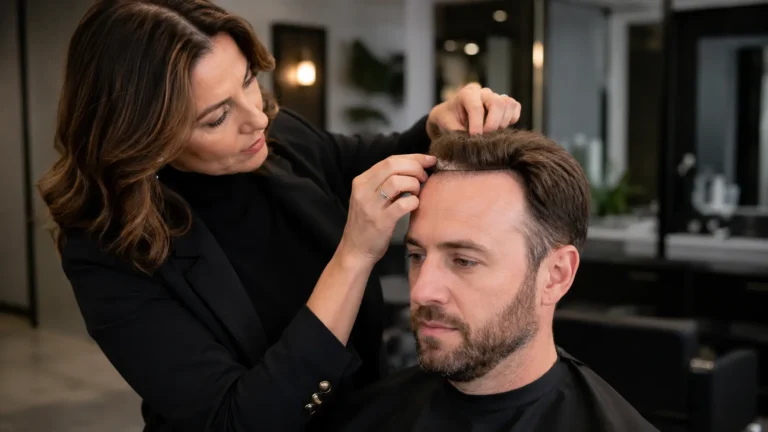
At the fitting appointment, the system is positioned and bonded at the crown. This involves a different adhesive approach from a hairline system because the system is surrounded by natural hair on all sides, the natural hair must be managed throughout the bonding process to ensure both correct placement and clean blending at every edge after bonding.
The system is then blended with the surrounding natural hair and styled. For crown coverage, the styling stage is where the result takes shape the hair over the top of the crown needs to flow naturally with the system hair rather than sitting as two separate sections.
Maintaining a Crown System
Crown system maintenance follows the same principles as any bonded system sulphate-free shampoo, correct water temperature, no conditioner near the base, satin pillowcase with one additional consideration specific to crown positioning.
Movement and friction. The crown of the scalp is a high-movement area pillows, headrests, hats, and hands all make contact with the crown during daily life. This creates slightly more friction-related wear on a crown unit than on a hairline system where the front edge is the primary contact point. Satin pillowcases, being aware of sustained direct pressure on the crown area, and correct re-bonding intervals all become slightly more important for crown units than for hairline systems.
Styling to maintain the blend. The most important daily maintenance consideration for crown coverage is preserving the blend between the system hair and the natural hair at the edges. This means brushing the system hair and the surrounding natural hair in the same session rather than separately, maintaining the styling direction that the technician established at the fitting, and not disturbing the edge blending by handling the crown area roughly.
Re-bonding intervals. The bond on a crown system typically follows the same interval as any bonded system one to four weeks depending on attachment method and lifestyle. Re-bond appointments allow the technician to assess the edge blending and adjust the styling approach as the natural hair grows between appointments. Natural hair growth at the edges of the loss area means the blend requires adjustment every few months as the surrounding hair length changes.
The full maintenance routine washing, drying, heat styling, and scalp care between appointments is covered in our complete maintenance and aftercare guide.
Crown Thinning and Hair Transplants: The Comparison
For people researching crown thinning specifically, the comparison with a hair transplant is worth addressing directly.
Crown transplants are technically more complex than hairline transplants because replicating the crown whorl pattern with transplanted grafts requires more technical precision, and because continued hair loss around the transplanted area can produce an unnatural appearance over time if the surrounding natural hair continues to recede. A hair transplant that covers the crown today may be surrounded by progressively thinner natural hair in five years, creating an island of dense transplanted hair that looks increasingly unnatural.
For people whose crown thinning is still actively progressing, which is most people under fifty, a hair system addresses the current loss without foreclosing the transplant option later, once the loss pattern has fully established and donor supply can be properly assessed. This is one of the most rational applications of the system-first approach, particularly for younger wearers.
For the full comparison of how systems and transplants compare across all factors, see our hair system vs hair transplant guide.
Frequently Asked Questions
Can a hair system cover crown thinning?
Yes, a custom-fitted crown system addresses thinning at the vertex of the scalp with no surgery and a result visible the same day as fitting. Crown coverage requires a different fitting approach from hairline systems because the unit must blend with natural hair on all sides rather than at a single front edge. The quality of the colour match, density gradation, and hair direction replication determines how natural the result looks.
What base type is best for crown thinning?
It depends on hair type and styling preference, and on whether a natural parting is needed through the crown. Fine lace produces the most natural scalp appearance at a parting line. Monofilament offers a practical balance of natural appearance and durability. Hybrid bases, monofilament or skin at the centre and lace at the perimeter, are often the strongest all-round choice for crown coverage. Your technician will assess the most appropriate base for your specific situation at the consultation.
How does a crown system blend with surrounding natural hair?
The system is designed with gradated density at its edges, lower density at the perimeter that matches the natural hair adjacent to the thinning area, and with hair direction that replicates the crown whorl pattern of the client’s natural hair. Correct density gradation and hair direction are what prevent the visible ring of contrast that identifies a poorly fitted crown system.
How long does a crown hair system last?
The same as any bonded system, the unit typically lasts three to six months before replacement, with the adhesive bond needing professional re-doing every one to four weeks. Crown systems may experience slightly more friction-related wear than hairline systems due to the positioning of the crown, so satin pillowcases and correct re-bonding intervals are important. See our guide to how long hair replacement systems last for the full breakdown.
Does a crown system require different maintenance from a hairline system?
The core maintenance routine is the same: sulphate-free shampoo, correct water temperature, no conditioner near the base, and a satin pillowcase. The specific additional consideration for crown systems is maintaining the styling blend between the system hair and the surrounding natural hair, and being aware that the crown positioning creates more sustained contact with pillows and headrests than a hairline system.
Can a hair system address crown thinning that is still progressing?
Yes, and this is one of the advantages of a system over a transplant for active crown thinning. As the loss pattern changes, the system specification can be updated at the next unit replacement. A transplant performed while loss is still progressing risks creating an unnatural appearance as the surrounding natural hair continues to thin. A system adapts to the current state of loss rather than being fixed to the pattern at the time of treatment.
Book a Crown Thinning Consultation at The Hair Standard
Crown thinning is one of the most common reasons people come to us and one of the presentations where the fitting approach most clearly determines whether the result looks natural or obvious. The consultation is where we assess the specific area and degree of thinning, map the crown whorl pattern, and establish exactly how the system needs to be specified to blend correctly with your surrounding natural hair.